How Europe is leading the world in building guardrails around AI

Advertisement

Advertise with us

LONDON (AP) — Authorities around the world are racing to draw up rules for artificial intelligence, including in the European Union, where draft legislation faced a pivotal moment on Thursday.

Read this article for free:


or

Already have an account? Log in here »

To continue reading, please subscribe:

Subscribe and receive a limited-edition Free Press branded hat or tote.

Digital Subscription

One year of digital access for only $205*

  • Enjoy unlimited reading on winnipegfreepress.com
  • Read the E-Edition, our digital replica newspaper
  • Access News Break, our award-winning app
  • Play interactive puzzles

*First annual payment billed as $205.00 + GST for one year. This annual subscription will automatically renew at $233.00 + GST every 52 weeks (10% off the regular annual price of $259.35). Offer available to new and qualified returning subscribers only. Cancel any time.

To continue reading, please subscribe:

Add Free Press access to your Brandon Sun subscription for only an additional

$1 for the first 4 weeks*

  • Enjoy unlimited reading on winnipegfreepress.com
  • Read the E-Edition, our digital replica newspaper
  • Access News Break, our award-winning app
  • Play interactive puzzles
Start now

*Your next Brandon Sun subscription payment will increase by $1.00 and you will be charged $17.95 plus GST for four weeks. After four weeks, your payment will increase to $24.95 plus GST every four weeks.

Hey there, time traveller!
This article was published 11/05/2023 (1223 days ago), so information in it may no longer be current.

LONDON (AP) — Authorities around the world are racing to draw up rules for artificial intelligence, including in the European Union, where draft legislation faced a pivotal moment on Thursday.

A European Parliament committee voted to strengthen the flagship legislative proposal as it heads toward passage, part of a yearslong effort by Brussels to draw up guardrails for artificial intelligence. Those efforts have taken on more urgency as the rapid advances of chatbots like ChatGPT highlight benefits the emerging technology can bring — and the new perils it poses.

Here’s a look at the EU’s Artificial Intelligence Act:

FILE - The OpenAI logo is seen on a mobile phone in front of a computer screen displaying output from ChatGPT, on March 21, 2023, in Boston. European lawmakers have rushed to add language on general artificial intelligence systems like ChatGPT as they put the finishing touches on the Western world's first AI rules. (AP Photo/Michael Dwyer, File)

HOW DO THE RULES WORK?

The AI Act, first proposed in 2021, will govern any product or service that uses an artificial intelligence system. The act will classify AI systems according to four levels of risk, from minimal to unacceptable. Riskier applications will face tougher requirements, including being more transparent and using accurate data. Think about it as a “risk management system for AI,” said Johann Laux, an expert at the Oxford Internet Institute.

WHAT ARE THE RISKS?

One of the EU’s main goals is to guard against any AI threats to health and safety and protect fundamental rights and values.

That means some AI uses are an absolute no-no, such as “social scoring” systems that judge people based on their behavior. AI that exploits vulnerable people including children or that uses subliminal manipulation that can result in harm, such as an interactive talking toy that encourages dangerous behavior, is also forbidden.

Lawmakers beefed up the proposal by voting to ban predictive policing tools, which crunch data to forecast where crimes will happen and who will commit them. They also approved a widened ban on remote facial recognition, save for a few law enforcement exceptions like preventing a specific terrorist threat. The technology scans passers-by and uses AI to match their faces to a database.

The aim is “to avoid a controlled society based on AI,” Brando Benifei, the Italian lawmaker helping lead the European Parliament’s AI efforts, told reporters Wednesday. “We think that these technologies could be used instead of the good also for the bad, and we consider the risks to be too high.”

AI systems used in high risk categories like employment and education, which would affect the course of a person’s life, face tough requirements such as being transparent with users and putting in place risk assessment and mitigation measures.

The EU’s executive arm says most AI systems, such as video games or spam filters, fall into the low- or no-risk category.

WHAT ABOUT CHATGPT?

The original 108-page proposal barely mentioned chatbots, merely requiring them to be labeled so users know they’re interacting with a machine. Negotiators later added provisions to cover general purpose AI like ChatGPT, subjecting them to some of the same requirements as high-risk systems.

One key addition is a requirement to thoroughly document any copyright material used to teach AI systems how to generate text, images, video or music that resembles human work. That would let content creators know if their blog posts, digital books, scientific articles or pop songs have been used to train algorithms that power systems like ChatGPT. Then they could decide whether their work has been copied and seek redress.

FILE - Text from the ChatGPT page of the OpenAI website is shown in this photo, in New York, Feb. 2, 2023. European lawmakers have rushed to add language on general artificial intelligence systems like ChatGPT as they put the finishing touches on the Western world's first AI rules. (AP Photo/Richard Drew, File)

WHY ARE THE EU RULES SO IMPORTANT?

The European Union isn’t a big player in cutting-edge AI development. That role is taken by the U.S. and China. But Brussels often plays a trendsetting role with regulations that tend to become de facto global standards.

“Europeans are, globally speaking, fairly wealthy and there’s a lot of them,” so companies and organizations often decide that the sheer size of the bloc’s single market with 450 million consumers makes it easier to comply than develop different products for different regions, Laux said.

But it’s not just a matter of cracking down. By laying down common rules for AI, Brussels is also trying to develop the market by instilling confidence among users, Laux said.

“The thinking behind it is if you can induce people to to place trust in AI and in applications, they will also use it more,” Laux said. “And when they use it more, they will unlock the economic and social potential of AI.”

WHAT IF YOU BREAK THE RULES?

Violations will draw fines of up to 30 million euros ($33 million) or 6% of a company’s annual global revenue, which in the case of tech companies like Google and Microsoft could amount to billions.

WHAT’S NEXT?

It could be years before the rules fully take effect. European Union lawmakers are now due to vote on the draft legislation at a plenary session in mid-June. Then it moves into three-way negotiations involving the bloc’s 27 member states, the Parliament and the executive Commission, where it could face more changes as they wrangle over the details. Final approval is expected by the end of the year, or early 2024 at the latest, followed by a grace period for companies and organizations to adapt, often around two years.

Report Error Submit a Tip

More Stories

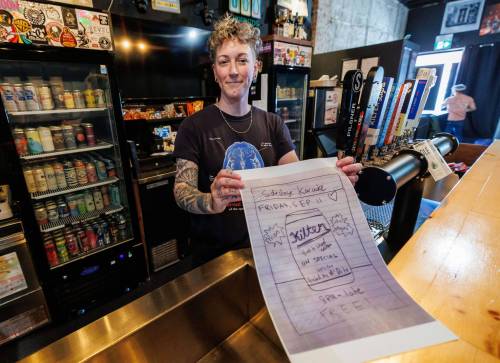
Winnipeg venues saying no to AI-made advertisements

Sheldon Birnie 8 minute read Preview

Winnipeg venues saying no to AI-made advertisements

Sheldon Birnie 8 minute read Updated: Yesterday at 10:22 AM CDT

Although the days when telephone poles and notice boards across the city were thick with gig posters, either slopped up with wheat paste or wrapped tight with packing tape, are behind us, the art of making an appealing visual ad for live music events is still a vital part of the local creative scene.

However, a widespread backlash against a new kind of slop — the use of generative AI images — has been building, especially among creatives when it comes to promoting live music.

“Live music is and always has been a DIY type of scene, especially locally,” says Evan Simpson, who has been working as a graphic designer for nearly a decade.

“For years people have been making their own flyers, or if they have the budget, hiring a designer or artist to come up with some artwork for their flyers. It’s a whole ecosystem, a scene supporting itself. If you take away the visual side of it, the spark, individuality and uniqueness of each gig poster is lost. What a sad world it would be if all art were made by AI.”

Read
Updated: Yesterday at 10:22 AM CDT

Young Winnipeg Jet hopeful, Viggo Bjorck, shines brightly in prospects tournament

Mike McIntyre 6 minute read Preview

Young Winnipeg Jet hopeful, Viggo Bjorck, shines brightly in prospects tournament

Mike McIntyre 6 minute read Sunday, Sep. 13, 2026

It’s safe to say Viggo Bjorck made plenty of new friends and fans this past weekend — including members of his own Winnipeg Jets prospects team which split a pair of tournament games in Quebec.

Take Davis Burnside for example. The undrafted 22-year-old forward, who signed with the Manitoba Moose last spring after finishing up at Ohio State University, couldn’t believe his eyes when he was put on a line with Bjorck, the eighth-overall pick from this summer’s draft and one of the most exciting young players in 2.0 Jets history.

“You see all the highlights and you just can’t wait to play with him,” said Burnside.

It wasn’t long before they teamed up for a highlight of their own. Bjorck made a sensational through-the-legs, no-look pass to Burnside on Sunday afternoon, setting him up for a shorthanded snipe in an eventual 6-4 loss to the Toronto Maple Leafs young guns.

Read
Sunday, Sep. 13, 2026

Don’t deny kids a bedtime bond with Gran

Maureen Scurfield 5 minute read Yesterday at 2:00 AM CDT

DEAR MISS LONELYHEARTS: My mother is coming to visit and our little kids want her to sleep in their bedroom, where there’s a double bed and a single. My husband thinks this idea is ridiculous and says grandma needs her sleep, but I disagree.

I remember sleeping with my grandma — who’s now with the angels — and she told us grandkids (two girls) some wonderful bedtime stories she made up herself. She even put our names into them, making us the stars of the stories.

The best part was getting into our pyjamas with our grandmother, who showed us the magic cord from the little thing that ran from her near-deaf ear down to the secret battery pocket hidden in the bra of her slip. It made her hear us better in the daytime. We thought, “Wow!”

Not surprisingly my own mother has inherited her mom’s fantastic storytelling talent and who knows what else she has to teach the kids when she’s alone with them? I want them to be close.

Defenceman Morrissey focused on season ahead

Ken Wiebe 8 minute read Preview

Defenceman Morrissey focused on season ahead

Ken Wiebe 8 minute read Yesterday at 12:08 PM CDT

Josh Morrissey insists that a trade request from the franchise goalie doesn’t change his desire to be a lifelong Winnipeg Jet.

The top-pairing defenceman and alternate captain reinforced that view on Monday morning when speaking to a group of reporters prior to the Winnipeg Jets Golf Classic at St. Charles Country Club.

“At the end of the day, I love being here and I love being a Jet. That’s how I’ve always felt,” said Morrissey, who spoke for just over nine minutes on a variety of topics. “That doesn’t change because of somebody else’s decision. Nothing is finalized, so who knows, he could be back. My position doesn’t change.”

Morrissey has two years left on a contract that pays him US$6.25 million and he’s only eligible to sign an extension on July 1, but the future of the franchise pillar will be a topic of discussion as the Jets work to sort through the situation with franchise goaltender Connor Hellebuyck, which remains unresolved.

Read
Yesterday at 12:08 PM CDT

Premier touts Port of Churchill opportunities at Canadian investment summit

Carol Sanders 5 minute read Preview

Premier touts Port of Churchill opportunities at Canadian investment summit

Carol Sanders 5 minute read Updated: Yesterday at 6:58 PM CDT

Premier Wab Kinew announced Monday that major capital investments in the Port of Churchill Plus project will receive an exemption from Manitoba’s seven per cent retail sales tax.

Kinew made the announcement at the start of the two-day Canada investment summit in Toronto. The premier made the pitch to a room of 250 Canadian and global investors representing more than US$13 trillion in assets.

“We are here in Toronto to tell global investors that the Port of Churchill is open and ready to expand,” Kinew told the Canadian Global Growth Forum, a provincial government news release said.

“These new capital incentives make it easier for investors to get in on the ground floor of the largest project featured at the Canada investment summit. The grain and critical minerals we are already shipping out of the port are reaching Europe faster than the Port of Vancouver. With the right investments we can ship commodities year-round, strengthening trade between reliable partners and creating good jobs,” the premier, who was not made available for an interview, said in the release.

Read
Updated: Yesterday at 6:58 PM CDT

MMF walks away from bid to buy Fort Garry Hotel

Carol Sanders 3 minute read Preview

MMF walks away from bid to buy Fort Garry Hotel

Carol Sanders 3 minute read Yesterday at 3:03 PM CDT

The Manitoba Métis Federation won’t buy the historic Fort Garry Hotel, President David Chartrand said Monday.

Read
Yesterday at 3:03 PM CDT