In the Amazon, Brazilian ecologists try new approach against deforestation and poverty
Advertisement
Read this article for free:
or
Already have an account? Log in here »
To continue reading, please subscribe:

Digital Subscription
One year of digital access for only $205*
- Enjoy unlimited reading on winnipegfreepress.com
- Read the E-Edition, our digital replica newspaper
- Access News Break, our award-winning app
- Play interactive puzzles
*First annual payment billed as $205.00 + GST for one year. This annual subscription will automatically renew at $233.00 + GST every 52 weeks (10% off the regular annual price of $259.35). Offer available to new and qualified returning subscribers only. Cancel any time.
To continue reading, please subscribe:
Add Free Press access to your Brandon Sun subscription for only an additional
$1 for the first 4 weeks*
- Enjoy unlimited reading on winnipegfreepress.com
- Read the E-Edition, our digital replica newspaper
- Access News Break, our award-winning app
- Play interactive puzzles
*Your next Brandon Sun subscription payment will increase by $1.00 and you will be charged $17.95 plus GST for four weeks. After four weeks, your payment will increase to $24.95 plus GST every four weeks.
Read unlimited articles for free today:
or
Already have an account? Log in here »
Hey there, time traveller!
This article was published 22/05/2023 (1205 days ago), so information in it may no longer be current.
CARAUARI, Brazil (AP) — In a remote corner of the Amazon, Brazilian ecologists are trying to succeed where a lack of governance has proved disastrous. They’re managing a stretch of land in a way that welcomes both local people and scientists to engage in preserving the world’s largest tropical forest.
The goal is ambitious, counter the forces that have destroyed 10% of the forest in less than four decades and create something that can be replicated in other parts of the Amazon.
It began with a four-month expedition along the Juruá River in 2016. Researchers visited some 100 communities that at first sight looked similar: rows of wooden homes on stilts along the water. But they were struck by contrasts in the living conditions.
To understand what they saw, it’s important to know that 29% of the Amazon, an area roughly three times the size of California, is either public land with no special protection, or public land for which no public information exists, according to a study by the Amazon Institute of People and the Environment.
These areas have been shown to be more vulnerable to deforestation. Land robbers drive traditional communities off the land and then clear it, hoping the government will recognize them as owners, which usually happens.
“It’s very unequal. Inside protected areas, there are many positive things happening, but outside, they seemed to be 40 years behind,” João Vitor Campos-Silva, a tropical socio-ecologist, told The Associated Press.
The researchers were aware that the part of the river known as Medio Juruá, near the city of Carauari, has remarkable social organization and people manage its fish and forest products, such as acai, sustainably. The land designation here is “extractive reserves,” public lands where residents are allowed to fish and harvest some crops.
But outside these reserves, in many places, people take orders from self-appointed landowners, Campos-Silva said. Entire communities are denied access to lakes, even to fish to feed their families. People don´t own the land, and they don’t know who does.
“We started thinking that it might be interesting to design a conservation model based on a basin scale,” where communities could harvest forest produce and fish and protect the forest, instead of moving to the city or resorting to illegal activities, such as unlicensed logging and overfishing.
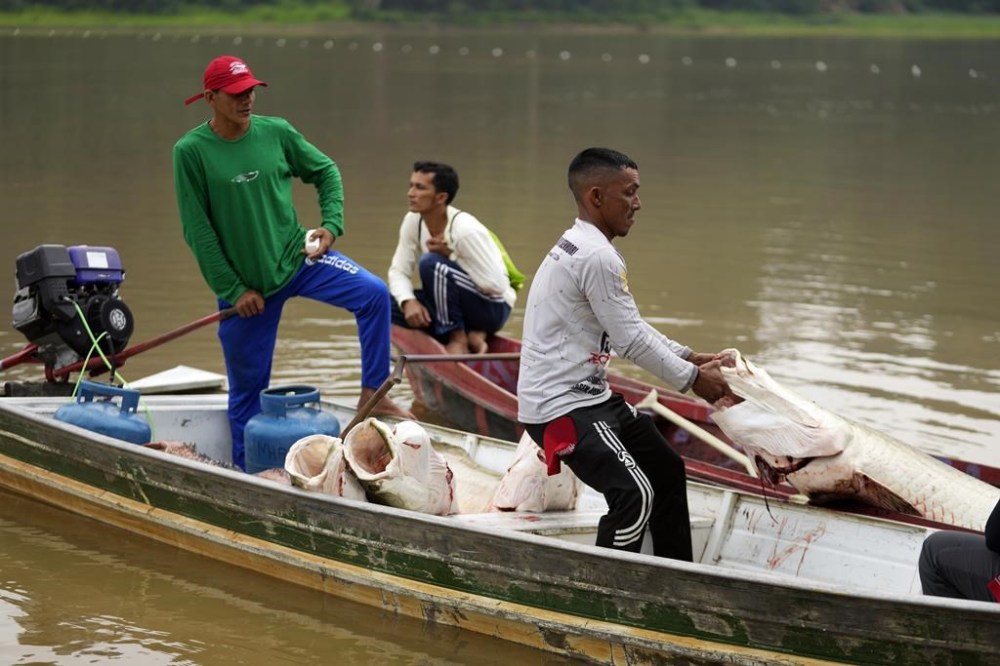
So they created the non-profit Juruá Institute and purchased a 13 km (8 miles) rainforest property along the Juruá River. It includes about 20 lakes, some with good potential for raising prized pirarucu, the world’s largest freshwater scale fish, which can reach up to 200 kilos (440 pounds).
The goal, Campos-Silva said, is to promote high-quality science, grounded in working together with the region’s people.
In the vicinity of the Institute’s land there are 12 communities of former rubber-tappers. Brazilians call them “ribeirinhos,” or river people, as distinguished from Indigenous residents.
In the past, the chance to make a living from rubber trees drew their grandparents to the Amazon. Nowadays the main revenue comes from pirarucu. Controlling that fishery has proved to be sustainable, reviving a species that was in decline and generating income without the need to clear the forest, with all that means for loss of biodiversity.
The Amazon rainforest, covering an area twice the size of India, also holds tremendous stores of carbon and is a crucial buffer against climate change. Driven by land-robbers, deforestation surged to a 15-year high in recent years while Jair Bolsonaro, who left office in January, was president. Destruction in the eastern Amazon has been so extensive that it has become a carbon source, rather than a carbon sink.
To involve the riverine communities in governance, the institute set up a steering committee and launched a series of public meetings called “community of dreams,” where people could prioritize the improvements they want most.
To avoid potential gender and age biases, they worked in three groups – women, youth, and men, said Campos-Silva.
The president of the river communities’ association, Fernanda de Araujo Moraes, said the main purpose is to prevent river people from moving to Amazon cities, where unemployment among low-skilled people is rampant and violence is widespread, thanks to drug-trafficking.
In her own community of Lago Serrado, where 12 families live in stilt houses, both the women and men listed 24-hour electricity as their top priority. Currently, it’s only available three hours a day. The youths chose fishing training.
Moraes believes this kind of collaboration is the fastest route to progress. “We want to improve people’s lives and the Institute wants the same thing,” she said, seated on the floor of her house, tending to her infant daughter. The government, she said, is not always on the same page.
“This is something that doesn’t exist here in the Amazon, it doesn’t exist anywhere in Brazil. If it works, which it will, it will attract a lot of people’s attention,” said resident José Alves de Morais, in an interview by the lake just behind the community.
Morais works as a lake keeper, watching for trespassers who might take fish or cut trees. His family hopes to take part in the institute’s management of pirarucu fishing, which awaits federal approval.
On the scientific front, the institute has built a houseboat and a wooden house for as many as 20 researchers to spend seasons along the Juruá River. One is studying the uakari monkey. Others are looking at what makes social arrangements successful in the region. They created a program, Forest Scientists, to train local high school students in field collection, data systematization, and how to prepare reports.
The initiative is led by Carlos Peres, an Amazon-born professor of tropical conservation ecology at the University of East Anglia, in the United Kingdom. In April this work, begun as an experiment, got some recognition from a Swiss nonprofit when he and three other scientists won the Frontiers Planet Prize, which comes with $1.1 million. The money will be reinvested in the project, which has already received support from Synchronicity Earth, National Geographic and Rolex within Perpetual Planet Project.
The winning study used data gathered during that 2016 trip. Co-authored by Campos-Silva and others, it found communities living inside protected areas enjoy better access to health care, education, electricity, and basic sanitation, plus a more stable income, than communities in undesignated areas. They found only 5% of adults inside protected areas aspire to move to a city, compared with 58% of adults in unprotected areas.
The article argues that in tropical countries with limited resources, it is possible to achieve conservation and benefit local communities at the same time, by putting more power in their hands.
Peres, the Institute’s scientific director, says it hopes to inspire solutions across the Amazon region, by integrating traditional knowledge with the science of Western models.
“We do not have all the answers,” he said. “But we have the audacity to try to advance on these issues.”
____
Associated Press climate and environmental coverage receives support from several private foundations. See more about AP’s climate initiative here. The AP is solely responsible for all content.