Nevada fight over leaky irrigation canal and groundwater more complicated than appears on surface
Advertisement
Read this article for free:
or
Already have an account? Log in here »
To continue reading, please subscribe:

Digital Subscription
One year of digital access for only $205*
- Enjoy unlimited reading on winnipegfreepress.com
- Read the E-Edition, our digital replica newspaper
- Access News Break, our award-winning app
- Play interactive puzzles
*First annual payment billed as $205.00 + GST for one year. This annual subscription will automatically renew at $233.00 + GST every 52 weeks (10% off the regular annual price of $259.35). Offer available to new and qualified returning subscribers only. Cancel any time.
To continue reading, please subscribe:
Add Free Press access to your Brandon Sun subscription for only an additional
$1 for the first 4 weeks*
- Enjoy unlimited reading on winnipegfreepress.com
- Read the E-Edition, our digital replica newspaper
- Access News Break, our award-winning app
- Play interactive puzzles
*Your next Brandon Sun subscription payment will increase by $1.00 and you will be charged $17.95 plus GST for four weeks. After four weeks, your payment will increase to $24.95 plus GST every four weeks.
Read unlimited articles for free today:
or
Already have an account? Log in here »
Hey there, time traveller!
This article was published 30/05/2023 (1217 days ago), so information in it may no longer be current.
RENO, Nev. (AP) — Water conflicts are nothing new to the arid West, where myriad users long have vied for their share of the precious resource from California’s Central Valley to the Colorado and Missouri rivers.
But few have waded into the legal question playing out in rural Nevada: To what extent can local residents, farmers and ranchers claim the water that is soaking into the ground through the dirt floor of an antiquated, unlined irrigation canal?
A federal appeals court recently breathed new life into litigation that has entangled the U.S. government and the high-desert town of Fernley ever since a 118-year-old canal burst and flooded hundreds of homes in 2008.
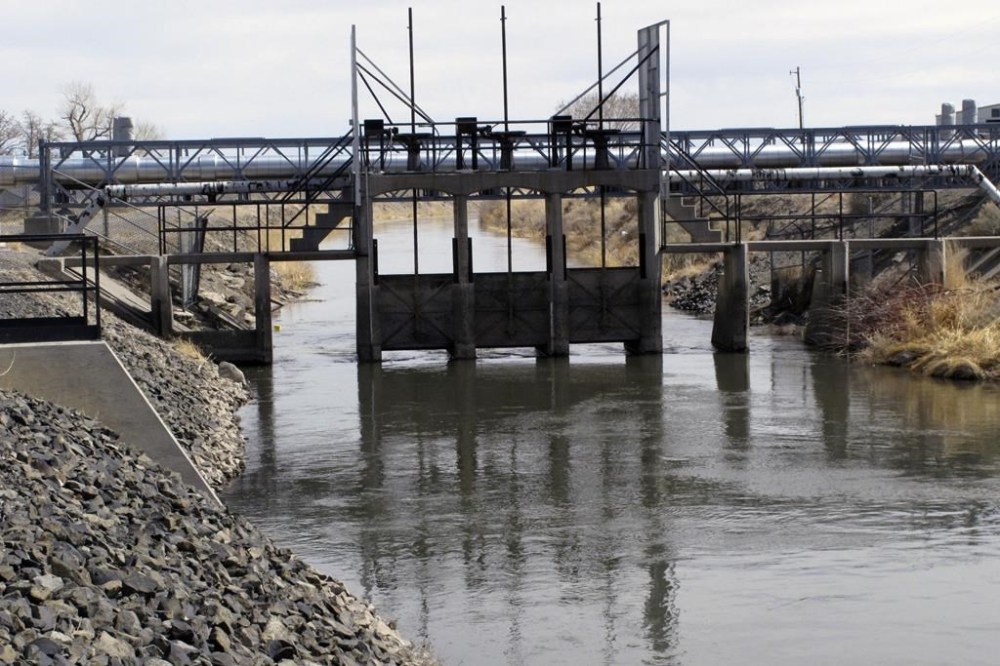
This year the U.S. Bureau of Reclamation began work on a plan to line parts of the 31-mile (50 kilometer) canal with concrete. The canal diverts water from the Truckee River, which flows out of Lake Tahoe in the Sierra, sending it to irrigation ditches supporting alfalfa farmers and livestock ranchers about 30 miles (50 kilometers) east of Reno.
However, farmers and ranchers in and around the town of Fenley said the repairs would stop water from leaking that they have used for a century to help fill their wells east of Reno.
The government says locals don’t have any rights to the water that belongs to U.S. taxpayers. Government experts say the renovation also willl help guard against future canal failures even though they acknowlege it will prevent leaks into the local aquifer used by Fenley’s residents.
Completed in 1905, the Truckee Canal was the first major irrigation system in the West under the Newlands Reclamation Act signed by President Theodore Roosevelt in 1902.
The act was named after a Nevada congressman who said the project would “make the desert bloom” and attract settlers to places like Fernley, where annual rainfall averages 5 inches (13 centimeters).
Similar projects followed across the arid West — many much larger. Construction began in 1903 on the Theodore Roosevelt Dam on the Salt River in Arizona, which Roosevelt himself dedicated in 1911.
By then, two dozen projects had been authorized, including one that dammed the Lower Yellowstone River near its confluence with the Missouri to irrigate cropland in Montana and North Dakota.
In Nevada, Fernley and surrounding agricultural users eventually became “utterly reliant” on the government-subsidized water, their lawyers say.
Evoking a sort of finders-keepers doctrine as old as western expansion, opponents of the canal renovation have argued in state and federal court that they have a right to the water partly because, before the canal burst, no one told them they couldn’t.
The bureau, the Truckee-Carson Irrigation District operating the canal and various judges generally have agreed the water belongs to U.S. taxpayers.
Fernley is attempting to claim a water right that doesn’t exist under state or federal law, irrigation district lawyer Benjamin Shawcroft said in recent Nevada Supreme Court filings.
“A related, but perhaps unanswerable question is why the City of Fernley is so determined to disrupt a project, the sole purpose of which is to prevent a breach of the canal and flooding of hundreds of homes?” he wrote.
Fernley lawyer David Rigdon said the town doesn’t oppose less expensive alternatives to alleviate the flood risk while still maintaining groundwater recharge.
“What Fernley opposes is a cure that is worse than the disease,” Rigdon wrote in court filings. “To fix a problem that affected approximately 500 homes, they have implemented a solution that imperils the primary water supply of all 20,000 city residents.”
“And, to add insult to injury, they now want the very people they are harming to pay for the costs of building the project,” he wrote.
No one was killed or seriously injured in the 2008 flood, but the irrigation district agreed in 2016 to an $18.1 million class-action settlement with 1,200 people who suffered property damage. Unusual, heavy winter rain put pressure on the canal system, which experts later determined was weakened by decades of rodents burrowing into the sides.
The legal battle over the plans to fix the canal followed.
Fernley sought relief in state court last year after U.S. District Court Judge Miranda Du threw out its federal lawsuit, which claimed the government failed to adequately consider alternatives required by the National Environmental Policy Act when it approved a $148 million plan to line 12.7 miles (20 km) of the canal.
In March, the 9th U.S. Circuit Court of Appeals upheld Du’s ruling that concluded the NEPA claims had no legal basis because their interests in the water are economic, not environmental.
But the San Francisco-based appellate court also concluded she erred by refusing to allow Fernley to amend its lawsuit to try to prove the harms would be both.
Du issued a new order this month giving Fernley until June 12 to file an amended complaint while the Bureau of Reclamation continues work on the first phase lining 3.5 miles (5.6 kilometers) of the canal for $35 million.
About $2.5 million of the initial phase is to be recouped from the irrigation district through assessments on water users who depend on the district to meet the demands of a growing community that has doubled in size over the past 20 years.
Fernley now wants to show the loss of an aquifer recharge will have dramatic, complicated impacts on the natural environment, as well as farmers’ wallets.
“It’s going to kill our community environmentally,” said David Stix, a longtime rancher and former Fernley mayor.

He said hydrological studies predict a drop in the local aquifer will draw water from salty marshes at the nearby Fernley Wildlife Management Area, degrading the community’s water quality.
“That migration would be very concerning because treating salt in water is way more expensive than treating arsenic,” Stix said. “There’s all these unknown domino effects.”
He’s among those who say lining the embankment walls, but not the dirt floor where the water seeps, would accomplish everyone’s goals at a lower cost without causing domestic wells to “start sucking air.”
Without aquifer recharge from the seepage, he fears the landscape will eventually revert to its pre-canal condition.
“It was basically desert,” Stix said. “There was nothing here.”