Small-brained ancient human cousins may have buried their dead, according to a surprising study

Advertisement

Advertise with us

NEW YORK (AP) — An ancient human cousin may have buried its dead and carved symbols into cave walls, surprising findings for a creature with a small brain.

Read this article for free:


or

Already have an account? Log in here »

To continue reading, please subscribe:

Subscribe and receive a limited-edition Free Press branded hat or tote.

Digital Subscription

One year of digital access for only $205*

  • Enjoy unlimited reading on winnipegfreepress.com
  • Read the E-Edition, our digital replica newspaper
  • Access News Break, our award-winning app
  • Play interactive puzzles

*First annual payment billed as $205.00 + GST for one year. This annual subscription will automatically renew at $233.00 + GST every 52 weeks (10% off the regular annual price of $259.35). Offer available to new and qualified returning subscribers only. Cancel any time.

To continue reading, please subscribe:

Add Free Press access to your Brandon Sun subscription for only an additional

$1 for the first 4 weeks*

  • Enjoy unlimited reading on winnipegfreepress.com
  • Read the E-Edition, our digital replica newspaper
  • Access News Break, our award-winning app
  • Play interactive puzzles
Start now

*Your next Brandon Sun subscription payment will increase by $1.00 and you will be charged $17.95 plus GST for four weeks. After four weeks, your payment will increase to $24.95 plus GST every four weeks.

Hey there, time traveller!
This article was published 05/06/2023 (1195 days ago), so information in it may no longer be current.

NEW YORK (AP) — An ancient human cousin may have buried its dead and carved symbols into cave walls, surprising findings for a creature with a small brain.

Fossil remains of the species — named Homo naledi — were uncovered in underground caves in South Africa a decade ago. Now, researchers say they’ve found evidence that the species was capable of complex behavior that so far has only been seen in those with bigger brains.

“We are facing a remarkable discovery here” for a species with brains one-third the size of humans, said anthropologist Lee Berger, who led the research funded by the National Geographic Society, where he now works.
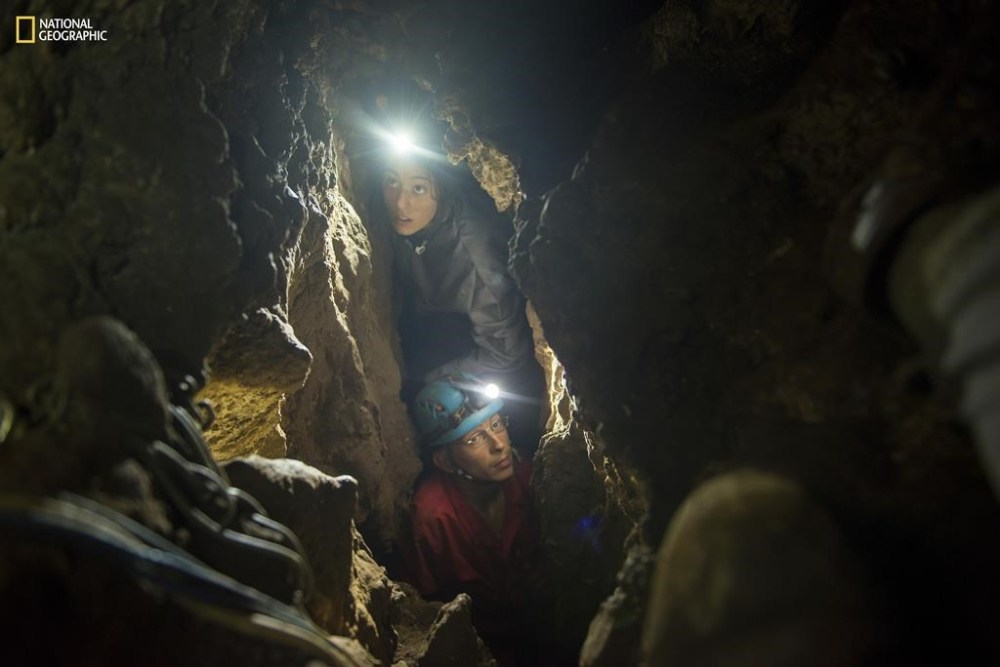
In this photo provided by National Geographic, National Geographic Explorer-in-Residence Lee Berger's daughter, Megan, and underground exploration team member Rick Hunter navigate the narrow chutes leading to the Dinaledi Chamber of the Rising Star Cave in South Africa in 2014, where fossil elements belonging to Homo naledi, a new species of human relative, were discovered. In research released on Monday, June 5, 2023, scientists say they've found evidence that the ancient human cousin buried its dead and carved symbols into cave walls, actions previously tied only to bigger-brained species. (Robert Clark/National Geographic via AP)

Berger and colleagues describe their findings in studies posted online Monday. The research has not been peer-reviewed yet and some outside scientists think more evidence is needed to challenge what we know about how humans evolved their complex thinking.

“There’s still a lot to uncover,” said Rick Potts, director of the Smithsonian’s Human Origins Program who was not involved in the research.

H. naledi is a pretty new addition to the family tree of hominins, which includes our direct ancestors and other extinct relatives who walked on two legs. Berger and his team announced the species in 2015, after a tip from local spelunkers led them to the Rising Star cave system near Johannesburg where they uncovered fossils from at least 15 individuals who lived around 300,000 years ago.

These creatures had some traits in common with modern humans, like legs made for walking upright and hands that could work with objects, said University of Wisconsin-Madison anthropologist John Hawks, a member of the research team. But other features looked more ancient, including their small brains.

In recent years, team members have ventured back into the caves, a tricky descent through tight underground spaces. What’s down there shows the species in a new light, they reported.

One of the new studies describes what researchers say were intentional burial sites. The team uncovered fossil remains of adults and children in shallow holes in the ground, their bodies in a fetal position.

Another study describes a series of marks carved into the cave walls, including geometric patterns and cross-hatched lines.

“This is something that takes a lot of time and effort to do,” said Berger, who led the initial research while at the University of the Witwatersrand in Johannesburg.

All of this behavior would be surprising for a creature whose brain was closer in size to an ape’s than a human’s, experts said.

Decades ago, we thought Homo sapiens were the only ones who could figure out how to use fire, bury their dead or create art, said Chris Stringer, a human evolution expert at London’s Natural History Museum who was not involved in the research.

Since then, we’ve learned that other groups like Neanderthals also lived complex lives. But those species still had big brains — unlike H. naledi, whose burials would raise further questions about human evolution, Stringer said.

Scientists haven’t yet been able to identify how old the engravings are. So Potts said the current evidence can’t say for sure whether H. naledi was truly the one to create the symbols, or if some other creature — maybe even H. sapiens — made its way down there at some point.

For study author Agustin Fuentes, an anthropologist at Princeton University, the H. naledi evidence takes the focus off brain size.

“Big brains are still important,” Fuentes said. “They just don’t explain what we thought they explained.”

___

The Associated Press Health and Science Department receives support from the Howard Hughes Medical Institute’s Science and Educational Media Group. The AP is solely responsible for all content.


Report Error Submit a Tip

More Stories

City to hire consultant to analyze 911 staffing levels amid skyrocketing calls

Joyanne Pursaga 4 minute read Preview

City to hire consultant to analyze 911 staffing levels amid skyrocketing calls

Joyanne Pursaga 4 minute read Yesterday at 5:36 PM CDT

The Winnipeg Fire Paramedic Service is ordering a detailed analysis of its 911 communications staffing level to cope with a surge in emergency calls and the demands of new technology.

WFPS emergency communications staff handled calls for 136,198 separate incidents in 2025. That number has risen every year since at least 2020, when 104,250 incidents were reported, the service’s annual report notes.

The total number of calls to the centre reached almost 275,000 last year. That broader figure also includes multiple calls per event and administrative calls.

“Things have changed in the last decade and call volumes have increased dramatically. That puts pressure on our systems,” said Coun. Vivian Santos (Point Douglas).

Read
Yesterday at 5:36 PM CDT

Goodness alive, well in N.L.-set musical

Jen Zoratti 4 minute read Preview

Goodness alive, well in N.L.-set musical

Jen Zoratti 4 minute read 2:01 AM CDT

I first saw Come From Away — the true-story musical about the incredible efforts of the residents of Gander, N.L. on Sept. 11, 2001, who welcomed nearly 7,000 travellers diverted to their remote town after the attacks on the World Trade Center and the Pentagon — in 2022, when Broadway Across Canada brought it to the Centennial Concert Hall.

I went in cold, but with blunted expectations; it seemed, on premise alone, like it could tilt too far into shmaltzy sentimentality, that it would be too earnest in its goodness.

So, when I wept until my face was as wet and salty as though it had been slapped by the waves of the North Atlantic, I was pleasantly surprised. I loved it. It’s emotional, yes. It’s sentimental, yes. But you can’t help but feel both buoyed — and, dare I say, patriotic — by the end of it.

Written by Canadians Irene Sankoff and David Hein, Come From Away seemed an unlikely hit when it opened on Broadway in 2017. But there was, by then, an appetite for it.

Read
2:01 AM CDT

Is Trump about to poke Quebec’s political beehive?

Peter McKenna 5 minute read Preview

Is Trump about to poke Quebec’s political beehive?

Peter McKenna 5 minute read 2:00 AM CDT

When was the last time that a U.S. president seriously stirred the hornet’s nest of Quebec politics?

My best recollection is former U.S. president Bill Clinton. During the 1994 Quebec referendum campaign, Clinton made clear that the U.S. wholly endorsed a united and strong federal Canada — as opposed to a dismembered one. He went on to add that an independent Quebec would have no guarantee of joining the North American Free Trade Agreement as a full-fledged member.

Today, we see U.S. President Donald Trump inserting himself — unwittingly or wittingly — into the electoral and sovereignty politics of Quebec. It’s pretty clear that the resurgent Coalition Avenir Québec government is trying to make the Oct. 5 provincial election about anything other than its own governmental record and more about Trump’s economic coercion against Canada. Of course, the Parti Québécois, the odds-on-favourite, wants to make the electoral contest a referendum on the CAQ and its party leader, Christine Fréchette.

But what if Trump really wanted to make his presence felt in Quebec’s political life? How much influence could he have on shaping political outcomes in Quebec? How much of an “X factor” could he be?

Read
2:00 AM CDT

Pokemon thieves clear out collectibles shop

Scott Billeck 5 minute read Preview

Pokemon thieves clear out collectibles shop

Scott Billeck 5 minute read Yesterday at 4:47 PM CDT

Terri Settle loved watching children walk into her collectibles shop to hunt for their favourite Pokemon cards.

After the latest break in stripped her shelves of much of the inventory, she’s not sure she’ll get to see it again.

Thieves broke into Terri’s Trinkets and Toys on Tuesday evening, punching through a grate and then the store’s bathroom wall to reach the storefront.

They made off with about $6,000 worth of merchandise, including all of the store’s Pokemon cards — about 7,000 of them — along with toys, Lego, jewelry, video games, a debit machine and personal laptop. They even took her vacuum cleaner.

Read
Yesterday at 4:47 PM CDT

Artist’s inspired work brings Red River Métis story back to Portage and Main

Conrad Sweatman 8 minute read Preview

Artist’s inspired work brings Red River Métis story back to Portage and Main

Conrad Sweatman 8 minute read Updated: Yesterday at 2:47 PM CDT

Jennine Krauchi calls them the “grandmothers.” “They speak to you very silently. You never hear a word, but they speak,” Krauchi says, referring to the antique pieces of Métis needlework she’s carefully studied for years. But there are few precedents for her latest art project: a 85-foot-wide by 32-foot-high chain curtain of Métis needlework that drapes over the historic Bank of Montreal’s neoclassical facade.

Read
Updated: Yesterday at 2:47 PM CDT

Closure of Nomads field massive upset for North End

Joshua Frey-Sam 5 minute read Preview

Closure of Nomads field massive upset for North End

Joshua Frey-Sam 5 minute read Updated: Yesterday at 8:49 AM CDT

The North Winnipeg Nomads have a flag on the field.

The long-standing minor football club was recently informed that its field is unfit to host games and that it would need to find a new home for its five youth and adult teams until repairs are made to the playing surface.

“Our board has made every effort to address the condition of our home field,” the club wrote in a statement. “Unfortunately, following a professional assessment, the field has been determined to be unsafe and unstable for our athletes.”

All five of the club’s teams will play their 2026 season at Frank Whyte Field, part of the Northwood Community Centre, with no confirmed date for when they can play on their home field again.

Read
Updated: Yesterday at 8:49 AM CDT