Himalayan glaciers could lose 80% of their volume if global warming isn’t controlled, study finds

Advertisement

Advertise with us

BENGALURU, India (AP) — Glaciers are melting at unprecedented rates across the Hindu Kush Himalayan mountain ranges and could lose up to 80% of their volume this century if greenhouse gas emissions aren't sharply reduced, according to a report.

Read this article for free:


or

Already have an account? Log in here »

To continue reading, please subscribe:

Subscribe and receive a limited-edition Free Press branded hat or tote.

Digital Subscription

One year of digital access for only $205*

  • Enjoy unlimited reading on winnipegfreepress.com
  • Read the E-Edition, our digital replica newspaper
  • Access News Break, our award-winning app
  • Play interactive puzzles

*First annual payment billed as $205.00 + GST for one year. This annual subscription will automatically renew at $233.00 + GST every 52 weeks (10% off the regular annual price of $259.35). Offer available to new and qualified returning subscribers only. Cancel any time.

To continue reading, please subscribe:

Add Free Press access to your Brandon Sun subscription for only an additional

$1 for the first 4 weeks*

  • Enjoy unlimited reading on winnipegfreepress.com
  • Read the E-Edition, our digital replica newspaper
  • Access News Break, our award-winning app
  • Play interactive puzzles
Start now

*Your next Brandon Sun subscription payment will increase by $1.00 and you will be charged $17.95 plus GST for four weeks. After four weeks, your payment will increase to $24.95 plus GST every four weeks.

Hey there, time traveller!
This article was published 19/06/2023 (1192 days ago), so information in it may no longer be current.

BENGALURU, India (AP) — Glaciers are melting at unprecedented rates across the Hindu Kush Himalayan mountain ranges and could lose up to 80% of their volume this century if greenhouse gas emissions aren’t sharply reduced, according to a report.

The report Tuesday from Kathmandu-based International Centre for Integrated Mountain Development warned that flash floods and avalanches would grow more likely in coming years, and that the availability of fresh water could be curtailed for nearly 2 billion people who live downstream of 12 rivers that originate in the mountains.

Ice and snow in the Hindu Kush Himalayan ranges are an important source of water for those rivers, which flow through 16 countries in Asia and provide fresh water to 240 million people in the mountains and another 1.65 billion downstream.
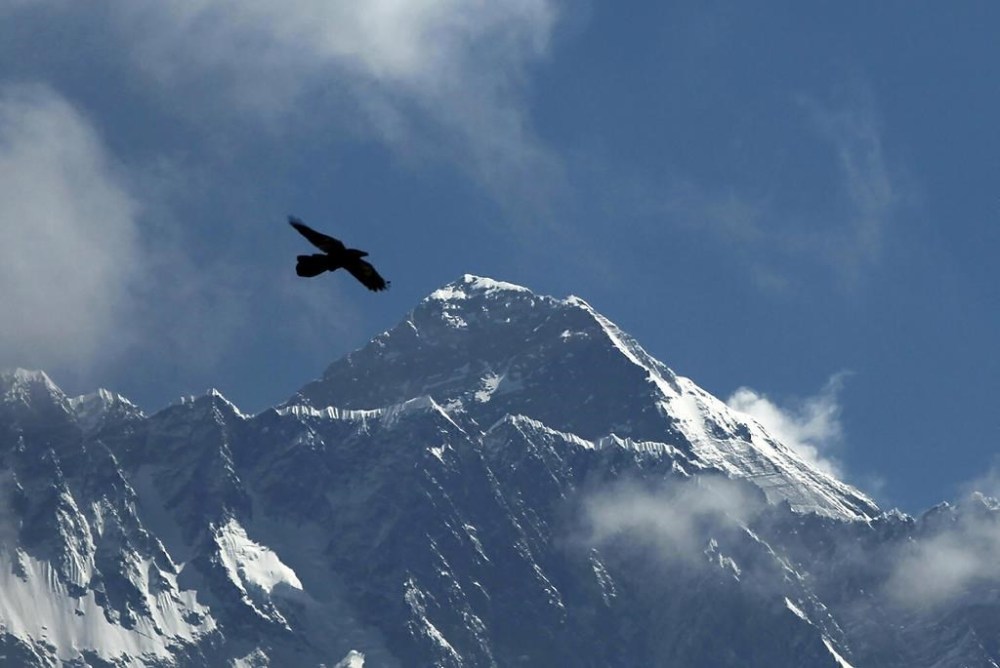
FILE - A bird flies with Mount Everest seen in the background from Namche Bajar, Solukhumbu district, Nepal, May 27, 2019. A new report Tuesday, June 20, 2023, from a Nepal-based research organization finds that water security for nearly 2 billion people living downstream of rivers that originate in the Himalayan ranges will likely be threatened by the end of this century due to rapid glacier melt if global warming is not controlled. (AP Photo/Niranjan Shrestha, File)

“The people living in these mountains who have contributed next to nothing to global warming are at high risk due to climate change,” said Amina Maharjan, a migration specialist and one of the report’s authors. “Current adaptation efforts are wholly insufficient, and we are extremely concerned that without greater support, these communities will be unable to cope.”

Various earlier reports have found that the cryosphere — regions on Earth covered by snow and ice — are among the worst affected by climate change. Recent research found that Mount Everest’s glaciers, for example, have lost 2,000 years of ice in just the past 30 years.

“We map out for the first time the linkages between cryosphere change with water, ecosystems and society in this mountain region,” Maharjan said.

Among the key findings from Tuesday’s report are that the Himalayan glaciers disappeared 65% faster since 2010 than in the previous decade, and that reducing snow cover due to global warming will result in reduced fresh water for people living downstream. The study found that 200 glacier lakes across these mountains are deemed dangerous, and the region could see a significant spike in glacial lake outburst floods by the end of the century.

The study found that communities in the mountain regions are being affected by climate change far more than many other parts of the world. It says changes to the glaciers, snow and permafrost of the Hindu Kush Himalayan region driven by global warming are “unprecedented and largely irreversible.”

Effects of climate change are already felt by Himalayan communities, sometimes acutely. Earlier this year the Indian mountain town of Joshimath began sinking and residents had to be relocated within days.

“Once ice melts in these regions, it’s very difficult to put it back to its frozen form,” said Pam Pearson, director of the International Cryosphere Climate Initiative, who was not involved with the report.

She added, “It’s like a big ship in the ocean. Once the ice starts going, it’s very hard to stop. So, with glaciers, especially the big glaciers in the Himalayas, once they start losing mass, that’s going to continue for a really long time before it can stabilize.”

Pearson said it is extremely important for Earth’s snow, permafrost and ice to limit warming to the 1.5 degrees Celsius agreed to at the 2015 Paris climate conference.

“I get the sense that most policymakers don’t take the goal seriously but, in the cryosphere, irreversible changes are already happening,” she said.

___

Associated Press climate and environmental coverage receives support from several private foundations. See more about AP’s climate initiative here. The AP is solely responsible for all content.

___

Follow AP’s climate change coverage at https://apnews.com/hub/climate-and-environment

Report Error Submit a Tip

More Stories

Driver of stolen vehicle facing impairment, other charges after fatal high-speed crash in West Kildonan Sunday

Scott Billeck 2 minute read Preview

Driver of stolen vehicle facing impairment, other charges after fatal high-speed crash in West Kildonan Sunday

Scott Billeck 2 minute read Monday, Sep. 21, 2026

A 19-year-old man faces impaired driving and other charges after a crash involving a stolen vehicle in north Winnipeg killed a 20-year-old woman and another left another woman with life-threatening injuries.

Read
Monday, Sep. 21, 2026

Manitoba budget reveals province underspent on crucial departments related to justice, public safety

Carol Sanders 5 minute read Preview

Manitoba budget reveals province underspent on crucial departments related to justice, public safety

Carol Sanders 5 minute read 2:00 AM CDT

While concerns about homelessness and public safety continue to make headlines in Manitoba, the two government departments mainly responsible for addressing them came in under budget last year.

The 2025-26 public accounts, released Monday, show Housing, Addictions and Homelessness underspent its budget of $869 million by $18 million. Manitoba Justice underspent its budget of $994 million by $34 million.

The 247-page public accounts report attributes the underspending in justice mainly to “reduced impacts of contingency liabilities,” such as a court ruling or legal settlement.

The report did not explain how and why Housing, Addictions and Homelessness underspent its budget last year as the province addresses those critical issues.

Read
2:00 AM CDT

AC/DC leaves Winnipeg crowd thunderstruck

Rob Williams 5 minute read Preview

AC/DC leaves Winnipeg crowd thunderstruck

Rob Williams 5 minute read Monday, Sep. 21, 2026

AC/DC proved once again that rock ‘n’ roll ain’t noise pollution.

A rowdy stadium of about 35,000 people at Princess Auto Stadium couldn’t agree more as the Australian rock legends made their first trip to the city since 2015 on their PWR/UP tour, cranking out two hours and 20 minutes of raw and raunchy high-voltage material, a mix of blues, crunchy power chords, melodic riffs and double entendres that spanned five decades.

Their wide-ranging appeal was apparent in the demographic makeup of the crowd, which ranged from young children to seniors, many clad in $30 glowing devil horns from the well-stocked merch booth that also offered posters, banners, beer koozies, lanyards, tour books and T-shirts.

There is no one in music quite like guitar god Angus Young. He is 71, but onstage he is ageless, a hyperactive teenager dressed in his signature blue schoolboy uniform and yellow and blue cap, running around, duck-walking and leaping in the air while cranking out riff after riff and extended solos on his trusty black Gibson SG.

Read
Monday, Sep. 21, 2026

If you feel stuck on repeat, reach out for advice

Maureen Scurfield 5 minute read 2:00 AM CDT

DEAR MISS LONELYHEARTS: My ex-mother-in-law and I ran into each other at a political do and had a great old time. I like her much better now than when I was married to her daughter. But she enjoyed mentioning that her daughter is now much happier in her new marriage to someone other than me. That’s rude, but I was actually happy to hear it.

Then she had the nerve to ask me if I felt better-suited to my new wife, and I said, “No, because she’s a lot like your daughter.” That was an awful thing for me to finally realize fully, and in front of my ex-mother-in-law.

Is it true people keep marrying the same type of person over and over again, and just keep trying to do better each time?

— Lying Awake, Tuxedo

Students and rising tuition

Jonathan Szo and Joy Chikezie 4 minute read 2:00 AM CDT

Students in Manitoba are facing additional costs at a time when many are already struggling with the rising cost of living, despite repeated promises from the provincial government to make life more affordable.

In the March 2026 Manitoba Budget, the provincial government permitted post-secondary institutions to increase domestic tuition by up to the legislated maximum of four per cent for the 2026-2027 academic year, despite students already facing rising housing costs, food insecurity, growing debt and an increasingly difficult labour market.

However, all hope was not lost — the decision on how much to raise tuition still rested with the institutions themselves. Much like a speed limit, the four per cent increase was the maximum, not necessarily the target.

Like with speed limits, however, the maximum became the target, as boards of the University of Winnipeg, Brandon University and the University of Manitoba decided to raise tuition by the maximum allowable four per cent. Meanwhile, provincial operating funding to post-secondary institutions increased by only two per cent.

Post-secondary leaders to discuss cross-campus collaborations

Maggie Macintosh 4 minute read Preview

Post-secondary leaders to discuss cross-campus collaborations

Maggie Macintosh 4 minute read Yesterday at 2:00 AM CDT

The artificial intelligence boom is inducing panic about the makeup of Manitoba’s future workforce and influencing new post-secondary application trends.

What remains a constant, says the economist who oversees the University of Manitoba, is the often-overlooked value of a liberal arts degree.

“I’ve always believed in it being a foundation for lifelong learning,” said Michael Benarroch, president and vice-chancellor of the largest post-secondary institute in the province.

“Even more so, in a world of AI, where AI is going to do certain tasks, I think humanities education and social sciences education is going to become even more important.”

Read
Yesterday at 2:00 AM CDT