UN tech agency rolls out human-looking robots for questions at a Geneva news conference
Advertisement
Read this article for free:
or
Already have an account? Log in here »
To continue reading, please subscribe:

Digital Subscription
One year of digital access for only $205*
- Enjoy unlimited reading on winnipegfreepress.com
- Read the E-Edition, our digital replica newspaper
- Access News Break, our award-winning app
- Play interactive puzzles
*First annual payment billed as $205.00 + GST for one year. This annual subscription will automatically renew at $233.00 + GST every 52 weeks (10% off the regular annual price of $259.35). Offer available to new and qualified returning subscribers only. Cancel any time.
To continue reading, please subscribe:
Add Free Press access to your Brandon Sun subscription for only an additional
$1 for the first 4 weeks*
- Enjoy unlimited reading on winnipegfreepress.com
- Read the E-Edition, our digital replica newspaper
- Access News Break, our award-winning app
- Play interactive puzzles
*Your next Brandon Sun subscription payment will increase by $1.00 and you will be charged $17.95 plus GST for four weeks. After four weeks, your payment will increase to $24.95 plus GST every four weeks.
Read unlimited articles for free today:
or
Already have an account? Log in here »
Hey there, time traveller!
This article was published 07/07/2023 (1194 days ago), so information in it may no longer be current.
BERLIN (AP) — A United Nations technology agency assembled a group of robots that physically resembled humans at a news conference Friday, inviting reporters to ask them questions in an event meant to spark discussion about the future of artificial intelligence.
The nine robots were seated and posed upright along with some of the people who helped make them at a podium in a Geneva conference center for what the U.N.’s International Telecommunication Union billed as the world’s first news conference featuring humanoid social robots.
Among them: Sophia, the first robot innovation ambassador for the U.N. Development Program, or UNDP; Grace, described as a health care robot; and Desdemona, a rock star robot. Two, Geminoid and Nadine, resembled their makers.
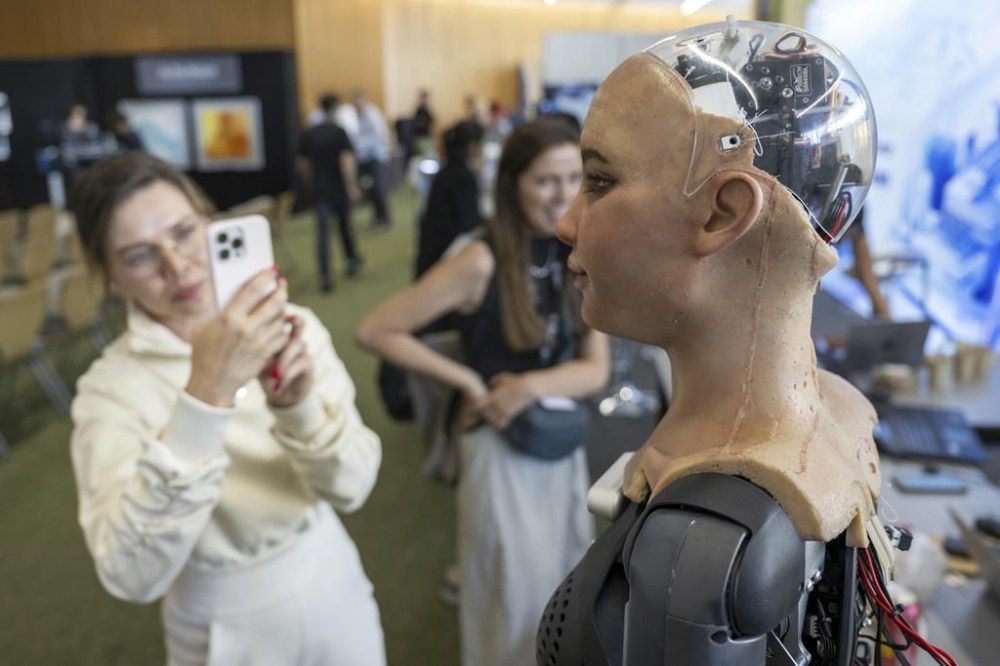
Organizers said the event at the AI for Good Global Summit was meant to showcase the capabilities, but also the limitations, of robotics and how those technologies could help the U.N.’s sustainable development goals. The media event featured introductions from the robots’ companions or creators, and a round of questions to the robots from reporters.
And while the robots vocalized strong statements — that robots could be more efficient leaders than humans, but wouldn’t take anyone’s job away or stage a rebellion — organizers didn’t specify to what extent the answers were scripted or programmed by people.
The summit was meant to showcase “human-machine collaboration,” and some of the robots are capable of producing preprogrammed responses, according to their documentation. The UNDP’s Sophia, for example, sometimes relies on responses scripted by a team of writers at Hanson Robotics, the company’s website shows.
Reporters were asked to speak slowly and clearly when addressing the robots, and were informed that time lags in responses would be because of the internet connection and not the robots themselves. That didn’t prevent awkward pauses, audio problems and some stilted or inconsistent replies.
Popular tech products such as Apple’s Siri have been using speech recognition technology to respond to relatively simple human queries for more than a decade. But last year’s release of ChatGPT, a chatbot with a strong command of the semantics and syntax of human language, has triggered worldwide debate about the rapid advancement of AI systems.