
No children’s remains found in Nebraska dig near former Native American boarding school

Advertisement

Advertise with us

An archeological dig for a lost children's cemetery near the Nebraska site of a former Native American boarding school has ended after two weeks — and no remains were found.

Read this article for free:


or

Already have an account? Log in here »

To continue reading, please subscribe:

Subscribe and receive a limited-edition Free Press branded hat or tote.

Digital Subscription

One year of digital access for only $205*

  • Enjoy unlimited reading on winnipegfreepress.com
  • Read the E-Edition, our digital replica newspaper
  • Access News Break, our award-winning app
  • Play interactive puzzles

*First annual payment billed as $205.00 + GST for one year. This annual subscription will automatically renew at $233.00 + GST every 52 weeks (10% off the regular annual price of $259.35). Offer available to new and qualified returning subscribers only. Cancel any time.

To continue reading, please subscribe:

Add Free Press access to your Brandon Sun subscription for only an additional

$1 for the first 4 weeks*

  • Enjoy unlimited reading on winnipegfreepress.com
  • Read the E-Edition, our digital replica newspaper
  • Access News Break, our award-winning app
  • Play interactive puzzles
Start now

*Your next Brandon Sun subscription payment will increase by $1.00 and you will be charged $17.95 plus GST for four weeks. After four weeks, your payment will increase to $24.95 plus GST every four weeks.

Hey there, time traveller!
This article was published 21/07/2023 (1176 days ago), so information in it may no longer be current.

An archeological dig for a lost children’s cemetery near the Nebraska site of a former Native American boarding school has ended after two weeks — and no remains were found.

Dave Williams, the state’s archeologist, said the team searching near the former Genoa Indian Industrial School plans to meet on Zoom with representatives of 40 tribes across the U.S. next week to determine next steps.

“I would have preferred that we found the children,” said Judi gaiashkibos, a member of the Ponca Tribe of Nebraska and the executive director of the Nebraska Commission on Indian Affairs. “But we have to remain hopeful. They’ve been gone more than 90 years. I feel like I have to remain steadfast and committed.”
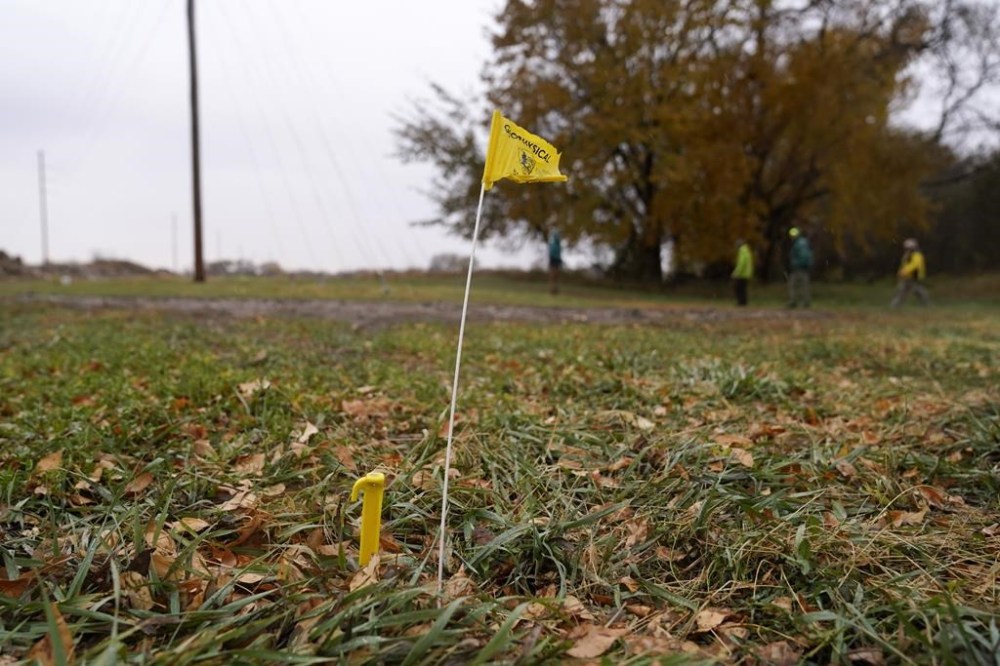
FILE - A flag marks a spot where a team affiliated with the National Park Service use ground-penetrating radar in hopes of detecting what is beneath the soil while searching for more than 80 Native American children buried at the former Genoa Indian Industrial School, Thursday, Oct. 27, 2022, in Genoa, Neb. Archeologists are starting to dig Monday, July 10, 2023, to find the bodies of the children. (AP Photo/Charlie Neibergall, File)

The search for gained renewed interest after hundreds of children’s remains were discovered at other Native American boarding school sites across the U.S. and Canada in recent years.

Dogs trained to detect the odor of decaying remains searched the area last summer and indicated there could be a burial site in a strip of land bordered by a farm field, railroad tracks and a canal. In November, ground-penetrating radar identified four anomalies — or areas of disturbed soil beneath the ground surface — in the shapes of graves.

Williams and his team spent the last two weeks excavating, but didn’t find the first anomaly they were seeking, which could’ve contained children’s remains.

“That’s one of the challenges of archaeology,” Williams said. “We can have a lot of evidence that something should be where we think it’s going to be. And then once we actually get in and open up the ground and take a look, it’s not what we expected.”

They’ll spend the next few weeks reevaluating the data and everything that led them to that location, Williams said, and figure out a new plan in consultation with the dozens of tribes that lost their children to the school.

There are three other anomalies nearby. Crews could search for those, pursue other leads or stop the search entirely if the tribes collectively decide that’s what they want, Williams said, but he hopes the team can still help the tribes, find the children and “bring them to rest in a satisfactory way.”

Sunshine Thomas-Bear, a member of the Winnebago Tribe of Nebraska and the cultural preservation director for the tribe, said she wishes there had been more consultation with the 40 tribes. She’s looking forward to that happening more in this next phase.

“Nothing was found this time. But perhaps that was because we weren’t all ready yet,” Thomas-Bear said. “There were tribes that weren’t notified, there were tribes that weren’t there. We believe that everything happens for a reason. I think that if we get on the right track together, perhaps we’ll be more successful.”

The Nebraska Commission on Indian Affairs and the state’s archeology office sent a letter to the 40 tribes in May describing the plan for the search and requesting input from tribal leaders, gaiashkibos and Williams said.

The Genoa Indian Industrial School was part of a national system of more than 400 Native American boarding schools that attempted to assimilate Indigenous people into white culture by separating children from their families, prohibiting them from speaking their Native languages, cutting them off from their heritage and inflicting abuse.

The school, about 90 miles (145 kilometers) west of Omaha, opened in 1884 and at its height was home to nearly 600 students. It closed in the 1930s and most buildings were demolished long ago.

The U.S. Interior Department — led by Secretary Deb Haaland, a member of Laguna Pueblo in New Mexico and the first Native American Cabinet secretary — released a first-of-its-kind report last year that named hundreds of schools the federal government supported to strip Native Americans of their cultures and identities.

At least 500 children died at some of the schools, but that number is expected to reach into the thousands or tens of thousands as efforts like the Nebraska dig continue.

___

This story was first published on July 21, 2023. It was updated on July 24, 2023, to make clear that the Nebraska Commission on Indian Affairs and the state’s archeology office sent a letter to 40 tribes in May describing the plan for the search and requesting input from tribal leaders.

___

Trisha Ahmed is a corps member for the Associated Press/Report for America Statehouse News Initiative. Report for America is a nonprofit national service program that places journalists in local newsrooms to report on under-covered issues. Follow Trisha Ahmed on Twitter: @TrishaAhmed15


Report Error Submit a Tip

More Stories

Today’s horoscope

Georgia Nicols 4 minute read Preview

Today’s horoscope

Georgia Nicols 4 minute read 2:00 AM CDT

MOON ALERT: After 3:30 a.m. there are no restrictions to shopping or important decisions. The moon is in Libra.

ARIES (March 21-April 19)

You will have to go more than halfway when dealing with others, which is no biggie. This simply requires you to be present, accommodating and willing to go along to get along. Be aware that a partner, spouse or close friend might surprise you.

TAURUS (April 20-May 20)

Read
2:00 AM CDT

Winnipeg more than its worst headlines

Marwa Suraj 4 minute read 2:00 AM CDT

Winnipeg takes a reputational beating sometimes and some of the criticism is deserved.

Concerns about public safety are real. Homelessness remains painfully visible. Too many people are struggling with addiction, poverty, mental illness and inadequate housing in plain sight.

Those concerns deserve to be taken seriously. But a city can be making measurable progress, struggling badly in other areas and still be reduced unfairly to its worst headlines. Winnipeg deserves neither denial nor caricature.

Take public safety.

Police on scene at Fairmont hotel construction site

1 minute read Updated: 12:19 AM CDT

At least three police cars were present at the under-construction Fairmont Winnipeg Thursday evening.

The nature of the response was unclear, but officers were guiding traffic outside of the construction zone at 2 Lombard Place while the response was underway. At 6:50 p.m., traffic was flowing normally.

Security on site provided no information on the response, but an individual working behind site fencing told the Free Press there’d be no comment from anyone on site as to why police were on scene at this time.

An SUV with a Government of Manitoba logo on its side was also present alongside personnel from Manitoba Workplace Safety and Health. However, it’s unknown if it’s connected to the police response.

Bit of creepy consultation could go a long way

Maureen Scurfield 5 minute read 2:01 AM CDT

DEAR MISS LONELYHEARTS: Halloween has always been my favourite time of year. I do my house up with lots of spooky lighting and characters on the lawn with eerie sounds booming out.

But last year I got seriously hassled by some people in the neighbourhood who thought it was too creepy. How do I get them on board this year? I don’t want to fight with them again.

— Want to Be Good Neighbour, River Heights

Dear Good Neighbour: Go to your close neighbours and explain what you want to do with your yard for Halloween this year, and also provide them with a firm time by which the celebrating will wrap up and things can quiet down.

Booze sales down, gaming and cannabis up in Manitoba

Carol Sanders 4 minute read Preview

Booze sales down, gaming and cannabis up in Manitoba

Carol Sanders 4 minute read Yesterday at 2:01 AM CDT

MANITOBA Liquor and Lotteries delivered $724.1 million in profits to the province in 2025-26, with the lion’s share coming from alcohol, even as booze sales continue to shrink.

The Crown corporation’s contribution to Manitoba’s general revenues decreased by $6 million or 0.8 per cent from last year’s allocation of $730.1 million, its annual report shows.

That indicates stable overall performance “despite a changing operating environment,” the recently-released report said.

Those changes include the order from Premier Wab Kinew last year to remove U.S. alcohol from Liquor Mart store shelves after President Donald Trump launched a trade war against Canada as well as Manitobans’ changing tastes.

Read
Yesterday at 2:01 AM CDT

Can’t cut your way to being a better city

Molly McCracken 5 minute read 2:00 AM CDT

The powers that be in Winnipeg have pushed for cheap property taxes for decades. As a result, the city doesn’t have enough money to balance the books, let alone maintain infrastructure, deliver services and respond to challenges like homelessness and the toxic drug crisis.

Winnipeg’s fiscal problem stems from decades of keeping property-tax increases below inflation and relying on inadequate revenues to fund a growing city. The result? Today, Winnipeg spends less money per person on city services than it did in 2001.

A look at the books at city hall is stark. Winnipeg has run a deficit almost every year since the COVID-19 pandemic because of climate-change-driven heavy ice and snowstorms, higher fuel costs and increased policing overtime. During this time, city council tried to cut and freeze public service spending where it could; as a result, community services have been cut to the bone.

Departments responsible for what makes a city a good place to live have been squeezed. Since 1999, community services — responsible for libraries, recreation, swimming lessons and aspects of Winnipeg’s poverty-reduction work — has 149 fewer staff positions, an 18 per cent reduction, even as the city’s population has grown 35 per cent, or by 220,000 people.