Balzan Prizes recognize achievements in study of human evolution, black holes with $840,000 awards
Advertisement
Read this article for free:
or
Already have an account? Log in here »
To continue reading, please subscribe:

Digital Subscription
One year of digital access for only $205*
- Enjoy unlimited reading on winnipegfreepress.com
- Read the E-Edition, our digital replica newspaper
- Access News Break, our award-winning app
- Play interactive puzzles
*First annual payment billed as $205.00 + GST for one year. This annual subscription will automatically renew at $233.00 + GST every 52 weeks (10% off the regular annual price of $259.35). Offer available to new and qualified returning subscribers only. Cancel any time.
To continue reading, please subscribe:
Add Free Press access to your Brandon Sun subscription for only an additional
$1 for the first 4 weeks*
- Enjoy unlimited reading on winnipegfreepress.com
- Read the E-Edition, our digital replica newspaper
- Access News Break, our award-winning app
- Play interactive puzzles
*Your next Brandon Sun subscription payment will increase by $1.00 and you will be charged $17.95 plus GST for four weeks. After four weeks, your payment will increase to $24.95 plus GST every four weeks.
Read unlimited articles for free today:
or
Already have an account? Log in here »
Hey there, time traveller!
This article was published 11/09/2023 (1104 days ago), so information in it may no longer be current.
MILAN (AP) — An American literary historian, a French paleoanthropologist, a Danish evolutionary geneticist and a German-Dutch astrophysicist have been named the winners of this year’s Balzan Prize. Their work in the humanities and natural sciences advances the study of comparative literature, human evolution and black holes.
David Damrosch, chair of Harvard University’s comparative literature department, was recognized for “his creative approach to world literature as a translational circulation of works that remain alive because they are embraced and changed,’’ the Balzan Foundation said in its citation.
Frenchman Jean-Jacques Hublin of the Max-Planck-Institute for evolutionary anthropology in Leipzig was cited for his discoveries of the oldest Homo sapiens in Africa, contributing to the study of human evolution. The citation also praised his ability to synthesize data, organize scientific teams and his qualities as a teacher “and popularizer.”
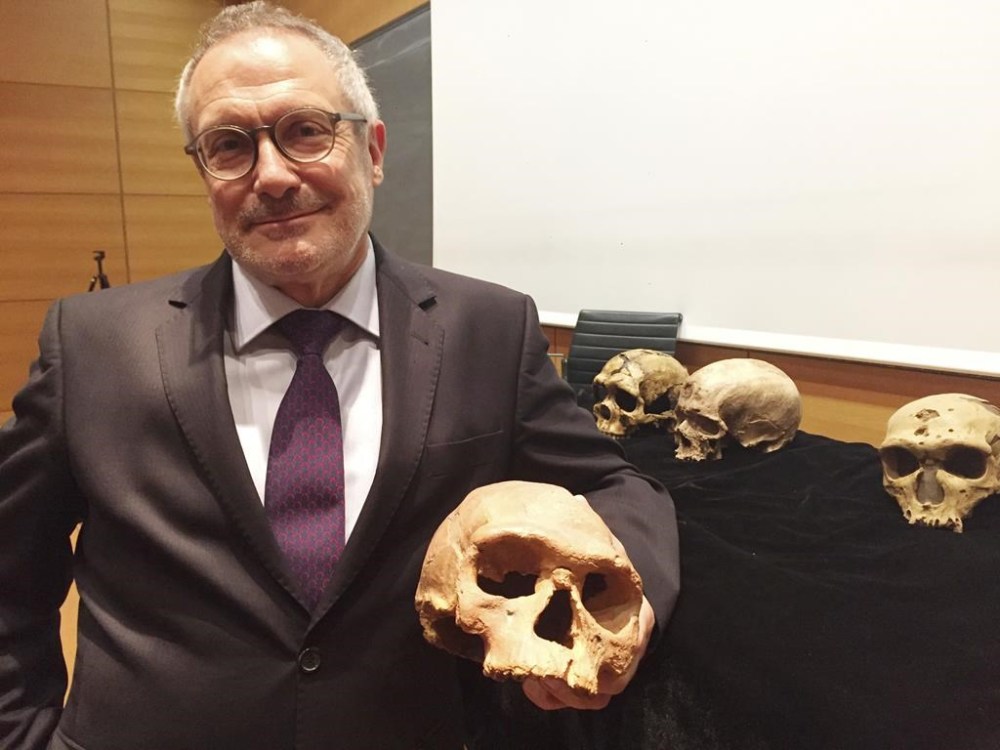
Also awarded for contributions to the study of human evolution, Eske Willerslev of the University of Copenhagen in Denmark was cited for studies of human DNA, focusing on population migrations to “transform our understanding of human history.” The citation said he used ancient DNA from teeth to identify human pathogens and retrieved DNA from environmental samples “opening a new scientific field.”
The final individual award went to Heino Falcke, an astrophysicist at Radboud University in the Netherlands, for his role in producing high-resolution images of what surrounds black holes as leader of the Event Horizon Telescope. The work validated “Einstein’s General Relativity in situations where gravity is so strong that spacetime is significantly curved,’’ the judges said.
The Balzan Foundation awards prizes in the sciences and humanities each year, rotating specialties to highlight new or emerging areas of research and sustain fields that might be overlooked elsewhere. Recipients receive 750,000 Swiss francs ($840,000), half of which must be used for research, preferably by young scholars or scientists.

This year, a special prize for humanity, peace and brotherhood among peoples was made to the Francesca Rava Foundation, an Italian organization that helps responds to humanitarian and natural disasters in Italy and Latin America. The prize, also worth 750,000 Swiss francs, is give out at intervals of at least three years.
The prizes will be awarded in Bern, Switzerland on Nov. 17.