Study says fish stocks along Atlantic, Pacific coasts unaffected by marine heat waves

Advertisement

Advertise with us

Marine heat waves haven't had a lasting effect on fish populations along Canada’s Atlantic and Pacific coasts, says a study showing there is still a chance to act on climate change.

Read this article for free:


or

Already have an account? Log in here »

To continue reading, please subscribe:

Subscribe and receive a limited-edition Free Press branded hat or tote.

Digital Subscription

One year of digital access for only $205*

  • Enjoy unlimited reading on winnipegfreepress.com
  • Read the E-Edition, our digital replica newspaper
  • Access News Break, our award-winning app
  • Play interactive puzzles

*First annual payment billed as $205.00 + GST for one year. This annual subscription will automatically renew at $233.00 + GST every 52 weeks (10% off the regular annual price of $259.35). Offer available to new and qualified returning subscribers only. Cancel any time.

To continue reading, please subscribe:

Add Free Press access to your Brandon Sun subscription for only an additional

$1 for the first 4 weeks*

  • Enjoy unlimited reading on winnipegfreepress.com
  • Read the E-Edition, our digital replica newspaper
  • Access News Break, our award-winning app
  • Play interactive puzzles
Start now

*Your next Brandon Sun subscription payment will increase by $1.00 and you will be charged $17.95 plus GST for four weeks. After four weeks, your payment will increase to $24.95 plus GST every four weeks.

Hey there, time traveller!
This article was published 11/09/2023 (1084 days ago), so information in it may no longer be current.

Marine heat waves haven’t had a lasting effect on fish populations along Canada’s Atlantic and Pacific coasts, says a study showing there is still a chance to act on climate change.

The study published Aug. 30 in the journal Nature looked at data from 1993 to 2019, which included 248 marine heat waves – described as prolonged periods of warm ocean temperatures.

“The expectation is that whenever there are heat waves, the fish stocks will be affected, and that the bigger the heat waves, the bigger the impacts. But what we find is that the impact is not consistent,” William Cheung, professor at the University of British Columbia’s Institute for Oceans and Fisheries, and co-author of the study, said in a recent interview.
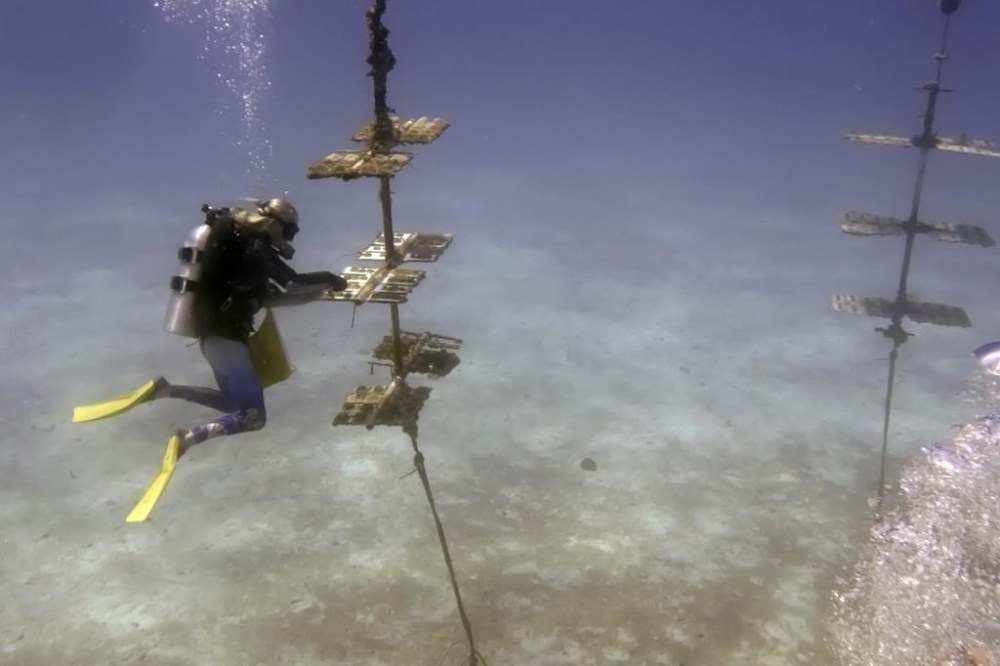
Marine heat waves haven't had a lasting effect on fish populations along Canada’s Atlantic and Pacific coasts says a study, showing there is still a chance to act on climate change. A diver with non-profit Reef Renewal USA cleans and maintains a coral nursery, Tuesday, Aug. 1, 2023, near Tavernier, Fla., in the Florida Keys. THE CANADIAN PRESS/AP/Wilfredo Lee

“What it suggested is that the relationship between heat waves and fish stocks can be more complicated.”

The study looked at 82,322 samples of heat wave data from long-term scientific surveys of marine ecosystems in North America and Europe spanning the subtropics to the Arctic. The authors defined a marine heat wave as a period of five days or more with extreme higher-than-average temperatures.

The data included notable marine heat waves, such as “the Blob,” which blanketed the Northeast Pacific from 2014-2016, and the 2012 one in the Northwest Atlantic. While “the Blob” caused a 22-per-cent loss of fish in the Gulf of Alaska, the 2012 marine heat wave led to a 70-per-cent gain in the number of fish in the Northwest Atlantic.

The authors said steep declines in fish populations – “occasionally occurred after marine heat waves, (but) these were the exception, not the rule … Marine heat waves have not driven biomass change or community turnover in fish communities that support many of the world’s largest and most productive fisheries.”

Cheung said while the study measured heat waves through temperature changes, there are other factors that affect fish, such as food availability, oxygen levels and salinity of the oceans.

“It may be that the relationship between temperature and those other changes in ocean conditions are more complex,” he said.

But the study warns that as marine heat waves get longer and more intense, fisheries may eventually be affected because marine life is more vulnerable to warming than is terrestrial life. Marine organisms tend to live close to the temperature limits of what their bodies can sustain, while oceans, compared with land, have fewer “thermal refugia” – areas with cooler temperatures than the surrounding ecosystem.

“As a future that is more than 1.5 C warmer looks increasingly likely, it is more critical than ever to develop a deeper understanding of what drives ecological responses to extreme climate events,” the study said.

Marine heat waves have also been linked to widespread coral bleaching and die-offs of kelp forests and reef fish in shallow coastal seas, Cheung said. As well, he said, scientists have observed fish migrating to cooler parts of the ocean as temperatures have risen.

“But the thing is that not all species will have the same ability to shift their distribution; some species may be limited by geography,” he said. “There are also other environmental conditions that may prevent fish from moving to even further, deeper waters.”

Cheung pointed to sockeye salmon – a species of fish important to First Nations and historically found in the coastal regions of British Columbia – which seem to be changing habitat in search of cooler waters. This shift in species habitat will be felt by people who rely on the salmon, he said, as well as on other organisms that feed on those animals.

Scientists are carefully studying the rare flash of good news about the lack of major impact caused by marine heat waves. But Cheung said marine life may be limited in its capacity to absorb a constant pummeling of high temperatures.

“It really highlights the urgency to do climate actions now,” he said.

“If we don’t take any actions now, with continuous climate change, we know it will increase the intensity and frequency of marine heat waves and it is going to lead to a bigger, scary impact.”

This report by The Canadian Press was first published Sept. 11, 2023.
Report Error Submit a Tip

More Stories

Advocate assembles gift bundles for Trans Day of Remembrance

Janine LeGal 6 minute read Preview

Advocate assembles gift bundles for Trans Day of Remembrance

Janine LeGal 6 minute read 7:00 AM CDT

In a world rife with chaos and division, there’s never been a better time for kindness, joy… and a cookie.

Kalyn Falk is on a mission to provide all three.

Falk founded the Trans Day of Remembrance Care Package Project in 2020 as a way to mourn those lost and to ensure that trans and non-binary people in the community feel valued, seen and cared for.

Trans Day of Remembrance is observed every year on Nov. 20 to honour the memory of transgender, two-spirit and non-binary people who lost their lives to acts of anti-transgender violence and systemic oppression.

Read
7:00 AM CDT

‘Last chance’ clearance U.S. booze punted from Liquor Marts

Carol Sanders 5 minute read Preview

‘Last chance’ clearance U.S. booze punted from Liquor Marts

Carol Sanders 5 minute read Thursday, Aug. 27, 2026

American alcohol that returned to Manitoba Liquor Mart shelves in May as part of a “last chance” sale is headed back to storage or will be destroyed.

“We are removing U.S. liquor products from Liquor Mart shelves,” a spokesperson for Manitoba Liquor and Lotteries said Thursday. The Crown corporation had been pushing to off-load its stockpile of U.S. booze.

Premier Wab Kinew launched a provincewide boycott of American alcohol in March 2025 to fight back against tariffs imposed by U.S. President Donald Trump. Manitoba Liquor and Lotteries has not placed new orders since the boycott began, but it still had inventory.

As of early May, the U.S. inventory had a value of roughly $3.4 million, which is roughly one-third of what was removed from shelves and placed in storage, Manitoba Liquor and Lotteries has said. It was unable to provide an inventory update on Thursday.

Read
Thursday, Aug. 27, 2026

Summer Reading Challenge concludes with more musings from young readers

8 minute read Preview

Summer Reading Challenge concludes with more musings from young readers

8 minute read 6:00 AM CDT

Another Free Press Summer Reading Challenge for Kids is in the books, but before we turn the page completely, there are a few more reviews written by our young readers to share.

Participating readers were tasked to write down their thoughts about any of the books on the Summer Reading Challenge’s three reading lists; with a range of formats (novels, graphic novels, books with pictures), themes and reading levels to choose from, budding reviewers of all ages were eager to share their opinion.

Those registered for the challenge received reading resources and activities throughout the summer, from word searches or puzzles based on the content of the books to a set of discussion questions and, in one instance, a special video from an author.

There were also more creative activities meant to engage readers’ critical thinking skills, all of which were free to access for anyone who signed up for the challenge.

Read
6:00 AM CDT

Five exceptional Manitobans reflect on what it means to be Canadian while bracing against Trump’s vitriol and economic upheaval

Aaron Epp and Gabrielle Piché 11 minute read Preview

Five exceptional Manitobans reflect on what it means to be Canadian while bracing against Trump’s vitriol and economic upheaval

Aaron Epp and Gabrielle Piché 11 minute read Yesterday at 1:35 PM CDT

Canadians have been trying to make sense of a new reality since Canada-United States trade talks broke down on Aug. 21.

The following day, President Donald Trump’s administration imposed 50 per cent tariffs on US$20 billion worth of Canadian exports to the U.S.

The federal government responded in kind a few days later, rolling out tariffs on $27.6 billion worth of imports from the U.S.

The Free Press contacted five Manitobans who have been appointed to the Order of Canada and asked them for their thoughts on the status of Canada-U.S. relations and what is means to be a Canadian today. Their responses have been edited for length and clarity.

Read
Yesterday at 1:35 PM CDT

Impact of Winnipeg hoops giant Laping went well beyond coaching

Joshua Frey-Sam 7 minute read Preview

Impact of Winnipeg hoops giant Laping went well beyond coaching

Joshua Frey-Sam 7 minute read Yesterday at 5:37 PM CDT

In life, few connected with others like Jeff Laping.

A legendary high school basketball coach and influential educator for more than 30 years, he was a figurative giant in Winnipeg’s hoops community with an innate ability to resonate with anyone he met.

Laping was a best friend to many, a confidant to others, and a mentor to even more.

He died on Monday, one week after suffering from cardiac arrest.

Read
Yesterday at 5:37 PM CDT

Motion seeks to remove longtime head of Southern Chiefs’ Organization due to ‘behaviour’ concerns

Carol Sanders 4 minute read Preview

Motion seeks to remove longtime head of Southern Chiefs’ Organization due to ‘behaviour’ concerns

Carol Sanders 4 minute read Wednesday, Aug. 26, 2026

For the second time in a year, the leadership of Southern Chiefs’ Organization Grand Chief Jerry Daniels is being called into question.

A motion obtained by the Free Press calls “immediately” for a special summit of the 33 SCO chiefs to consider removing Daniels, who’s been at the helm since 2017.

The Aug. 17 motion, put forward by Lake Manitoba First Nation Chief Cornell McLean and Bloodvein First Nation Chief Lisa Young, cites concerns about “governance, leadership, accountability, transparency, organizational decision-making and confidence of member Nations in the current leadership of the organization.”

McLean would not provide specific examples Wednesday but said the “behaviour” of Daniels is a concern.

Read
Wednesday, Aug. 26, 2026