What if public transit was like Uber? A small city ended its bus service to find out
Advertisement
Read this article for free:
or
Already have an account? Log in here »
To continue reading, please subscribe:
Digital Subscription
One year of digital access for only $1.44 a week*
- Enjoy unlimited reading on winnipegfreepress.com
- Read the E-Edition, our digital replica newspaper
- Access News Break, our award-winning app
- Play interactive puzzles
*Billed as $5.77 plus GST every four weeks. After 52 weeks, price increases to the regular rate of $19.95 plus GST every four weeks. Offer available to new and qualified returning subscribers only. Cancel any time.
To continue reading, please subscribe:
Add Free Press access to your Brandon Sun subscription for only an additional
$1 for the first 4 weeks*
- Enjoy unlimited reading on winnipegfreepress.com
- Read the E-Edition, our digital replica newspaper
- Access News Break, our award-winning app
- Play interactive puzzles
*Your next Brandon Sun subscription payment will increase by $1.00 and you will be charged $17.95 plus GST for four weeks. After four weeks, your payment will increase to $24.95 plus GST every four weeks.
Read unlimited articles for free today:
or
Already have an account? Log in here »
Hey there, time traveller!
This article was published 15/09/2023 (1127 days ago), so information in it may no longer be current.
When a small city abruptly parked all its buses to launch a publicly subsidized van service offering $1.50 trips anywhere in town, only one of its bus drivers — a big-city transplant — went along for the ride.
Milton Barnes used to oversee packed subway stations in Washington, D.C., a far cry from the sparsely filled buses he drove after moving to Wilson, North Carolina, to care for his elderly parents. Although transit ridership plummeted almost everywhere due to the pandemic, it has been surging in Wilson since its September 2020 switch from a fixed-route system to an on-demand one powered by a smartphone app.
“All day long I’m picking up people and dropping them off,” Barnes, 59, the only driver to work under both systems, said while driving his van on a typically busy morning. “When you’ve got door-to-door, corner-to-corner service, it’s going to be more popular.”
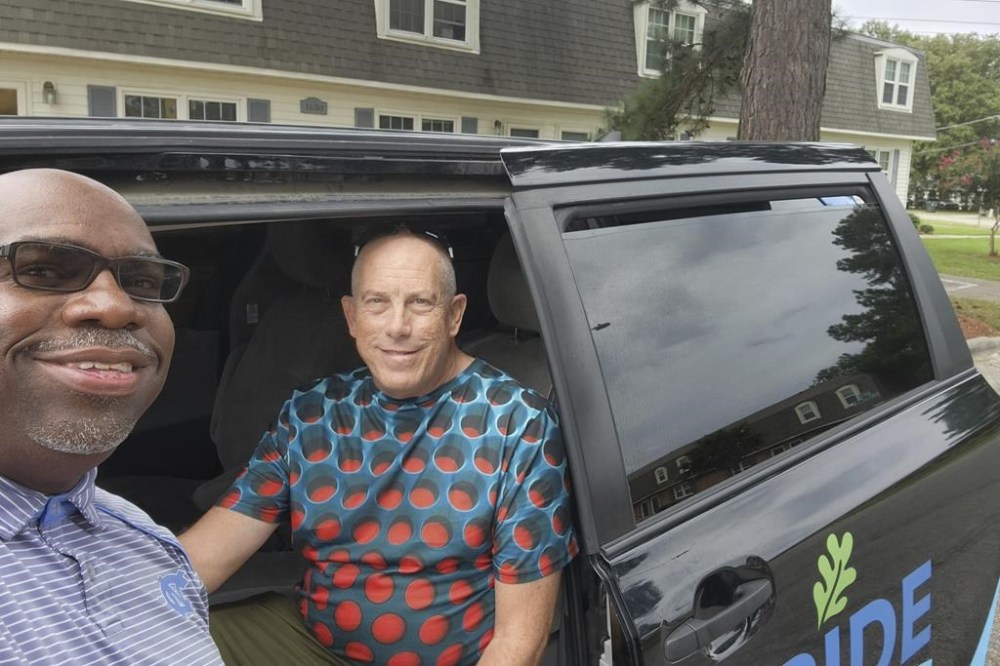
Long wait times made the bus route almost unusable for David Bunn, even when his car broke down and he couldn’t afford to replace it. Instead, Bunn, who has two broken discs in his back, would take a 5-mile (8-kilometer) roundtrip walk to pick up groceries. Then he spotted one of the public vans and dialed the phone number posted in a rear window.
“I don’t have to walk everywhere I want to go now,” said Bunn, 64. “They come pick me up, they’re respectful, and they’re very professional. It’s a great asset to Wilson and a great service to me.”
The city of less than 50,000 people is frequently cited as a model for how less-populated areas can capitalize on transit in the same way as bustling metropolises.
Wilson landed federal and state infrastructure grants to support the shared, public rides residents summon — usually within 15 minutes — through a service operating like Uber and Lyft, but at a fraction of the cost to riders. Trips are now $2.50, a dollar more than they were at launch, and Bunn quips, “you can’t drive a Pinto for that.”
Other communities in North Carolina and elsewhere took notice and have tapped into available public funding to start programs of their own, heightening Wilson’s competition for continuing grant money.
These smaller-scale, tech-based solutions to public transportation problems, known broadly as microtransit, have emerged as a great equalizer in the battle for infrastructure dollars that has traditionally pit the bus, train and subway needs of urban areas against the road construction projects sought by rural communities.
“We don’t view transit as something only for big cities,” U.S. Transportation Secretary Pete Buttigieg told The Associated Press. “We want people to benefit wherever they live, including in less-dense, rural areas. The point of transit is not to have a bus. The point of transit is getting people where they need to be.”
Ryan Brumfield, director of the North Carolina’s Department of Transportation integrated mobility division, said Wilson’s transition to microtransit came largely by necessity. Officials seeking to lower Wilson’s sluggish unemployment rate first had to address the fact that in some pockets of the 23-square-mile (59-square-kilometer) city, as many as 3 in 10 residents lacked access to a car to get to work.
“That combination of a lot of people needing a service and it happens to be fairly dense makes on-demand a perfect fit,” Brumfield said.
More than half the rides are for residents using the vans to “maintain or get employment,” said Rodger Lentz, Wilson’s assistant city manager who pushed for the switch.
But need and convenience weren’t the only reasons behind the city’s 300% spike in public transit ridership. Image was a factor, too.
“In small, southern towns, the perception of public transportation is that it’s for the low-income,” said Gronna Jones, Wilson’s transportation manager. “There’s a stigma attached to riding the bus. Going to microtransit and nontraditional vehicles removed that stigma.”
Wilson partnered with New York-based Via, one of the nation’s top microtransit companies, to create the software and launch the on-demand public van service known as RIDE.
Via started operations seven years earlier with what was then a consumer service offering shared van rides in parts of Manhattan’s Upper East Side where the New York City subway didn’t go. But founder and CEO Daniel Ramot said he always considered Via a public transit company, not a private competitor to Uber, though it took a while for cities to buy in.
“We literally could not get a meeting,” Ramot said. “They said it was the dumbest idea they’d ever heard, that it was never going to work, that public transit was buses and trains.”
The first city to sign a public contract with Via was the Texas capital of Austin, where certain corridors were adequately served by city buses but others were considered transit deserts. Since then, Via has expanded operations to fill the transportation gaps in a broad range of communities in the U.S. and beyond.
On the Blackfeet Reservation in rural Montana, residents can use its app to order door-to-door rides. At one of the nation’s busiest airports, Chicago’s O’Hare, overnight FedEx cargo workers now use it to get home.
“Every movement is individual,” said Melinda Metzger, executive director at PACE, a bus system in the Chicago area that teamed with Via this summer for the O’Hare pickup service. “People are going different directions, and the biggest thing is patterns have changed. We have to understand and adjust to them.”
Although the pandemic drastically altered the nation’s transportation needs, it also helped illustrate one of microtransit’s greatest assets: the ability to be nimble. Subway systems and even major bus lines lack flexibility to instantly change service as demand changes, but microtransit is designed exactly for such fluctuations, if it’s tailored specifically to each community.
“This is not the music man, where you just bring it from town to town,” said Alvaro Villagran, director of federal programs at the Shared-Use Mobility Center, which helps grant recipients with microtransit projects. “There are opportunities and challenges at the local level that need to be considered.”
Still, the biggest challenge of all is largely universal: cost.
While the Biden administration has prioritized mass transit and microtransit projects, providing grants through the $1 trillion infrastructure law enacted in 2021, there is soaring demand for a limited amount of money.

Even Wilson won’t be able to operate under its microtransit pilot program forever without finding new ways to pay for it, said Kai Monast, associate director of the Institute for Transportation Research and Education at North Carolina State University.
Monast predicts that although Wilson will remain committed to microtransit, the community eventually will return in part to a fixed-route system, adjusted heavily from the data gathered through years of on-demand van rides. But he trusts the city’s creativity to make it more efficient.
“It could be that they’ll find an answer that has never existed before,” Monast said.
___
McMurray reported from Chicago.