NASA spacecraft delivering biggest sample yet from an asteroid
Advertisement
Read this article for free:
or
Already have an account? Log in here »
To continue reading, please subscribe:

Digital Subscription
One year of digital access for only $205*
- Enjoy unlimited reading on winnipegfreepress.com
- Read the E-Edition, our digital replica newspaper
- Access News Break, our award-winning app
- Play interactive puzzles
*First annual payment billed as $205.00 + GST for one year. This annual subscription will automatically renew at $233.00 + GST every 52 weeks (10% off the regular annual price of $259.35). Offer available to new and qualified returning subscribers only. Cancel any time.
To continue reading, please subscribe:
Add Free Press access to your Brandon Sun subscription for only an additional
$1 for the first 4 weeks*
- Enjoy unlimited reading on winnipegfreepress.com
- Read the E-Edition, our digital replica newspaper
- Access News Break, our award-winning app
- Play interactive puzzles
*Your next Brandon Sun subscription payment will increase by $1.00 and you will be charged $17.95 plus GST for four weeks. After four weeks, your payment will increase to $24.95 plus GST every four weeks.
Read unlimited articles for free today:
or
Already have an account? Log in here »
Hey there, time traveller!
This article was published 20/09/2023 (1098 days ago), so information in it may no longer be current.
Planet Earth is about to receive a special delivery — the biggest sample yet from an asteroid.
A NASA spacecraft will fly by Earth on Sunday and drop off what is expected to be at least a cupful of rubble it grabbed from the asteroid Bennu, closing out a seven-year quest.
The sample capsule will parachute into the Utah desert as its mothership, the Osiris-Rex spacecraft, zooms off for an encounter with another asteroid.
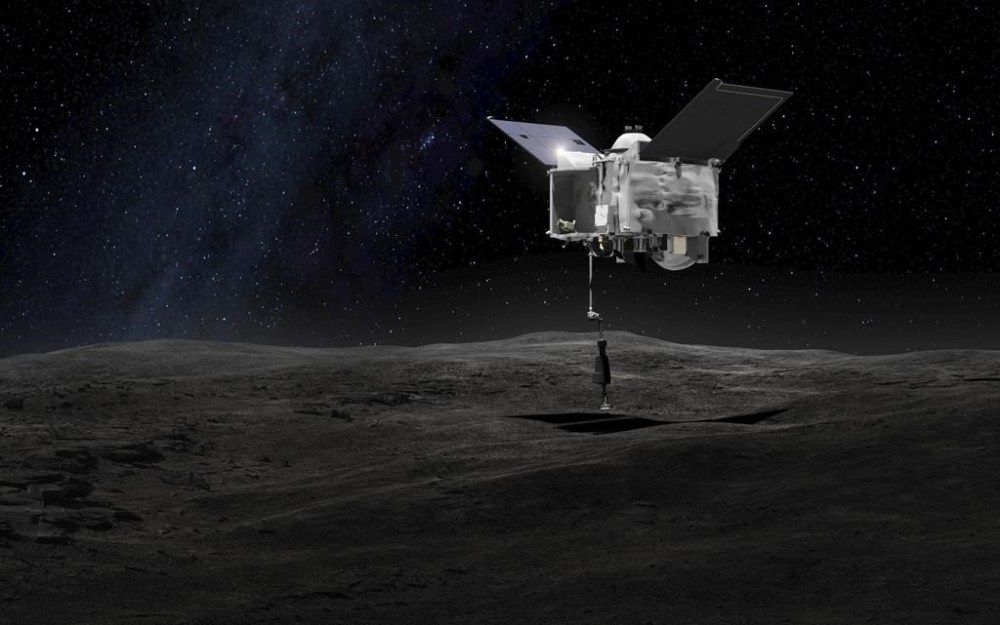
Scientists anticipate getting about a half pound (250 grams) of pebbles and dust, much more than the teaspoon or so brought back by Japan from two other asteroids. No other country has fetched pieces of asteroids, preserved time capsules from the dawn of our solar system that can help explain how Earth — and life — came to be.
Sunday’s landing concludes a 4 billion-mile (6.2-billion-kilometer) journey highlighted by the rendezvous with the carbon-rich Bennu, a unique pogo stick-style touchdown and sample grab, a jammed lid that sent some of the stash spilling into space, and now the return of NASA’s first asteroid samples.
“I ask myself how many heart-pounding moments can you have in one lifetime because I feel like I might be hitting my limit,” said the University of Arizona’s Dante Lauretta, the mission’s lead scientist.
A brief look at the spacecraft and its cargo:
THE LONG JOURNEY
Asteroid chaser Osiris-Rex blasted off on the $1 billion mission in 2016. It arrived at Bennu in 2018 and spent the next two years flying around the small spinning space rock and scouting out the best place to grab samples. Three years ago, the spacecraft swooped in and reached out with its 11-foot (3-meter) stick vacuum, momentarily touching the asteroid’s surface and sucking up dust and pebbles. The device pressed down with such force and grabbed so much that rocks became wedged around the rim of the lid. As samples drifted off into space, Lauretta and his team scrambled to get the remaining material into the capsule. The exact amount inside won’t be known until the container is opened.
ASTEROID BENNU
Discovered in 1999, Bennu is believed to be a remnant of a much larger asteroid that collided with another space rock. It’s barely one-third of a mile (half a kilometer) wide, roughly the height of the Empire State Building, and its black rugged surface is packed with boulders. Roundish in shape like a spinning top, Bennu orbits the sun every 14 months, while rotating every four hours. Scientists believe Bennu holds leftovers from the solar system’s formation 4.5 billion years ago. It may come dangerously close and strike Earth on Sept. 24, 2182 — exactly 159 years after the asteroid’s first pieces arrive. Osiris-Rex’s up-close study can help humanity figure out how to deflect Bennu if needed, Lauretta said.
GAME DAY
Osiris-Rex will release the sample capsule from 63,000 miles (100,000 kilometers) out, four hours before it’s due to touch down at the Defense Department’s Utah Test and Training Range on Sunday morning. The release command will come from spacecraft builder Lockheed Martin’s control center in Colorado. Soon afterward, the mothership will steer away and take off to explore another asteroid. The capsule — nearly 3 feet wide (81 centimeters) and 1.6 feet tall (50 centimeters) — will hit the atmosphere at 27,650 mph (44,500 kph) for the final 13 minutes of descent remaining. The main parachute will slow the last mile (1.6 kilometers), allowing for a mild 11 mph (18 kph) touchdown. Once everything is deemed safe, the capsule will be hustled by helicopter to a makeshift clean lab at the range. The next morning, a plane will carry the sealed container full of rubble to Houston, home to NASA’s Johnson Space Center. NASA is livestreaming the touchdown, set for around 10:55 a.m. EDT.
CLEANER THAN CLEAN
A new lab at Johnson will be limited to the Bennu rubble to avoid cross-contamination with other collections, said NASA curator Kevin Righter. Building 31 already holds the moon rocks brought back by the Apollo astronauts from 1969 through 1972, as well as comet dust and specks of solar wind collected during two previous missions and Mars meteorites found in Antarctica. The asteroid samples will be handled inside nitrogen-purging gloveboxes by staff in head-to-toe clean room suits. NASA plans a splashy public reveal of Bennu’s riches on Oct. 11.
ASTEROID AUTUMN

This fall is what NASA is calling Asteroid Autumn, with three asteroid missions marking major milestones. The Osiris-Rex touchdown will be followed by the launch of another asteroid hunter on Oct. 5. Both the NASA spacecraft and its target — a metal asteroid — are named Psyche. Then a month later, NASA’s Lucy spacecraft will encounter its first asteroid since soaring from Cape Canaveral, Florida, in 2021. Lucy will swoop past Dinkinesh in the main asteroid belt between Mars and Jupiter on Nov. 1. It’s a warmup for Lucy’s unprecedented tour of the so-called Trojans, swarms of asteroids that shadow Jupiter around the sun. Neither Psyche nor Lucy will collect souvenirs, nor will Osiris-Rex on its next assignment, to explore the asteroid Apophis in 2029.
OTHER SAMPLE RETURNS
This is NASA’s third sample return from deep space, not counting the hundreds of pounds (kilograms) of moon rocks gathered by the Apollo astronauts. The agency’s first robotic sample grab ended with a bang in 2004. The capsule bearing solar wind particles slammed into the Utah desert and shattered, compromising the samples. Two years later, a U.S. capsule with comet dust landed intact. Japan’s first asteroid sample mission returned microscopic grains from asteroid Itokawa in 2010. It’s second trip yielded about 5 grams — a teaspoon or so— from the asteroid Ryugu in 2020. The Soviet Union transported moon samples to Earth during the 1970s, and China returned lunar material in 2020.
___
The Associated Press Health and Science Department receives support from the Howard Hughes Medical Institute’s Science and Educational Media Group. The AP is solely responsible for all content.