As thaw accelerates, Swiss glaciers have lost 10% of their volume in the past 2 years, experts say

Advertisement

Advertise with us

GENEVA (AP) — A Swiss Academy of Sciences panel is reporting a dramatic acceleration of glacier melt in the Alpine country, which has lost 10% of its ice volume in just two years after high summer heat and low snow volumes in winter.

Read this article for free:


or

Already have an account? Log in here »

To continue reading, please subscribe:

Subscribe and receive a limited-edition Free Press branded hat or tote.

Digital Subscription

One year of digital access for only $205*

  • Enjoy unlimited reading on winnipegfreepress.com
  • Read the E-Edition, our digital replica newspaper
  • Access News Break, our award-winning app
  • Play interactive puzzles

*First annual payment billed as $205.00 + GST for one year. This annual subscription will automatically renew at $233.00 + GST every 52 weeks (10% off the regular annual price of $259.35). Offer available to new and qualified returning subscribers only. Cancel any time.

To continue reading, please subscribe:

Add Free Press access to your Brandon Sun subscription for only an additional

$1 for the first 4 weeks*

  • Enjoy unlimited reading on winnipegfreepress.com
  • Read the E-Edition, our digital replica newspaper
  • Access News Break, our award-winning app
  • Play interactive puzzles
Start now

*Your next Brandon Sun subscription payment will increase by $1.00 and you will be charged $17.95 plus GST for four weeks. After four weeks, your payment will increase to $24.95 plus GST every four weeks.

Hey there, time traveller!
This article was published 28/09/2023 (1102 days ago), so information in it may no longer be current.

GENEVA (AP) — A Swiss Academy of Sciences panel is reporting a dramatic acceleration of glacier melt in the Alpine country, which has lost 10% of its ice volume in just two years after high summer heat and low snow volumes in winter.

Switzerland — home to the most glaciers of any country in Europe — has seen 4% of its total glacier volume disappear in 2023, the second-biggest decline in a single year on top of a 6% drop in 2022, the biggest thaw since measurements began, the academy’s commission for cryosphere observation said.

Experts at the GLAMOS glacier monitoring center have been on the lookout for a possible extreme melt this year amid early warning signs about the country’s estimated 1,400 glaciers, a number that is now dwindling.
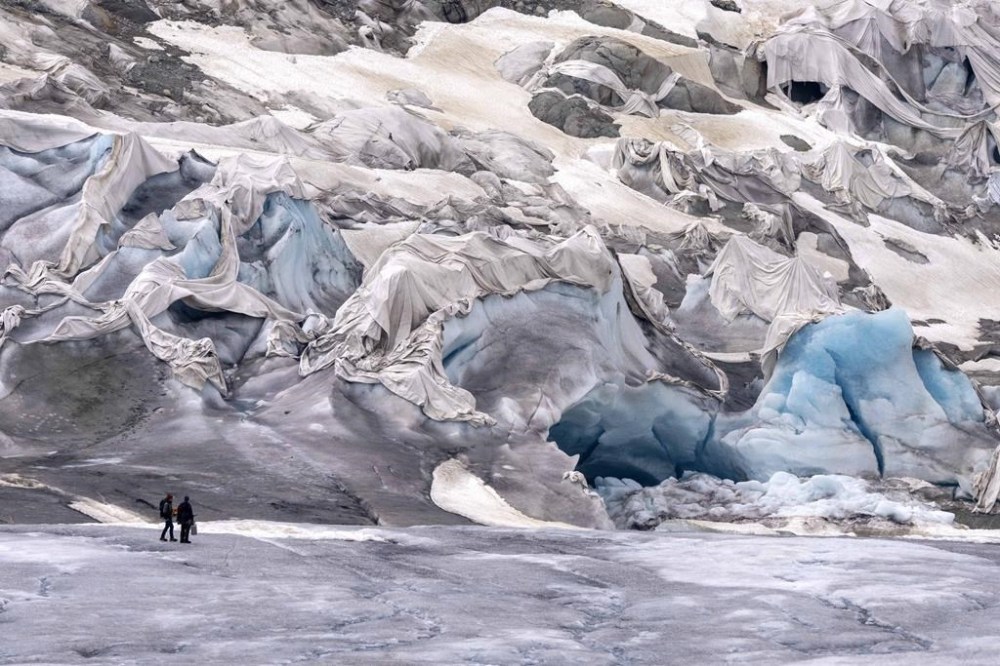
FILE - Team members of ETH (Swiss Federal Institute of Technology) glaciologist and head of the Swiss measurement network Glamos, Matthias Huss, arrive at the Rhone Glacier that is partially covered near Goms, Switzerland, June 16, 2023. (AP Photo/Matthias Schrader, File)

“The acceleration is dramatic, with as much ice being lost in only two years as was the case between 1960 and 1990,” the academy said. “The two extreme consecutive years have led to glacier tongues collapsing and the disappearance of many smaller glaciers.”

Matthias Huss, head of GLAMOS, which participated in the research, said in an interview that Switzerland has already lost up to 1,000 small glaciers, and that “now we are starting to lose also bigger and more important glaciers.”

“Glaciers are the ambassadors of climate change. They make it very clear what is happening out there because they respond in a very sensitive way to warming temperatures,” he said. “The study underlines once again that there is big urgency to act now if you want to stabilize (the) climate, and if you want to save at least some of the glaciers.”

The team said the “massive ice loss” stemmed from a winter with very low volumes of snow — which falls on top of glaciers and protects them from exposure to direct sunlight — and high summer temperatures.

All of Switzerland — where the Alps cut a swath through most of the southern and central parts of the country — was affected, and glaciers in the southern and eastern regions melted almost as fast as in 2022’s record thaw.

“Melting of several meters was measured in southern Valais (region) and the Engadin valley at a level above 3,200 meters (10,500 feet), an altitude at which glaciers had until recently preserved their equilibrium,” the team said.

The average loss of ice thickness was up to 3 meters (10 feet) in places such as the Gries Glacier in Valais, the Basòdino Glacier in the southern canton, or region, of Ticino, and the Vadret Pers glacier system in eastern Graubuenden.

The situation in some parts of the central Bernese Oberland and the Valais was less dramatic — such as for the Aletsch Glacier in Valais and Plaine Morte Glacier in the canton of Bern, because they enjoyed more winter snowfall. But even in such areas, “a loss of over 2 meters of the average ice thickness is extremely high,” the team said.
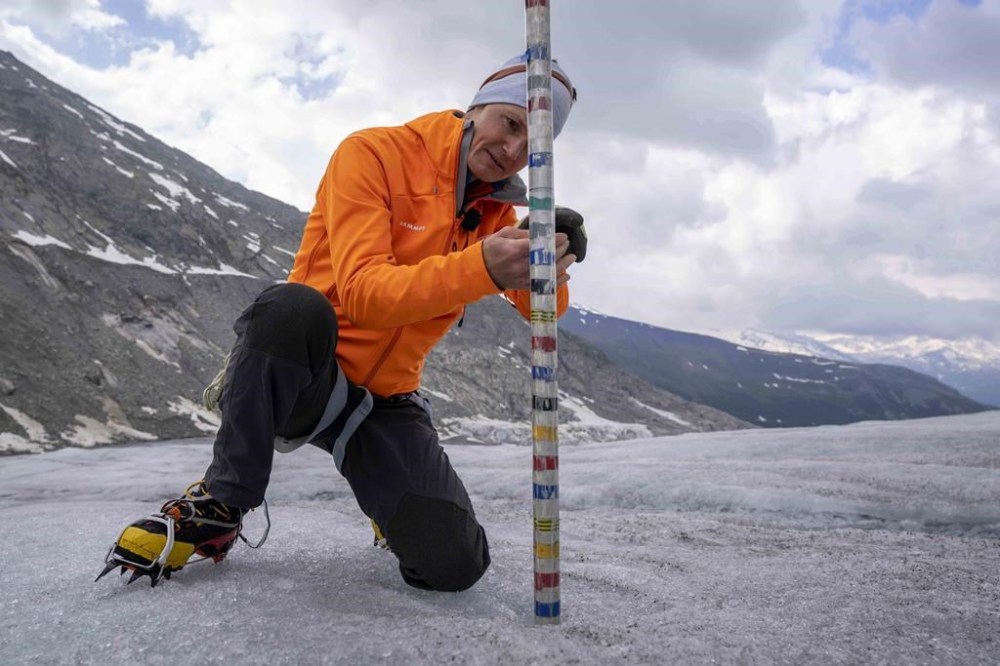
FILE - ETH (Swiss Federal Institute of Technology) glaciologist and head of the Swiss measurement network Glamos, Matthias Huss, checks the thickness of the Rhone Glacier near Goms, Switzerland, June 16, 2023. (AP Photo/Matthias Schrader, File)

Snow depths measured in the first half of February were generally higher than in the winters of 1964, 1990 or 2007, which were also characterized by low snowfalls, the team said. But snow levels sank to a new record low in the second half of the month of February, reaching only about 30% of the long-term average.

Over half of automated monitoring stations above 2,000 meters that have been in place for at least a quarter-century tallied record-low levels of snow at the time.

After that, an extremely warm June caused snow to melt two to four weeks earlier than usual, and mid-summer snowfalls melted very quickly, the team said.

Swiss meteorologists reported in August that the zero-degree Celsius level — the altitude where water freezes — had risen to its highest level ever recorded, at nearly 5,300 meters (17,400 feet), which means that all the Swiss Alpine peaks faced temperatures above freezing.

Report Error Submit a Tip

More Stories

May be whiff of truth to ex’s odour ardour

Maureen Scurfield 5 minute read Yesterday at 2:01 AM CDT

DEAR MISS LONELYHEARTS: I ran into an old boyfriend I used to curl on a team with, and we went for drinks. We’ve been almost eight years apart, and I couldn’t remember why we broke up, as we always had such a great time together.

It wasn’t until the second date — this time on a weekend — that it came back to me, with a jolt. Pee-yew! I remembered he doesn’t use deodorant on weekends. Why? He enjoys his own body odour. I recalled that a bit too late, and it was just as awful as ever! I went home early.

Tonight, he called and I refused him another date. I said, “Think back. You remember why we broke up?” Then he said, “Oh yeah, you hated my no-deodorant weekend policy. Well, guess what? Some women don’t mind!” I said I really doubted that, and that ended the conversation. Miss L., wouldn’t any women find stinky underarms offensive?

— Sensitive Nose, Fort Richmond

Living the dream

Ken Wiebe 7 minute read Preview

Living the dream

Ken Wiebe 7 minute read Yesterday at 4:48 PM CDT

DETROIT – As Tyrel Bauer took a left turn out of the tunnel from the Winnipeg Jets dressing room and into the stands, he was met with a hearty round of applause from the 25 friends and family members who had made the trek from various points around North America.

Bauer had just realized a childhood dream and the significance of the moment was not lost on some of his biggest supporters.

“It was a special walk, for sure. A special walk,” Bauer said on Saturday afternoon before the Jets departed for a two-game road trip that begins on Sunday in Detroit against the Red Wings. “Those people who came – and many more that weren’t there and were cheering on from afar – they’ve always been there.

“I wanted that for my family, maybe even more than I wanted it for me. They’ve been through thick and thin. I’ve stressed mom out quite a bit over the years doing my job. That meant a lot for them and I’m really happy they could be there for it.”

Read
Yesterday at 4:48 PM CDT

Volunteer pop-up library axed from Manitoba Youth Centre

Matthew Frank 4 minute read Preview

Volunteer pop-up library axed from Manitoba Youth Centre

Matthew Frank 4 minute read Updated: Yesterday at 11:25 AM CDT

Manitoba Corrections has cancelled a pop-up library program at the Manitoba Youth Centre, leaving inmates without librarian services and fewer options to borrow certain books.

The Prison Libraries Committee, part of the non-profit Manitoba Library Association, operated and funded the volunteer program since 2024 before it was shut down by the province last month. The group previously partnered with the province to offer the service because the facility has no dedicated library of its own.

“It is concerning that community members who are incarcerated, especially youth, are losing out on meaningful programming, access to information and rehabilitation efforts, which are offered at no cost to (Manitoba) Corrections. We urge Manitoba Justice to promote more library services and programming, not less,” said a Sept. 24 letter from the non-profit addressed to the justice minister.

Ashley Huot, chair of the Prison Libraries Committee, said she was puzzled when she received an email last month from Manitoba Corrections stating that the pop-up library was no longer needed.

Read
Updated: Yesterday at 11:25 AM CDT

Puzzles Palace

1 minute read Monday, Jul. 27, 2026

To solve our puzzles, please subscribe with this special offer: |

Letters, Oct. 3

7 minute read Yesterday at 2:01 AM CDT

A morning in the life …

My very first lesson does not start when I walk into that lecture hall, oh no — it starts long before. It begins when I walk to my car, check the estimated arrival time to the University of Manitoba and hope that Winnipeg traffic agrees with it.

A drive that appears completely manageable changes almost immediately when I’m greeted by a tsunami of orange pylons and a line of cars that appears to go on forever. Traffic moves by the inch, lanes magically disappear and the detour I took yesterday now has a detour of its own. These factors make me do a calculation that I have become all too familiar with. How late can I arrive and still find parking, run to my class across campus and get to class with enough time left to make it worth it?

I have grown used to people saying, “Why not just leave earlier?” I do. But when I’m already leaving for my 8:30 a.m. class at 7 a.m., there’s only so much I can do. This drive that some would think is relaxing is one that feels like an assignment that I didn’t know I had to complete and is due at 8:30 a.m.

Mayoral candidate Vogiatzakis criticized for living outside Winnipeg

Malak Abas 4 minute read Preview

Mayoral candidate Vogiatzakis criticized for living outside Winnipeg

Malak Abas 4 minute read Friday, Oct. 2, 2026

A mayoral hopeful took heat from other candidates Friday for living outside Winnipeg while running in the civic election.

Mike Vogiatzakis’s primary residence is in the Rural Municipality of St. Andrews, about 25 kilometres north of Winnipeg — a community with its own mayor and councillors.

But the funeral director said he owns a home in Winnipeg where he divides his time, and he would move to the city full-time if elected mayor.

“It doesn’t matter where a person lives. Why are we dividing St. Andrews and Manitoba and Winnipeg? I’ve met the criteria to run for mayor,” Vogiatzakis said Friday morning.

Read
Friday, Oct. 2, 2026