The Supreme Court will decide if state laws limiting social media platforms violate the Constitution

Advertisement

Advertise with us

WASHINGTON (AP) — The Supreme Court agreed Friday to decide whether state laws that seek to regulate Facebook, TikTok, X and other social media platforms violate the Constitution.

Read this article for free:


or

Already have an account? Log in here »

To continue reading, please subscribe:

Subscribe and receive a limited-edition Free Press branded hat or tote.

Digital Subscription

One year of digital access for only $205*

  • Enjoy unlimited reading on winnipegfreepress.com
  • Read the E-Edition, our digital replica newspaper
  • Access News Break, our award-winning app
  • Play interactive puzzles

*First annual payment billed as $205.00 + GST for one year. This annual subscription will automatically renew at $233.00 + GST every 52 weeks (10% off the regular annual price of $259.35). Offer available to new and qualified returning subscribers only. Cancel any time.

To continue reading, please subscribe:

Add Free Press access to your Brandon Sun subscription for only an additional

$1 for the first 4 weeks*

  • Enjoy unlimited reading on winnipegfreepress.com
  • Read the E-Edition, our digital replica newspaper
  • Access News Break, our award-winning app
  • Play interactive puzzles
Start now

*Your next Brandon Sun subscription payment will increase by $1.00 and you will be charged $17.95 plus GST for four weeks. After four weeks, your payment will increase to $24.95 plus GST every four weeks.

Hey there, time traveller!
This article was published 29/09/2023 (1086 days ago), so information in it may no longer be current.

WASHINGTON (AP) — The Supreme Court agreed Friday to decide whether state laws that seek to regulate Facebook, TikTok, X and other social media platforms violate the Constitution.

The justices will review laws enacted by Republican-dominated legislatures and signed by Republican governors in Florida and Texas. While the details vary, both laws aim to prevent the social media companies from censoring users based on their viewpoints.

The court’s announcement, three days before the start of its new term, comes as the justices continue to grapple with how laws written at the dawn of the digital age, or earlier, apply to the online world.
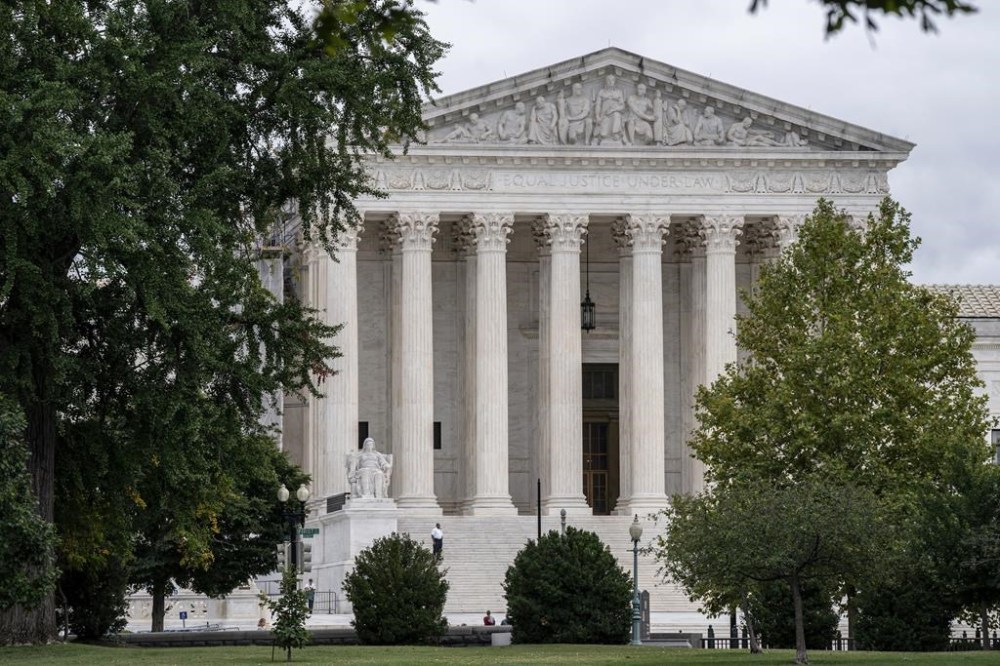
FILE - The Supreme Court is seen in Washington, Sept. 25, 2023. The new term of the high court begins next Monday, Oct. 2. The Supreme Court, which begins its new term on Monday, is awash in ritual. So it’s no surprise that the lawyers have a few regular, if occasionally eccentric, observances of their own. (AP Photo/J. Scott Applewhite, File)

The justices had already agreed to decide whether public officials can block critics from commenting on their social media accounts, an issue that previously came up in a case involving then-President Donald Trump. The court dismissed the Trump case when his presidential term ended in January 2021.

Separately, the high court also could consider a lower-court order limiting executive branch officials’ communications with social media companies about controversial online posts.

In all, the justices added 12 cases Friday that will be argued during the winter. They include:

— A dispute over the FBI’s no-fly list. The appeal came from the Biden administration in a case involving an Oregon man who once was on the list, but had been removed years ago. A federal appeals court said he could continue his lawsuit because the FBI never disavowed his initial inclusion.

— A copyright case that involves a hit for the hip-hop artist Flo Rida in which he made use of someone else’s song from the 1980s. Music publishing companies that were sued for copyright infringement over the 2008 song “In the Ayer” are challenging a lower court ruling against them.

— A plea by landowners in southeast Texas who want the state to compensate them for effectively taking their property. Their lawsuit claims that a successful project to renovate Interstate 10 and ensure it remains passable in bad weather results in serious flooding on their properties in heavy rainfall.

The new social media cases follow conflicting rulings by two appeals courts, one of which upheld the Texas law, while the other struck down Florida’s statute. By a 5-4 vote, the justices kept the Texas law on hold while litigation over it continues.

But the alignment was unusual. Chief Justice John Roberts and Justices Stephen Breyer, Sonia Sotomayor, Brett Kavanaugh and Amy Coney Barrett voted to grant the emergency request from two technology industry groups that challenged the law in federal court.

Justices Clarence Thomas, Samuel Alito, Elena Kagan and Neil Gorsuch would have allowed the law to remain in effect. In dissent, Alito wrote, “Social media platforms have transformed the way people communicate with each other and obtain news.”

Proponents of the laws, including Republican elected officials in several states that have similar measures, have sought to portray social media companies as generally liberal in outlook and hostile to ideas outside of that viewpoint, especially from the political right.

The tech sector warned that the laws would prevent platforms from removing extremism and hate speech.

“Online services have a well-established First Amendment right to host, curate and share content as they see fit,” Chris Marchese, the litigation director for the industry group NetChoice, said in a statement. “The internet is a vital platform for free expression, and it must remain free from government censorship. We are confident the Court will agree.”

Without offering any explanation, the justices had put off consideration of the case even though both sides agreed the high court should step in.

The justices had other social media issues before them last year, including a plea the court did not embrace to soften legal protections tech companies have for posts by their users.


Report Error Submit a Tip

More Stories

Former Bombers linebacker Gauthier enjoying career as electrician

Taylor Allen 6 minute read Preview

Former Bombers linebacker Gauthier enjoying career as electrician

Taylor Allen 6 minute read Yesterday at 12:44 PM CDT

Most professional football players don’t ride off into the sunset on their own terms.

Shayne Gauthier was well aware of that, but it didn’t make it sting any less when the Winnipeg Blue Bombers informed the veteran linebacker that they weren’t bringing him back for 2026.

“I was really hoping to play one more (season) because it would have been my 10th season, so, I’d say it didn’t really end the way I wanted,” Gauthier recently told the Free Press.

“It left a little sour taste in my mouth, but that’s part of pro sports. If everybody got the ending that they wanted, then it wouldn’t really work.”

Read
Yesterday at 12:44 PM CDT

Jets vets weigh in on franchise goalie Hellebuyck not reporting to training camp

Mike McIntyre 7 minute read Preview

Jets vets weigh in on franchise goalie Hellebuyck not reporting to training camp

Mike McIntyre 7 minute read Thursday, Sep. 17, 2026

Hockey is the ultimate team sport, where it’s supposed to be about the crest on your chest rather than the name on your back.

So how is Connor Hellebuyck’s trade request and subsequent training camp strike playing out inside the Winnipeg Jets locker room — particularly among other core players he’s gone to battle with over the years?

“Obviously the news is heartbreaking,” Jets forward Kyle Connor said Thursday.

“It feels like we had such a special group here and for whatever reason — I can’t speak to the reason until we hear from the man, I’m not going to speculate on what it is but I know that a lot of guys in that room that are heartbroken.”

Read
Thursday, Sep. 17, 2026

Cabernet Sauvignon star of wine festival

Ben Sigurdson 5 minute read Preview

Cabernet Sauvignon star of wine festival

Ben Sigurdson 5 minute read 3:00 AM CDT

The Winnipeg Wine Festival will celebrate the king of red wine grapes next weekend — the theme of this year’s festival, which takes place Sept. 25 and 26 at the RBC Convention Centre, is Cabernet Sauvignon.

Cab Sauv, as it’s also known, is the world’s most widely planted wine grape of any colour, first coming to prominence in the 1800s in France’s Bordeaux region, where the grape is still popular. Rather than single-variety wines, Bordeaux reds tend to be blends, with those coming from the left bank of the Gironde estuary being Cabernet-dominant, while right-bank wines are Merlot-dominant, with Cabernet Sauvignon playing a supporting role. Cabernet and Merlot work well together and many other countries have followed suit in blending the two.

A team at University of California Davis put Cabernet Sauvignon through a DNA test in 1996 and discovered its parent grapes are Cabernet Franc and Sauvignon Blanc — it’s likely that at some point the two varieties, planted next to each other in some vineyard, crossed and mutated and became the grape we know today. (Someone growing grapes in the 19th century must have had an inkling of what was up, as the grape has been called Cabernet Sauvignon since long before the DNA test.)

Flavour-wise, most Cabernet Sauvignon wines are big and bold, with a core of deep dark berry flavours, some graphite and spice notes and relatively bright acidity. It’s a grape that is well-suited to barrel aging, with most examples seeing at least some time in wood.

Read
3:00 AM CDT

Steinbach Credit Union member warns others after scammer steals $10K

Scott Billeck 5 minute read Preview

Steinbach Credit Union member warns others after scammer steals $10K

Scott Billeck 5 minute read Yesterday at 5:19 PM CDT

A Winnipeg single mother whose bank account was drained of nearly $10,000 says Steinbach Credit Union needs to warn its members about what she believes is a broader security problem.

The woman, who is not being named to protect her identity, said a scammer gained access to her account earlier this week after calling SCU’s contact centre, claiming to be her and successfully completing the credit union’s authentication process.

She said she knows of at least six others who have experienced similar incidents in which callers impersonate SCU account holders and pass the authentication checks.

The woman discovered something was wrong when her minor son asked why money had been transferred out of an account they jointly hold.

Read
Yesterday at 5:19 PM CDT

Siloam Mission, WFPS discussing on-site paramedic to reduce staggering number of emergency calls

Scott Billeck 4 minute read Preview

Siloam Mission, WFPS discussing on-site paramedic to reduce staggering number of emergency calls

Scott Billeck 4 minute read Yesterday at 2:00 AM CDT

Winnipeg’s fire-paramedic service and its largest homeless-serving organization are discussing what it would look like to station at least one paramedic at Siloam Mission, as emergency calls to the downtown facility surge.

The ongoing discussions come as Winnipeg Fire Paramedic Service crews were dispatched 1,771 times during the first eight months of the year to the two adjacent Siloam properties at 303 Stanley St. and 300 Princess St.

WFPS said most of the calls were related to overdoses or other consequences of substance use, with the total nearly double the 854 calls recorded over the same period last year. By comparison, there were 831 calls during the same span in 2024, and 591 in 2023.

“The number of emergency calls isn’t sustainable for us as a service, but it’s certainly not sustainable for them as an agency trying to provide services,” WFPS chief Ryan Sneath told the Free Press. “And they recognize that they’re impacting emergency services, not them specifically, but the site in a significant way.”

Read
Yesterday at 2:00 AM CDT

Family account spiced with magic realism, geopolitical intrigue and a ghost story

Reviewed by Zilla Jones 4 minute read Preview

Family account spiced with magic realism, geopolitical intrigue and a ghost story

Reviewed by Zilla Jones 4 minute read 2:01 AM CDT

Tom Lin’s second novel Babylon, South Dakota moves beyond a historical account of an immigrant family’s struggle, delightfully blending and bending genres.

Lin is a Chinese-born novelist whose family emigrated to the U.S. when he was four years old. His debut novel, The Thousand Crimes of Ming Tsu, won the 2022 Andrew Carnegie Medal for Excellence in Fiction, making him the youngest ever recipient of that award. He earned a PhD in English from the University of California Davis and is currently an assistant professor of English and creative writing at the University of Iowa.

Babylon, South Dakota takes place in an unspecified time period that can be understood to be during the Mao era — likely the 1950s or ’60s. A young Chinese couple, the Hsuis, immigrate to the rural community that gives the book its title. They take the names Saul and Mei and settle on a 160-acre homestead left to them by a distant relative.

Saul’s dream is to breed and sell chrysanthemums from seeds he brought from China, while Mei wants to raise livestock. They speak no English, know nothing of life in the United States, are unprepared for the harshness of winter and the isolation of the farm and bring nothing with them except some gold, which Mei hides around the house for emergencies. Their only link to the outside world is a discarded and marginally functioning TV set, which Saul rescues and rigs up.

Read
2:01 AM CDT