EU announces plans to better protect its sensitive technologies from foreign snooping
Advertisement
Read this article for free:
or
Already have an account? Log in here »
To continue reading, please subscribe:
Digital Subscription
One year of digital access for only $1.44 a week*
- Enjoy unlimited reading on winnipegfreepress.com
- Read the E-Edition, our digital replica newspaper
- Access News Break, our award-winning app
- Play interactive puzzles
*Billed as $5.77 plus GST every four weeks. After 52 weeks, price increases to the regular rate of $19.95 plus GST every four weeks. Offer available to new and qualified returning subscribers only. Cancel any time.
To continue reading, please subscribe:
Add Free Press access to your Brandon Sun subscription for only an additional
$1 for the first 4 weeks*
- Enjoy unlimited reading on winnipegfreepress.com
- Read the E-Edition, our digital replica newspaper
- Access News Break, our award-winning app
- Play interactive puzzles
*Your next Brandon Sun subscription payment will increase by $1.00 and you will be charged $17.95 plus GST for four weeks. After four weeks, your payment will increase to $24.95 plus GST every four weeks.
Read unlimited articles for free today:
or
Already have an account? Log in here »
Hey there, time traveller!
This article was published 03/10/2023 (1112 days ago), so information in it may no longer be current.
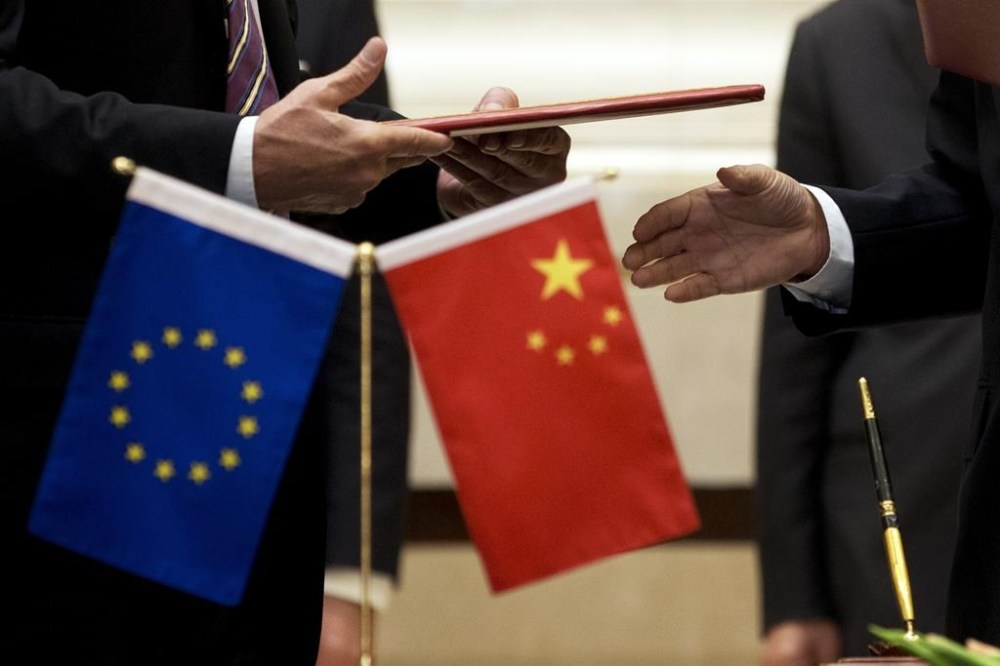
BRUSSELS (AP) — The European Union announced plans on Tuesday to better protect its cutting-edge technologies from foreign snooping that might threaten its economy and security in the wake of repeated warnings that the bloc needs to “de-risk” its relations with China.
“Technology is currently at the heart of geopolitical competition and the EU wants to be a player, and not a playground,” European Commission Vice President Vera Jourova said.
To better protect its relatively open market, the European Commission wants the member states to immediately carry out risk assessments of its most sensitive industries, including advanced semiconductor, artificial intelligence, quantum and biotechnologies.
Those are considered “highly likely to present the most sensitive and immediate risks related to technology security and technology leakage” and are up for the highest level of protection.
Even though the European Commission refrained from putting the onus on any specific country, the EU itself has repeatedly said that it must be better prepared to develop measures to protect trade and investment that China might exploit for its own security and military purposes.
“China indeed is a big elephant in general terms, but in our recommendation, we are country agnostic,” Jourova said.

Thierry Breton, the EU’s internal market commissioner, said that the measures would reach well beyond Beijing.
“We want to de-risk, but not only with China, with everybody, including some time, if it’s needed, with some of our like-minded partners,” he said.
How the risk assessments would be followed up with measures wasn’t fully clear.
The measures are the latest example of the struggle the 27-nation has in setting its relations with Beijing. The EU has said that despite sometimes fundamental differences on human rights and state involvement in the economy, it was no option to fully decouple relations with such a superpower.
Hence, the EU has sought to center on de-risking relations, and better protecting its vital economic sectors from undue interference.