How an award-winning Halifax professor nurtured a network of battery entrepreneurs
Advertisement
Read this article for free:
or
Already have an account? Log in here »
To continue reading, please subscribe:

Digital Subscription
One year of digital access for only $205*
- Enjoy unlimited reading on winnipegfreepress.com
- Read the E-Edition, our digital replica newspaper
- Access News Break, our award-winning app
- Play interactive puzzles
*First annual payment billed as $205.00 + GST for one year. This annual subscription will automatically renew at $233.00 + GST every 52 weeks (10% off the regular annual price of $259.35). Offer available to new and qualified returning subscribers only. Cancel any time.
To continue reading, please subscribe:
Add Free Press access to your Brandon Sun subscription for only an additional
$1 for the first 4 weeks*
- Enjoy unlimited reading on winnipegfreepress.com
- Read the E-Edition, our digital replica newspaper
- Access News Break, our award-winning app
- Play interactive puzzles
*Your next Brandon Sun subscription payment will increase by $1.00 and you will be charged $17.95 plus GST for four weeks. After four weeks, your payment will increase to $24.95 plus GST every four weeks.
Read unlimited articles for free today:
or
Already have an account? Log in here »
Hey there, time traveller!
This article was published 22/10/2023 (1076 days ago), so information in it may no longer be current.
HALIFAX – They call themselves the “Dahn lab” graduates, and they’re powering an unlikely, Halifax-based research hub for batteries designed to replace fossil fuels.
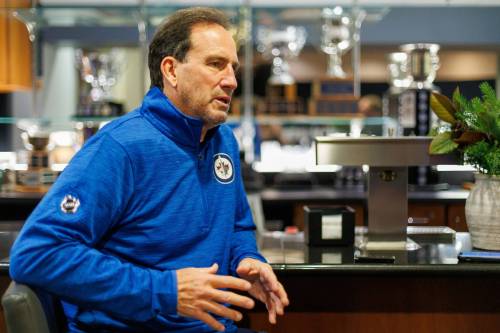
At the tightly wired network’s heart is Jeff Dahn, a professor of chemistry and physics at Dalhousie University, who on Oct. 9 was presented with the Olin Palladium Award from the Electrochemical Society for a lifetime of working to improve rechargeable batteries. The prestigious prize has previously been won by Nobel laureates.
According to the award citation, the 66-year-old researcher is an author or co-author of 78 inventions with patents issued or filed, and has trained over 65 PhDs and 30 post-doctoral researchers, many of whom now hold senior positions in battery firms around the globe.
They’re scientists who delve deeply into chemistry and physics, yet Dahn describes the mission driving the work in fairly simple social terms. “It’s a war on climate change. We need every sensible energy storage technology to store energy from solar and wind,” he said after receiving his prize at the Electrochemical Society’s biannual gathering in Sweden.
The genesis of the lab goes back to Dahn’s early career in the 1980s, working with industry on pioneering lithium-based batteries.
Following his return to Nova Scotia to teach, he leveraged this background into a partnership with Tesla in 2016. That’s brought a steady series of breakthroughs to improve the longevity, safety and energy density — the amount of energy stored in a given space — of the firm’s battery cells.
Today, the professor says there are 40 people at his Dalhousie lab, two new professors have been hired to “take over” when he eventually retires, and the storehouse of battery intelligence is flowing among his former acolytes as they seek ways to increase battery lifetimes.
“My whole goal was to set up a situation where this lab would not go into the ocean when I do finally stop,” he said in an interview on Friday.
At an industrial park on the other side of town, graduate Chris Burns illustrates how the Dahn network functions in the port city.
While studying with his mentor in 2009, Burns helped create higher-precision systems that test the endurance of lithium-ion cells. He and fellow researcher David Stevens used their findings to create Novonix Ltd., offering what Dahn calls the “most accurate” battery testing systems in the world.
From three people in 2013, Novonix has grown to more than 90 employees in Halifax, and its plant is capable of small-scale production of prototype batteries.
There are currently over 1,000 batteries being tested at the facility, as they’re tailored for diverse uses, temperatures and expected life cycles. “Even if you just look at vehicles and the difference between the battery for a commuter car or a pickup truck, the demands on these are wildly different, and all of those have different subsets of product requirements,” said Burns.
Meanwhile, Novonix is building a production facility for battery electrode materials — synthetic graphite — in Tennessee that he hopes will tie in with the battery “giga factories” being constructed across North America to build systems for vehicles and other uses. It’s expected to begin production late next year.
“Everything we started was out of his (Dahn’s) drive for longer-life batteries that started our cell-testing business,” the 36-year-old entrepreneur said.
Across the harbour, another post-doctoral graduate of the Dahn lab, Ravi Kempaiah, is using his ties to Burns and Dahn in hope of similar success with a commercialized battery for e-bikes and scooters in warm nations such as India. He is the chief executive of Zen Energy.
“Small batteries will change the way we deliver food and cargo in the cities,” Kempaiah said.
Holding a lithium ion battery his firm developed that he said lasts four times longer than what is currently on the market, he said he’s been helped by research from the Dalhousie lab and by Novonix’s testing centre.
“Some of the findings (at the Dalhousie lab), which are in the public domain, allow us to design these cells to withstand high temperatures and still maintain their capacity,” he said.
But will the science and the drive to customize and improve batteries in Halifax continue beyond Dahn and the initial startups?
Dahn says a new generation of researchers in the lab are building on past findings, and Tesla is receiving cost-effective results on a budget that’s assisted by university and federal research contributions.
He also predicts the “zero waste” process for Novonix’s electrodes in Tennessee is “going to be big,” as battery firms seek ways to avoid existing production methods that emit huge amounts of waste water and discarded sodium sulphate.
Meanwhile, he’s intending to carry on his lab’s mission of building longer-lasting batteries, starting most days before 8 a.m. in his lab among students from around the world, in the province where he grew up and intends to stay.
“You know, a lot of people are trying to move me, but I basically say, ‘I’m not moving.'”
This report by The Canadian Press was first published Oct. 22, 2023.