Humanoid robots are here, but they’re a little awkward. Do we really need them?
Advertisement
Read this article for free:
or
Already have an account? Log in here »
To continue reading, please subscribe:

Digital Subscription
One year of digital access for only $205*
- Enjoy unlimited reading on winnipegfreepress.com
- Read the E-Edition, our digital replica newspaper
- Access News Break, our award-winning app
- Play interactive puzzles
*First annual payment billed as $205.00 + GST for one year. This annual subscription will automatically renew at $233.00 + GST every 52 weeks (10% off the regular annual price of $259.35). Offer available to new and qualified returning subscribers only. Cancel any time.
To continue reading, please subscribe:
Add Free Press access to your Brandon Sun subscription for only an additional
$1 for the first 4 weeks*
- Enjoy unlimited reading on winnipegfreepress.com
- Read the E-Edition, our digital replica newspaper
- Access News Break, our award-winning app
- Play interactive puzzles
*Your next Brandon Sun subscription payment will increase by $1.00 and you will be charged $17.95 plus GST for four weeks. After four weeks, your payment will increase to $24.95 plus GST every four weeks.
Read unlimited articles for free today:
or
Already have an account? Log in here »
Hey there, time traveller!
This article was published 05/11/2023 (1054 days ago), so information in it may no longer be current.
Building a robot that’s both human-like and useful is a decades-old engineering dream inspired by popular science fiction.
While the latest artificial intelligence craze has sparked another wave of investments in the quest to build a humanoid, most of the current prototypes are clumsy and impractical, looking better in staged performances than in real life. That hasn’t stopped a handful of startups from keeping at it.
“The intention is not to start from the beginning and say, ‘Hey, we’re trying to make a robot look like a person,’” said Jonathan Hurst, co-founder and chief robot officer at Agility Robotics. “We’re trying to make robots that can operate in human spaces.”
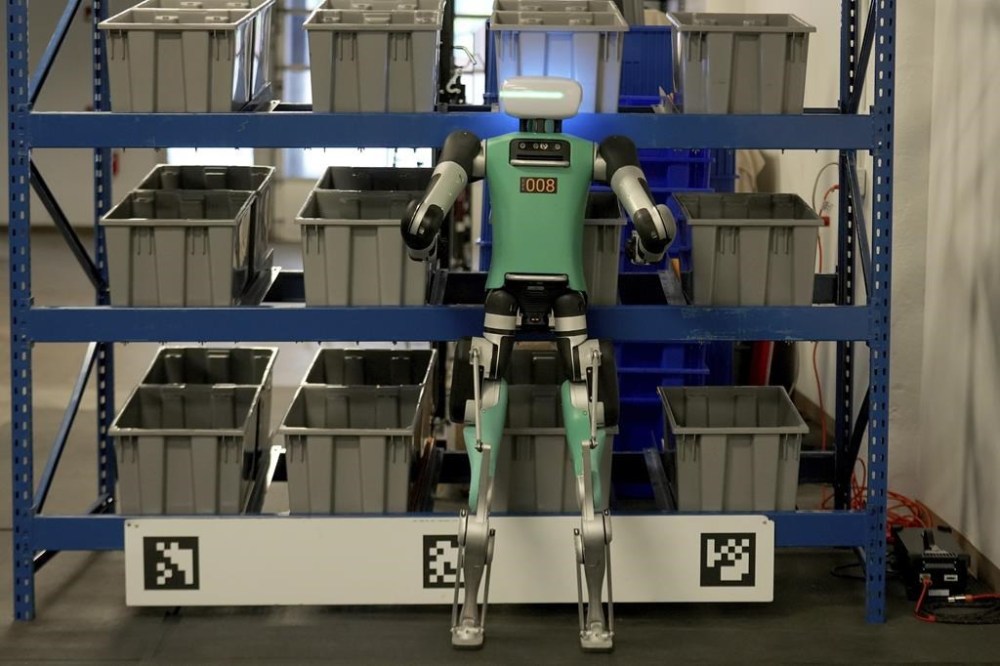
Do we even need humanoids? Hurst makes a point of describing Agility’s warehouse robot Digit as human-centric, not humanoid, a distinction meant to emphasize what it does over what it’s trying to be.
What it does, for now, is pick up tote bins and move them. Amazon announced in October it will begin testing Digits for use in its warehouses, and Agility opened an Oregon factory in September to mass produce them.
Digit has a head containing cameras, other sensors and animated eyes, and a torso that essentially works as its engine. It has two arms and two legs, but its legs are more bird-like than human, with an inverted knees appearance that resembles so-called digitigrade animals such as birds, cats and dogs that walk on their toes rather than on flat feet.
Rival robot-makers, like Figure AI, are taking a more purist approach on the idea that only true humanoids can effectively navigate workplaces, homes and a society built for humans. Figure also plans to start with a relatively simple use case, such as in a retail warehouse, but aims for a commercial robot that can be “iterated on like an iPhone” to perform multiple tasks to take up the work of humans as birth rates decline around the world.
“There’s not enough people doing these jobs, so the market’s massive,” said Figure AI CEO Brett Adcock. “If we can just get humanoids to do work that humans are not wanting to do because there’s a shortfall of humans, we can sell millions of humanoids, billions maybe.”
At the moment, however, Adcock’s firm doesn’t have a prototype that’s ready for market. Founded just over a year ago and after having raised tens of millions of dollars, it recently revealed a 38-second video of Figure walking through its test facility in Sunnyvale, California.
Tesla CEO Elon Musk is also trying to build a humanoid, called Optimus, through the electric car-maker’s robotics division, but a hyped-up live demonstration last year of the robot’s awkwardly halting steps didn’t impress experts in the robotics field. Seemingly farther along is Tesla’s Austin, Texas-based neighbor Apptronik, which unveiled its Apollo humanoid in an August video demonstration.
All the attention — and money — poured into making ungainly humanoid machines might make the whole enterprise seem like a futile hobby for wealthy technologists, but for some pioneers of legged robots it’s all about what you learn along the way.
“Not only about their design and operation, but also about how people respond to them, and about the critical underlying technologies for mobility, dexterity, perception and intelligence,” said Marc Raibert, the co-founder of Boston Dynamics, best known for its dog-like robots named Spot.
Raibert said sometimes the path of development is not along a straight line. Boston Dynamics, now a subsidiary of carmaker Hyundai, experimented with building a humanoid that could handle boxes.
“That led to development of a new robot that was not really a humanoid, but had several characteristics of a humanoid,” he said via an emailed message. “But the changes resulted in a new robot that could handle boxes faster, could work longer hours, and could operate in tight spaces, such as a truck. So humanoid research led to a useful non-humanoid robot.”
Some startups aiming for human-like machines focused on improving the dexterity of robotic fingers before trying to get their robots to walk.
Walking is “not the hardest problem to solve in humanoid robotics,” said Geordie Rose, co-founder and CEO of British Columbia, Canada-based startup Sanctuary AI. “The hardest problem is the problem of understanding the world and being able to manipulate it with your hands.”
Sanctuary’s newest and first bipedal robot, Phoenix, can stock shelves, unload delivery vehicles and operate a checkout, early steps toward what Rose sees as a much longer-term goal of getting robots to perceive the physical world to be able to reason about it in a way that resembles intelligence. Like other humanoids, it’s meant to look endearing, because how it interacts with real people is a big part of its function.
“We want to be able to provide labor to the world, not just for one thing, but for everybody who needs it,” Rose said. “The systems have to be able to think like people. So we could call that artificial general intelligence if you’d like. But what I mean more specifically is the systems have to be able to understand speech and they need to be able to convert the understanding of speech into action, which will satisfy job roles across the entire economy.”
Agility’s Digit robot caught Amazon’s attention because it can walk and also move around in a way that could complement the e-commerce giant’s existing fleet of vehicle-like robots that move large carts around its vast warehouses.
“The mobility aspect is more interesting than the actual form,” said Tye Brady, Amazon’s chief technologist for robotics, after the company showed it off at a media event in Seattle.

Right now, Digit is being tested to help with the repetitive task of picking up and moving empty totes. But just having it there is bound to resurrect some fears about robots taking people’s jobs, a narrative Amazon is trying to prevent from taking hold.
Agility Robotics co-founder and CEO Damion Shelton said the warehouse robot is “just the first use case” of a new generation of robots he hopes will be embraced rather than feared as they prepare to enter businesses and homes.
“So in 10, 20 years, you’re going to see these robots everywhere,” Shelton said. “Forever more, human- centric robots like that are going to be part of human life. So that’s pretty exciting.”
—-
AP writer Haleluya Hadero contributed to this report.