Nikki Haley walks back her demand that social media ban anonymous posters after facing GOP backlash
Advertisement
Read this article for free:
or
Already have an account? Log in here »
To continue reading, please subscribe:
Digital Subscription
One year of digital access for only $1.44 a week*
- Enjoy unlimited reading on winnipegfreepress.com
- Read the E-Edition, our digital replica newspaper
- Access News Break, our award-winning app
- Play interactive puzzles
*Billed as $5.77 plus GST every four weeks. After 52 weeks, price increases to the regular rate of $19.95 plus GST every four weeks. Offer available to new and qualified returning subscribers only. Cancel any time.
To continue reading, please subscribe:
Add Free Press access to your Brandon Sun subscription for only an additional
$1 for the first 4 weeks*
- Enjoy unlimited reading on winnipegfreepress.com
- Read the E-Edition, our digital replica newspaper
- Access News Break, our award-winning app
- Play interactive puzzles
*Your next Brandon Sun subscription payment will increase by $1.00 and you will be charged $17.95 plus GST for four weeks. After four weeks, your payment will increase to $24.95 plus GST every four weeks.
Read unlimited articles for free today:
or
Already have an account? Log in here »
Hey there, time traveller!
This article was published 15/11/2023 (1068 days ago), so information in it may no longer be current.
COLUMBIA, S.C. (AP) — Nikki Haley on Wednesday partially walked back her proposed requirement that social media companies ban people from posting anonymously online for national security reasons, a stance for which she drew backlash across conservative social media and some of her GOP presidential rivals.
The former United Nations ambassador’s comments Tuesday to Fox News were quickly spread by the campaign of Florida Gov. Ron DeSantis. Both Haley and DeSantis are trying to resonate with GOP constituencies including parents worried for their children’s online safety as well as voters fearful of China’s influence in U.S. affairs. As they try to battle for a distant second place behind former President Donald Trump, Haley and DeSantis have accused each other of being weak on China in particular.
“Every person on social media should be verified by their name. It’s a national security threat,” Haley, a former South Carolina governor and U.N. ambassador, said Tuesday on Fox News. “When you do that, all of a sudden people have to stand by what they say and it gets rid of the Russian bots, the Iranian bots and the Chinese bots.”
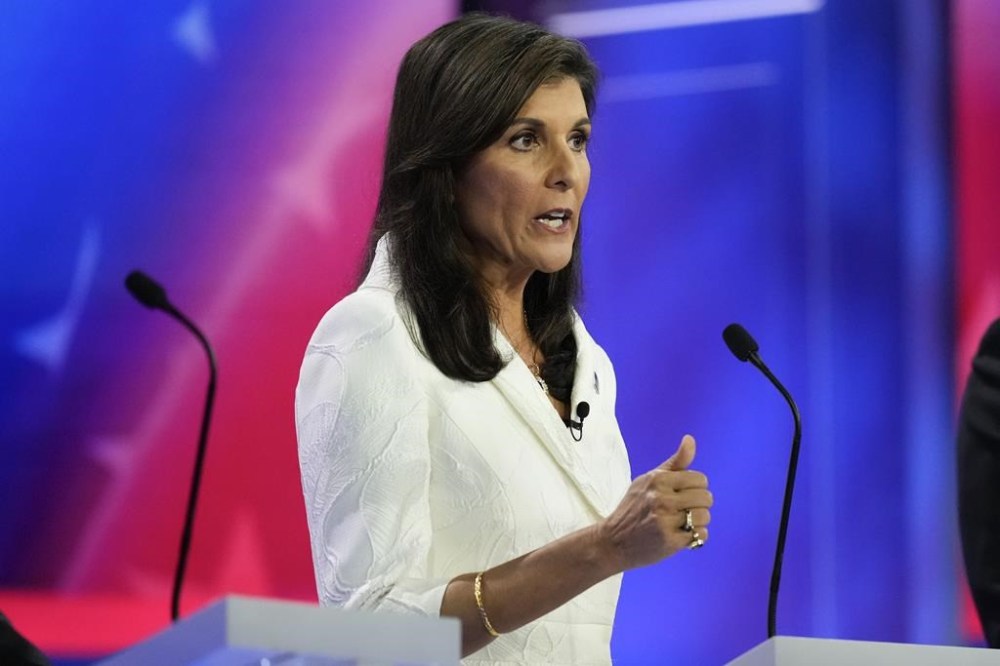
Saying that she fears that social media anonymity could translate into misinformation, Haley said “you’re going to get some civility when people know their name is next to what they say.”
Haley also said Tuesday she would demand access to social media algorithms to understand how various content ends up in front of certain users. She appeared on the Ruthless podcast — alongside a co-host who goes by “ComfortablySmug” online.
“They need to verify every single person on their outlet, and I want it by name,” Haley said, reiterating her previous comments that such a move would weed out foreign-based bot accounts.
Tuesday night, some of Haley’s Republican rivals had begun to critique her proposal online.
“You know who were anonymous writers back in the day? Alexander Hamilton, John Jay, and James Madison when they wrote the Federalist Papers,” DeSantis posted on X, formerly known as Twitter, calling Haley’s proposed ban “dangerous and unconstitutional.”
Others in conservative social media echoed DeSantis’ notion.
“Nice try, Nikki,” posted Charlie Kirk, CEO and co-founder of the conservative youth organization Turning Point USA, also referencing the Federalist Papers’ anonymous authors. “Anonymous speech is a core part of free speech.”
Conservative radio personality Dana Loesch agreed, saying Wednesday on her show that she was against Haley’s argument, despite the fact that Loesch said she has experienced online harassment and even death threats.
“I am still a million percent against government regulation of stuff like this,” Loesch said. “It’s not a free speech position, and it’s not in keeping with the way our country was founded. … It’s a bad argument.”
Entrepreneur Vivek Ramaswamy — with whom Haley has frequently feuded in recent candidate debates, including calling him “scum” after an attack on her daughter for having used TikTok — referenced her idea as “disgusting.”
And replying to Ramaswamy was Elon Musk, the owner of X, formerly known as Twitter. “Super messed up,” Musk wrote. “She can stop pretending to run for president now.”
Under his ownership, Musk has opened up X verification checkmarks to paid users, not just those who previously were required to submit identification, in order to be considered verified. The confusion that ensued after Musk bought the San Francisco company for $44 billion last year raised concerns the platform could lose its status as a purveyor of accurate, up-to-date information from authentic sources, including in emergencies.
By Wednesday, Haley had somewhat amended her stance. Asked on CNBC if she was advocating a ban on all anonymous social media posts, Haley said that, while she believed “life would be more civil if we were able to do that,” she was focused on foreign-based actors, not U.S. citizens.

“I don’t mind anonymous American people having free speech; what I don’t like is anonymous Russians and Chinese and Iranians having free speech,” Haley said, not explaining how she would recommend that social media companies parse those users.
Saying DeSantis “wants to let Chinese propaganda machines run wild on social media without any restrictions,” Haley campaign spokesperson Olivia Perez-Cubas on Wednesday added that the onus should be on social media companies to better police anonymous, foreign-based accounts.
“What Nikki doesn’t support is letting the Chinese and Iranians create anonymous accounts to spread chaos and anti-American filth among our people,” she said. “Social media companies have to do a way better job policing that.”
___
Meg Kinnard can be reached at http://twitter.com/MegKinnardAP