

Biggest solar flare in years temporarily disrupts radio signals on Earth
Advertisement
Read this article for free:
or
Already have an account? Log in here »
To continue reading, please subscribe:
Monthly Digital Subscription
$0 for the first 4 weeks*
- Enjoy unlimited reading on winnipegfreepress.com
- Read the E-Edition, our digital replica newspaper
- Access News Break, our award-winning app
- Play interactive puzzles
*No charge for 4 weeks then price increases to the regular rate of $19.95 plus GST every four weeks. Offer available to new and qualified returning subscribers only. Cancel any time.
Monthly Digital Subscription
$4.99/week*
- Enjoy unlimited reading on winnipegfreepress.com
- Read the E-Edition, our digital replica newspaper
- Access News Break, our award-winning app
- Play interactive puzzles
*Billed as $19.95 plus GST every four weeks. Cancel any time.
To continue reading, please subscribe:
Add Free Press access to your Brandon Sun subscription for only an additional
$1 for the first 4 weeks*
*Your next subscription payment will increase by $1.00 and you will be charged $16.99 plus GST for four weeks. After four weeks, your payment will increase to $23.99 plus GST every four weeks.
Read unlimited articles for free today:
or
Already have an account? Log in here »
Hey there, time traveller!
This article was published 15/12/2023 (751 days ago), so information in it may no longer be current.
CAPE CANAVERAL, Fla. (AP) — A NASA telescope has captured the biggest solar flare in years, which temporarily knocked out radio communication on Earth.
The sun spit out the huge flare on Thursday, resulting in two hours of radio interference in parts of the U.S. and other sunlit parts of the world. Scientists said it was the biggest flare since 2017.
Multiple pilots reported communication disruptions, with the impact felt across the country, said the government’s Space Weather Prediction Center. Scientists are now monitoring this sunspot region and analyzing for a possible outburst of plasma from the sun, also known as a coronal mass ejection, directed at Earth. The eruption occurred in the far northwest section of the sun, according to the center.
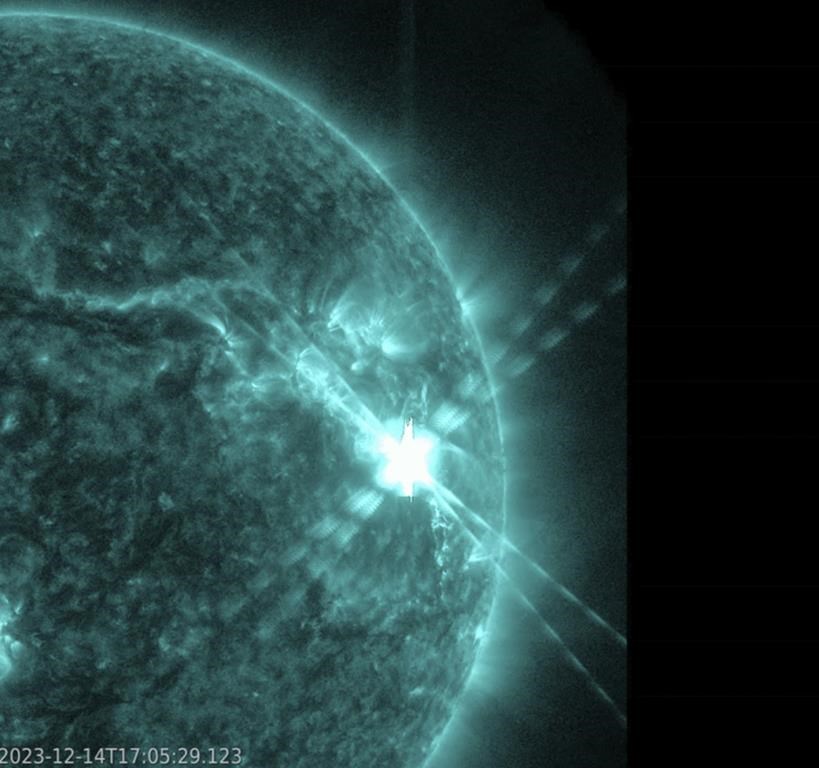
NASA’s Solar Dynamics Observatory caught the action in extreme ultraviolet light, recording the powerful surge of energy as a huge, bright flash. Launched in 2010, the spacecraft is in an extremely high orbit around Earth, where it constantly monitors the sun.
The sun is nearing the peak of its 11-year or so solar cycle. Maximum sunspot activity is predicted for 2025.

___
The Associated Press Health and Science Department receives support from the Howard Hughes Medical Institute’s Science and Educational Media Group. The AP is solely responsible for all content.