Post-flight feast: Study suggests reindeer vision evolved to spot favorite food
Advertisement
Read this article for free:
or
Already have an account? Log in here »
To continue reading, please subscribe:

Digital Subscription
One year of digital access for only $205*
- Enjoy unlimited reading on winnipegfreepress.com
- Read the E-Edition, our digital replica newspaper
- Access News Break, our award-winning app
- Play interactive puzzles
*First annual payment billed as $205.00 + GST for one year. This annual subscription will automatically renew at $233.00 + GST every 52 weeks (10% off the regular annual price of $259.35). Offer available to new and qualified returning subscribers only. Cancel any time.
To continue reading, please subscribe:
Add Free Press access to your Brandon Sun subscription for only an additional
$1 for the first 4 weeks*
- Enjoy unlimited reading on winnipegfreepress.com
- Read the E-Edition, our digital replica newspaper
- Access News Break, our award-winning app
- Play interactive puzzles
*Your next Brandon Sun subscription payment will increase by $1.00 and you will be charged $17.95 plus GST for four weeks. After four weeks, your payment will increase to $24.95 plus GST every four weeks.
Read unlimited articles for free today:
or
Already have an account? Log in here »
Hey there, time traveller!
This article was published 22/12/2023 (974 days ago), so information in it may no longer be current.
CONCORD, N.H. (AP) — Rudolph the red-nosed reindeer may have millions of carrots set out for him on Christmas Eve, but what about the rest of the year?
Finding food in a cold, barren landscape is challenging, but researchers from Dartmouth College in New Hampshire and the University of St. Andrews in Scotland report that reindeer eyes may have evolved to allow them to easily spot their preferred meal.
It’s further evidence that while reindeer are famous for pulling Santa’s sleigh, it’s their vision that really sets them apart, says Nathaniel Dominy, a Dartmouth anthropology professor and co-author of a recent study published in the journal i-Perception.
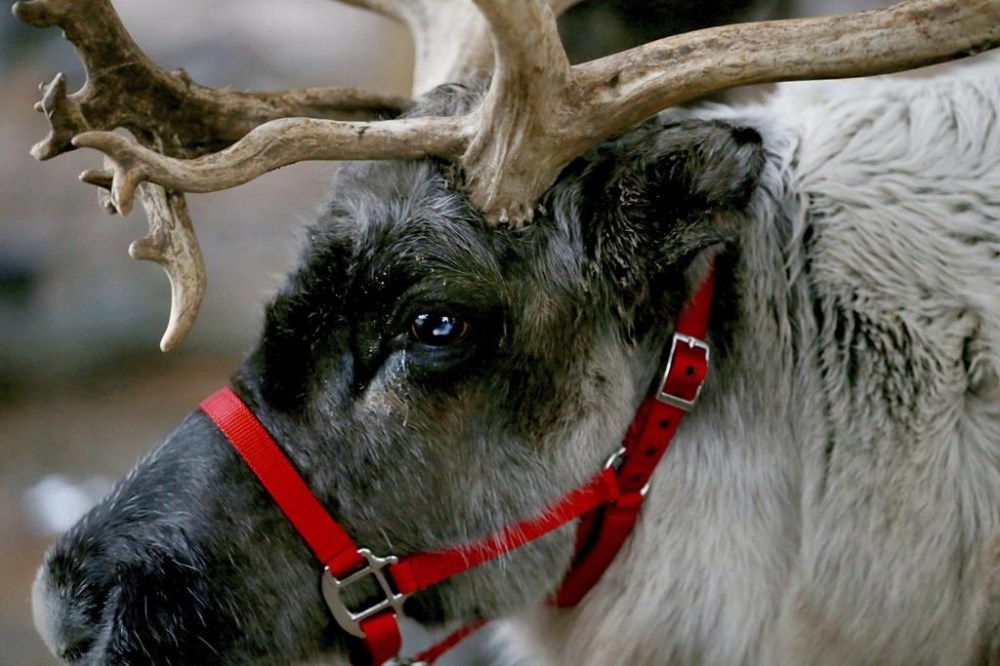
“They’ve been sort of obscure and unheralded in the annals of visual neuroscience, but they’re having their moment because they have a really fascinating visual system,” he said in an interview.
Scientists have known for years that mirror-like tissue in reindeer eyes changes color from a greenish gold in the summer to vivid blue in the winter, a process that is thought to amplify the low light of polar winter. But they weren’t sure what to make of another curious fact: Unlike other mammals, reindeer can see light in the ultraviolet spectrum.
“Most animals that are active under daylight conditions want to avoid UV light. UV light is damaging,” Dominy said. “Snow reflects UV light, which is a problem, which is why humans get snow blindness.”
Some scientists believe reindeer vision evolved to protect the animals from predators, allowing them to spot white wolves against a snowy landscape, for example. The new study points to another possibility: food.
Reindeer subsist largely on light-colored reindeer moss, which isn’t actually a moss but rather a type of lichen that grows in crunchy, carpet-like patches across northern latitudes.
Researchers traveled to the Cairngorms mountains in the Scottish Highlands, which hosts more than 1,500 species of lichen as well as Britain’s only reindeer herd. They found reindeer moss absorbs UV light, meaning the white lichen that humans have trouble seeing against the snow stands out as dark patches to the animals.
“If you’re a reindeer, you can see it and you have an advantage because then you’re not wandering around the landscape. You can walk in a straight line and get to that food, and you conserve energy in the process,” Dominy said. “These animals are desperate for food, and if they can find lichen sufficiently, then they have an advantage.”
Juan Jose Negro specializes in evolutionary ecology and conservation biology at the Spanish Council for Scientific Research. While his focus is mainly on birds of prey, he found the new reindeer research intriguing.
“I love every piece of work dealing with colors and vision,” he said. “Every time I read other people’s works, there is something that sparks new ideas. … And in the case of the reindeer, this is leading me to want to pay more attention to this part of the spectrum.”
While he saw no immediate biomedical benefit to the research, such work is useful in furthering the understanding of how animals deal with difficult environments, he said.

Dominy echoed that point, but said it also has human implications. There has been a lot of pharmacological research on lichens because they have antioxidant properties. Reindeer eyes allowing in UV light suggests there might be some mechanism in place to protect them from damage, he said.
“Reindeer eyes are full of ascorbic acid, or vitamin C, and vitamin C is just terrific for repairing damaged cells,” he said.
With that in mind, Dominy is updating the advice he offered after writing a 2015 paper exploring why a reindeer’s red nose would be ideal for guiding Santa’s sleigh.
Back then, he recommended children leave Rudolph cookies and other high-calorie food to make up for the body heat he loses through his nose. Now, he says, focus on his eyes and save the milk and cookies for Santa.
“The best thing to give them to protect the health of their eyes would be something rich in vitamin C,” he said. “Orange juice, carrots, these would be perfect treats for reindeer on Christmas Eve.”