Coach-to-player comms, sideline tablets tested in bowl games, but some schools decided to hold off
Advertisement
Read this article for free:
or
Already have an account? Log in here »
To continue reading, please subscribe:

Digital Subscription
One year of digital access for only $205*
- Enjoy unlimited reading on winnipegfreepress.com
- Read the E-Edition, our digital replica newspaper
- Access News Break, our award-winning app
- Play interactive puzzles
*First annual payment billed as $205.00 + GST for one year. This annual subscription will automatically renew at $233.00 + GST every 52 weeks (10% off the regular annual price of $259.35). Offer available to new and qualified returning subscribers only. Cancel any time.
To continue reading, please subscribe:
Add Free Press access to your Brandon Sun subscription for only an additional
$1 for the first 4 weeks*
- Enjoy unlimited reading on winnipegfreepress.com
- Read the E-Edition, our digital replica newspaper
- Access News Break, our award-winning app
- Play interactive puzzles
*Your next Brandon Sun subscription payment will increase by $1.00 and you will be charged $17.95 plus GST for four weeks. After four weeks, your payment will increase to $24.95 plus GST every four weeks.
Read unlimited articles for free today:
or
Already have an account? Log in here »
Hey there, time traveller!
This article was published 02/01/2024 (1003 days ago), so information in it may no longer be current.
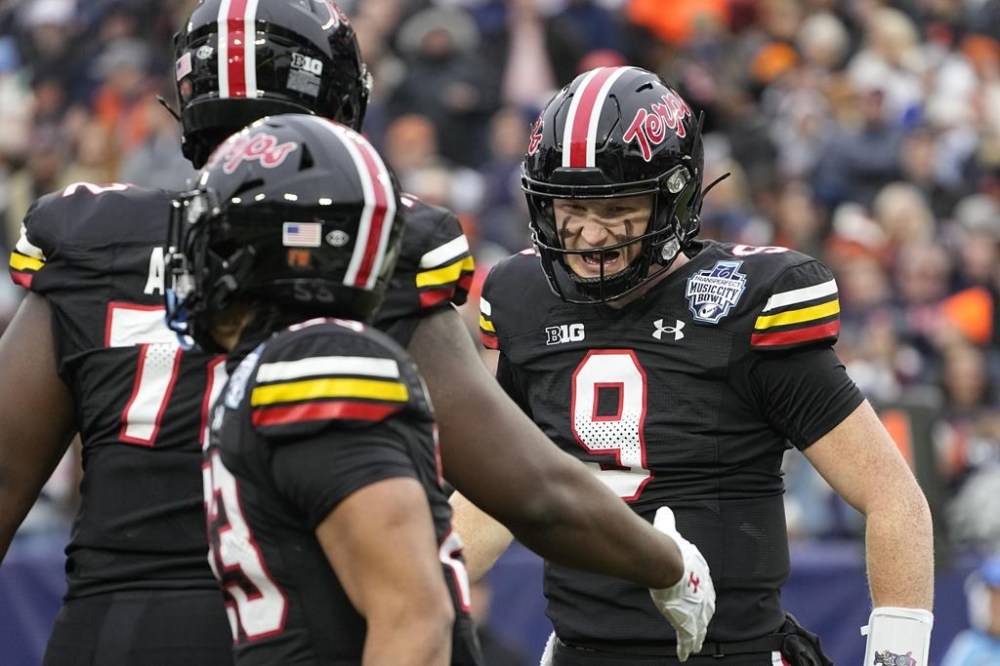
Billy Edwards Jr. became a test pilot of sorts for the type of helmet communication technology that might soon become commonplace in college football.
And the Maryland quarterback was a fan.
“I think overall it was good,” Edwards said after the Terrapins beat Auburn in the Music City Bowl. “On one of my runs down there at the goal line on I think the first or second drive, (offensive coordinator Josh) Gattis is up there, and most times I think I’m thinking the same thing he’s saying, but he was saying they were in like a stick coverage, kind of like a zero look, and he was like, ‘Pull, pull, pull it.’ He just confirmed what I was thinking.”
In the aftermath of the Michigan sign-stealing scandal, the possibility of college teams using NFL-style communication technology has been viewed with a little more urgency. And with non-playoff bowls sometimes looking more like 2024 exhibition games than 2023 postseason games, teams have taken advantage of the opportunity to try out various devices.
Maryland had access to coach-to-player communication technology, as well as sideline tablets showing video of previous plays. The latter created some interesting moments for Terrapins coach Michael Locksley.
“The bad part for me is I was able to see a holding call that I wanted to take it on the field and show the referee, like, ‘Bro you missed this call. What are we doing?’ No, it was great to have that technology,” he said. “I think the way we are as a developmental program it’s such a cool tool to be able to immediately reinforce so that they can see it, and then also when you guys ask me stuff at the end of the game, I can’t say, ‘Well I got to wait to see the film.’”
Virginia Tech was also able to use the tablets in the Military Bowl against Tulane, even though the game was played in a rainstorm. Offensive coordinator Tyler Bowen, formerly a tight ends coach with the Jacksonville Jaguars, said the tablets were actually more useful than what he had in the NFL, since video is better than still shots.
“You’re able to see all the views that you would look at in a film room with the guys,” Bowen said. “In between series, we would take the footage, go through the series, match the play call with it, and then now we can give live feedback to the coaches on the field, and they have the tablets as well to be able to show the players. So I think it allows you to be more detailed with your adjustments.”
The tablets came with obvious benefits, but the communication technology is the more significant innovation in light of all the concerns about sign stealing. It’s been experimental this postseason and not available for playoff games, and some teams in other bowls decided to pass on using it.
Ohio State coach Ryan Day had concerns about adjusting to something new at this stage in the season.
“Down the road it makes a lot of sense,” Day said before his team’s matchup with Missouri in the Cotton Bowl. “But to try to, with everything going on right now, to try to manage a game without having done it all season, we felt like it was probably something we want to have a spring practice and a preseason to work through because of the unintended consequences.”
Another big question is how much communication is too much. Edwards said he was able to hear his coach all the way until the snap.
“You shouldn’t be in someone’s ear for 30 seconds or when they’re standing over the ball. I think that will be a distraction more than a help,” said Arizona coach Jedd Fisch while explaining that his team wouldn’t be using the communication technology in the Alamo Bowl against Oklahoma. “Cut the thing off at 25 seconds, give a coach 15 seconds to talk, then move on. I think if we could do that, get this legislated properly, put it in one person’s helmet, not 11, we have a great chance of being successful here. If we do it the other way, I think it will cause more harm than good.”
For Locksley, part of the reason for using the technology in his bowl was so he could come up with his own preferences on what to do in the future.

“I’m a dinosaur when it comes to emails and iPhones and all that stuff. I guess I’m in the Boomer category,” he said prior to his bowl. “For us, it’s important to see how this works, because if we’re moving toward it, I want to make sure we’ve had an opportunity to practice it, to use it and have a feel, so I can make an educated decision when it comes time my opinion is asked.”
___
AP college football: https://apnews.com/hub/college-football and https://apnews.com/hub/ap-top-25-college-football-poll
___
AP Sports Writers Stephen Hawkins, John Marshall and Teresa M. Walker contributed to this report.