How Taiwan beat back disinformation and preserved the integrity of its election
Advertisement
Read this article for free:
or
Already have an account? Log in here »
To continue reading, please subscribe:

Digital Subscription
One year of digital access for only $205*
- Enjoy unlimited reading on winnipegfreepress.com
- Read the E-Edition, our digital replica newspaper
- Access News Break, our award-winning app
- Play interactive puzzles
*First annual payment billed as $205.00 + GST for one year. This annual subscription will automatically renew at $233.00 + GST every 52 weeks (10% off the regular annual price of $259.35). Offer available to new and qualified returning subscribers only. Cancel any time.
To continue reading, please subscribe:
Add Free Press access to your Brandon Sun subscription for only an additional
$1 for the first 4 weeks*
- Enjoy unlimited reading on winnipegfreepress.com
- Read the E-Edition, our digital replica newspaper
- Access News Break, our award-winning app
- Play interactive puzzles
*Your next Brandon Sun subscription payment will increase by $1.00 and you will be charged $17.95 plus GST for four weeks. After four weeks, your payment will increase to $24.95 plus GST every four weeks.
Read unlimited articles for free today:
or
Already have an account? Log in here »
Hey there, time traveller!
This article was published 26/01/2024 (986 days ago), so information in it may no longer be current.
WASHINGTON (AP) — The rumors about vote fraud started swirling as the ballots in Taiwan’s closely watched presidential election were tallied on Jan. 13. There were baseless claims that people had fabricated votes and that officials had miscounted and skewed the results.
In a widely shared video, a woman recording votes mistakenly enters one in the column for the wrong candidate. The message was clear: The election could not be trusted. The results were faked.
It could have been Taiwan’s Jan. 6 moment. But it wasn’t.
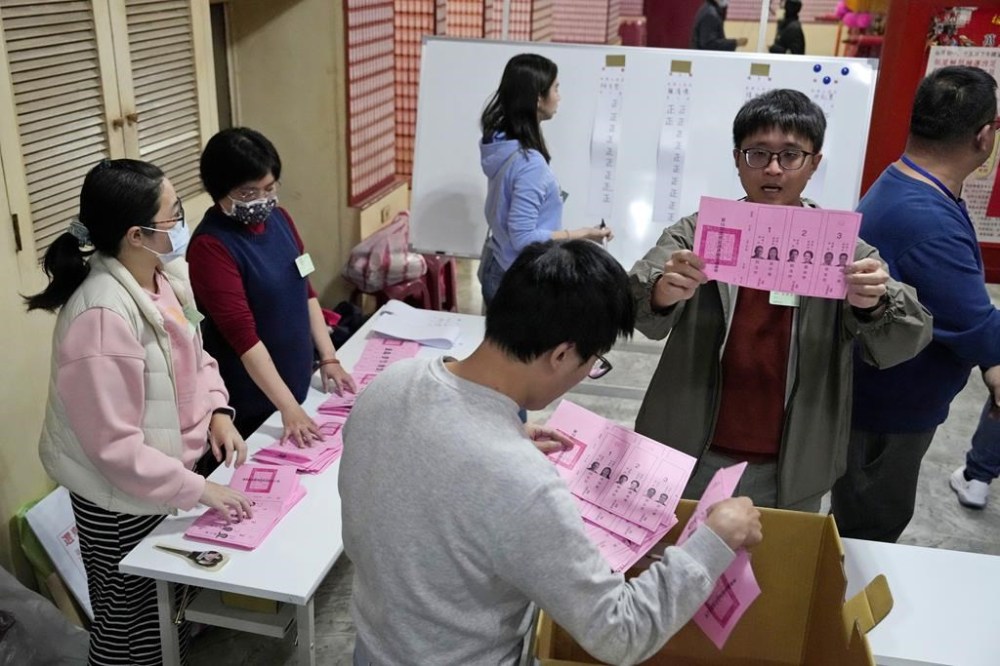
Worries that China would use disinformation to undermine the integrity of Taiwan’s vote dogged the recent election, a key moment in the young democracy’s development that highlighted tensions with its much larger neighbor.
In repelling disinformation, Chinese and domestic, Taiwan offers an example to other democracies holding elections this year.
This year , more than 50 countries that are home to half the planet’s population are due to hold national elections. From India to Mexico, the U.K. to Russia, the outcomes of the elections will test the strengths of democracies and countries with authoritarian leaders.
In Taiwan, the response to disinformation was swift. Fact-checking groups debunked the rumors, while the Central Election Commission held a news conference to push back on claims of electoral discrepancies. Influencers like @FroggyChiu with more than 600,000 subscribers also put out explainers on YouTube explaining how votes are tallied.
The video showing the election worker miscounting votes had been selectively edited, fact-checkers found. Voters at the voting station spotted the woman’s error and election workers quickly corrected the count, according to MyGoPen, an independent Taiwanese fact-checking chatbot.
It was just one of dozens of videos that fact checkers had to debunk.
“I believe some people genuinely believed this. And when the election results came out, they thought something was up,” said Eve Chiu, the editor-in-chief of Taiwan’s FactCheck Center, a nonprofit journalism organization.
Lai Ching-te of the incumbent Democratic Progressive Party won the election on Jan. 13 against Ko Wen-je of the Taiwan People’s Party and Hou Yu-ih of the Nationalist Party (Kuomingtang), in an election that was seen as a referendum on the island’s relationship with China.
Supporters of the Taiwan People’s Party presidential candidate, many of whom are young, had shared the videos widely on TikTok, which were then shared on Facebook. Prior to the election results, many thought there was a chance of a Ko upset in the race given the candidate had drawn a lot of online attention. Taiwan’s FactCheck Center debunked multiple videos of alleged voter fraud, including another one in which voting officials make a human error caught on camera. The source of these videos is unclear.
Notably, Taiwan has resisted calls for tougher laws that would require social media platforms to police their sites; a proposal to institute such rules was withdrawn in 2022 after free speech concerns were raised.
China, which claims Taiwan as its own, targeted the island with a stream of disinformation ahead of its election, according to research from DoubleThink Lab.
Much of it sought to undermine faith in the incumbent Democratic Progressive Party and cast it as belligerent and likely to start a war that Taiwan can’t win. Other narratives targeted U.S. support for Taiwan, arguing that America was an untrustworthy partner only interested in Taiwan’s semiconductor exports that wouldn’t support the island if it came to war with China.
Messages left with the Chinese embassy in Washington were not immediately returned Saturday.
Taiwan has been able to effectively respond to Chinese disinformation in part because of how seriously the threat is perceived there, according to Kenton Thibaut, a senior resident fellow and expert on Chinese disinformation at the Atlantic Council’s Digital Forensic Research Lab. Instead of a piecemeal approach — focusing solely on media literacy, for instance, or relying only on the government to fact-check false rumors — Taiwan adopted a multifaceted approach, what Thibaut called a “whole of society response” that relied on government, independent fact-check groups and even private citizens to call out disinformation and propaganda.
In an interview with The Associated Press, Alexander Tah-Ray Yui, Taipei’s economic and cultural representative to the U.S., said the government has learned it must identify and debunk false information as quickly as possible in order to counter false narratives. Yui is Taiwan’s de facto ambassador to the U.S.
“Find it early, like a tumor or cancer. Cut it before it spreads,” Yui said of foreign disinformation.
Taiwan’s civil society groups like MyGoPen and the Taiwan FactCheck Center, which received $1 million in funding from Google, have focused on raising public awareness through debunking individual rumors that members of the public report.
The island has a strong civil society. Many of the fact-checker groups were founded by dedicated individuals, such as MyGoPen, whose founder Charles Yeh started the chatbot service because he found his relatives would get confused by online rumors. Others like, Taiwan FactCheck Center, are careful to not take government money so as to preserve their independence, said Chiu.
Media literacy on fake news and the digital environment is growing, those on the front lines say, but slowly.
“It’s like in the past when everyone dumped bottles and cans in the garbage and now they sort them, that was done through a period of societal education,” said Chiu. “Everyone needs to slowly develop this awareness, and this needs time.”
In the U.S., government efforts to call out disinformation have themselves become politicized and criticized as government censorship or thought control.
With a population more than 10 times the size of Taiwan and years of growing polarization, the U.S. has deep, internal political and social fault lines that create good conditions for disinformation to take root — and make it harder for the government to push back without being accused of censoring legitimate political views.
In the United States, many of the narratives spread by Russia, for instance, are eagerly adopted by domestic groups that distrust the government. Donald Trump, the former president, and other Republicans have repeatedly made similar claims about the U.S. as those carried by Russian state media, for example.
“We have a dynamic in American politics where if you’re Russia, China or Iran, you don’t have to inject divisive topics, because they’re already here,” said Jim Ludes, a former national defense analyst who now leads the Pell Center for International Relations at Salve Regina University.
“The call is coming from inside the house,” he said, using a popular horror film metaphor.
That dynamic can also be seen in Taiwan. Although Ko, the presidential candidate, said publicly he didn’t believe there was election fraud, legislators from the TPP held a conference Wednesday in which they shared videos of miscounting that had spread online, which had already been debunked, to call for greater adherence to voting regulations.

Though the election passed without a major crisis, the challenge continues to evolve. Chinese efforts at disinformation have become increasingly localized and sophisticated, according to DoubleThink Lab’s post-election analysis.
In one example, a Chinese-run Facebook page called C GaChuDao made a video describing an affair that it said a DPP legislator had with a woman from China. Unlike in years past, where Chinese disinformation was easily recognized and mocked for its use of simplified characters and vocabulary from China, this video featured a man speaking with a Taiwanese accent and in a way that appeared completely local.
“In picking topics, they’d pick something that exists in your society, and then it’s relatively more convincing,” said Wu Min Hsuan, the co-founder of Doublethink Lab.
___
Wu reported from Bangkok. Associated Press writer Didi Tang contributed to this report.
Related Articles
The deliberate undermining of news
Advertisement Advertise With Us
Advertisement Advertise With Us