Canada signs letter of intent with AI giant Nvidia during CEO’s Toronto trip
Advertisement
Read this article for free:
or
Already have an account? Log in here »
To continue reading, please subscribe:

Digital Subscription
One year of digital access for only $205*
- Enjoy unlimited reading on winnipegfreepress.com
- Read the E-Edition, our digital replica newspaper
- Access News Break, our award-winning app
- Play interactive puzzles
*First annual payment billed as $205.00 + GST for one year. This annual subscription will automatically renew at $233.00 + GST every 52 weeks (10% off the regular annual price of $259.35). Offer available to new and qualified returning subscribers only. Cancel any time.
To continue reading, please subscribe:
Add Free Press access to your Brandon Sun subscription for only an additional
$1 for the first 4 weeks*
- Enjoy unlimited reading on winnipegfreepress.com
- Read the E-Edition, our digital replica newspaper
- Access News Break, our award-winning app
- Play interactive puzzles
*Your next Brandon Sun subscription payment will increase by $1.00 and you will be charged $17.95 plus GST for four weeks. After four weeks, your payment will increase to $24.95 plus GST every four weeks.
Read unlimited articles for free today:
or
Already have an account? Log in here »
Hey there, time traveller!
This article was published 02/02/2024 (976 days ago), so information in it may no longer be current.
TORONTO – Industry Minister François-Philippe Champagne says Canada has signed a letter of intent with artificial intelligence chip giant Nvidia to boost computing power.
In a post on X, formerly known as Twitter, the minister announced the document was signed with the California-based powerhouse, which recently saw the race to innovate with AI push its valuation past the $1.5 trillion mark.
Neither party revealed the contents of the letter during Nvidia chief executive Jensen Huang’s trip to Toronto on Thursday.
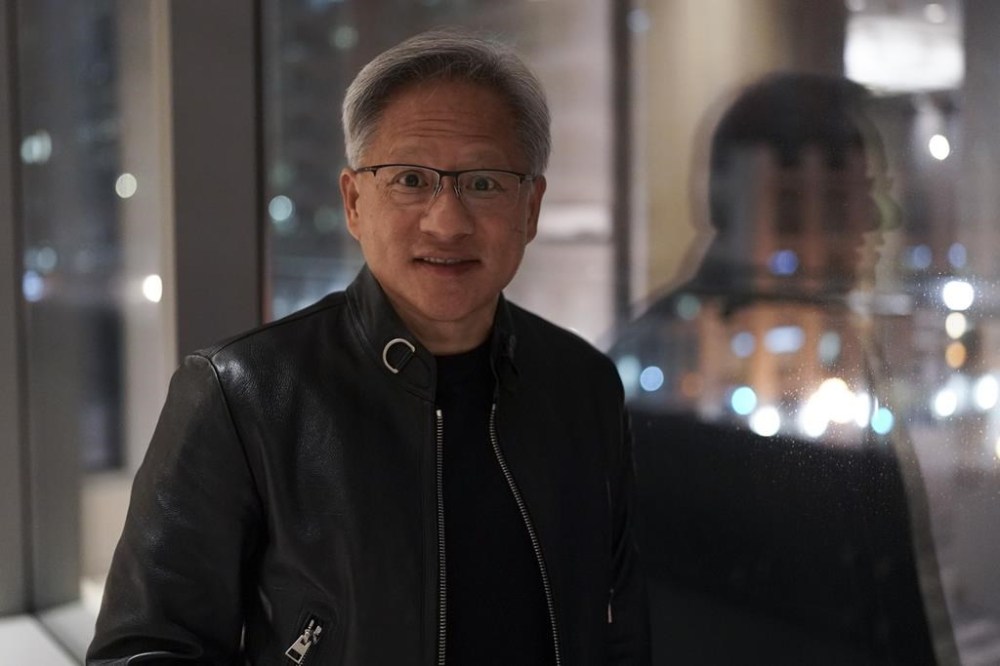
“Minister Champagne wants my support to ensure that Canada can have access to leading edge technology so that it could, with necessary funding, build its own infrastructure and I’m very enthusiastic about that,” Huang told The Canadian Pressin an interview late Thursday.
“We’ve been a partner of Canada since the beginning of deep learning … and so this is a very important region for us to invest in, a very important country for us to invest in.”
Canada is not alone in prioritizing AI infrastructure. Huang said Japan, South Korea, Malaysia, Singapore, Britain, France and Italy are all attuned to the topic.
The opportunity facing Canada, however, is unique.
Huang considers Canada the birthplace of modern AI because two “godfathers” of the technology, Yoshua Bengio and Geoffrey Hinton, long completed AI research in the country. The two eventually won the prestigious A.M. Turing Award — often called “the Nobel Prize of computing” — with Yann LeCun.
Bengio and Hinton have since set up AI research hubs, the Vector Institute in Toronto and Mila in Montreal.
“Canada has such deep and quite significant in scale AI research, between Montreal and Toronto,” Huang said.
“Don’t squander that and make sure that these researchers have the instruments they need, the funding they need to continue to advance the science they, in a lot of ways, invented.”
Wearing his signature black leather jacket, Huang spoke to a Canadian Press reporter at the Four Seasons Hotel in Toronto while he dined on sushi and sliders.
Earlier, he shared a stage before an invite-only crowd with Raquel Urtasun of autonomous driving company Waabi, Aidan Gomez from AI darling Cohere, Alán Aspuru-Guzik of the Vector Institute and Brendan Frey from drug discovery firm Deep Genomics.
“There are a lot of different things that we have to do in order to accelerate the ecosystem here in Canada,” Huang told the audience.
“Part of it requires the encouragement and support of government, part of it is about inspiring a young researcher to continue to do research here in Canada, and part of it is about creating the opportunities for them … after they graduate.”
He emphasized Canada doesn’t lack research or talent — an observation shared by Stephen Toope, president of the Canadian Institute for Advanced Research.
However, Toope pointed out Canada’s global ranking on AI talent had slipped over the past few years, according to a report from U.K. firm Tortoise. It’s ranking on AI capacity, which measures a nation’s AI adoption and development capabilities, also dipped.
Its AI infrastructure ranking fell from 15 to 23 between 2021 and 2023, which concerns Toope.
“My fear is that we could reach a point where the people who we brought here and retained here actually can’t do the work they want to do because they don’t have access to the computing power,” Toope said.
Computing power includes power sources, data centres and chips.
Most chips come from the Taiwan Semiconductor Manufacturing Company, which counts Apple and Nvidia as customers. (Nvidia, which Huang co-founded in 1993, designs graphics processing units — cards that enhance the performance and quality of gaming and creative applications — but often uses third parties to manufacture them.)
Many feel it’s unlikely Canada, which lacks major foundries, could ever seriously rival Taiwan Semiconductor.
“Quite frankly, Canada is not in the short term, or even the medium term, likely to build out massive capacity to produce the kind of chips that are required for AI,” Toope said.
“It’s just too complicated, too expensive.”
A 2021 report from Canada’s Semiconductor Council found fabrication facilities for semiconductors, also known as chips, can cost about US$5 billion in land, equipment and materials, and advanced logic and memory factories can reach US$20 billion.
“Canada doesn’t have to advance chips. There are so many companies that build chips,” Huang said.
Rather than make chips, Toope is pushing for the country to adopt a purchasing consortium backstopped by the Canadian government — but including public and private actors — that could all work together to help the country more efficiently procure computing capacity.
“It’s not making its own chips, but it’s a kind of sovereignty because we’ve got a guaranteed supply,” he said.
This report by The Canadian Press was first published Feb. 2, 2024.