A brazen iPhone scam in Iran reflects its economic struggles and tensions with the West
Advertisement
Read this article for free:
or
Already have an account? Log in here »
To continue reading, please subscribe:
Digital Subscription
One year of digital access for only $1.44 a week*
- Enjoy unlimited reading on winnipegfreepress.com
- Read the E-Edition, our digital replica newspaper
- Access News Break, our award-winning app
- Play interactive puzzles
*Billed as $5.77 plus GST every four weeks. After 52 weeks, price increases to the regular rate of $19.95 plus GST every four weeks. Offer available to new and qualified returning subscribers only. Cancel any time.
To continue reading, please subscribe:
Add Free Press access to your Brandon Sun subscription for only an additional
$1 for the first 4 weeks*
- Enjoy unlimited reading on winnipegfreepress.com
- Read the E-Edition, our digital replica newspaper
- Access News Break, our award-winning app
- Play interactive puzzles
*Your next Brandon Sun subscription payment will increase by $1.00 and you will be charged $17.95 plus GST for four weeks. After four weeks, your payment will increase to $24.95 plus GST every four weeks.
Read unlimited articles for free today:
or
Already have an account? Log in here »
Hey there, time traveller!
This article was published 28/02/2024 (965 days ago), so information in it may no longer be current.
TEHRAN, Iran (AP) — With flashy celebrity ads and promises of deep discounts, a shop in Iran’s capital had offered consumers in the Islamic Republic one of the hottest products in the country — an iPhone that came out in 2021.
But instead of getting their hands on the handsets, police and prosecutors in Iran allege customers found themselves ensnared by a business owner running a multimillion-dollar Ponzi scheme.
Yet the controversy surrounding the Kourosh, or “Son of the Sun,” Company extends far beyond just the alleged scheme.
It’s a sign of the economic woes plaguing Iran after decades of Western sanctions, now accelerating as Tehran rapidly advances its nuclear program, helps arm Russia in Moscow’s war on Ukraine, steps up support for proxy militias in the Middle East and violently cracks down on dissent ahead of parliamentary elections on Friday.
When the government last year banned Apple’s iPhone 14 and 15 from the Islamic Republic, the ban spurred a parallel economy for the older handsets, jacking up prices for the devices as many sought to put their depreciating Iranian rials into any physical commodity.
And even though Supreme Leader Ayatollah Ali Khamenei has denounced American luxury goods amid years of tensions with the West, consumers still want the phones and the prestige associated with them.
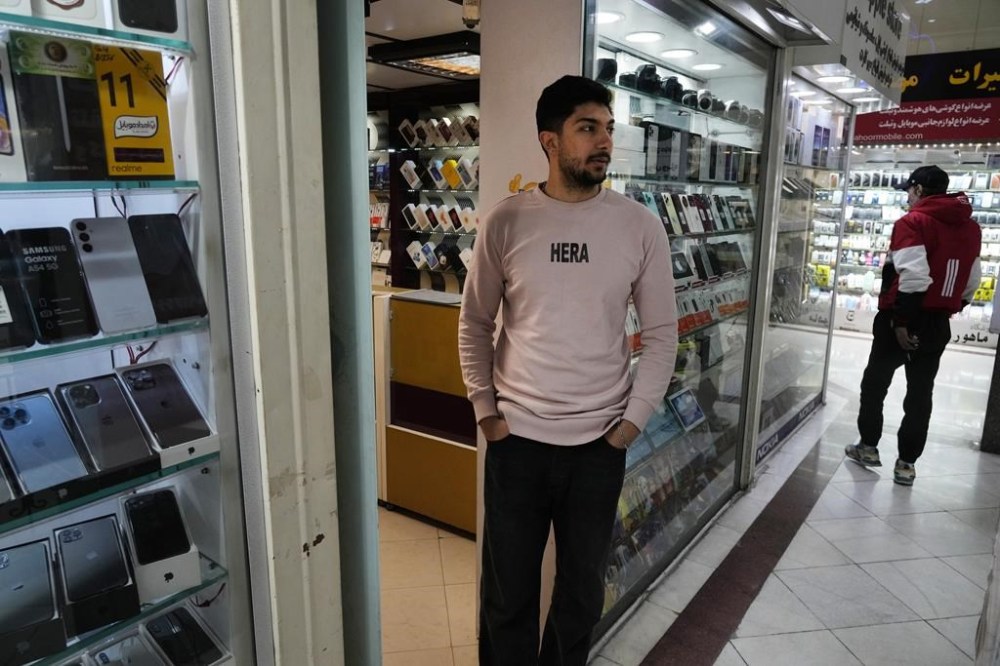
“There is a lot of demand,” said Aram, a mobile phone shop keeper in Tehran who gave only her first name for fear of retaliation. Her customers keep asking for the “latest couple of iPhone models” — the ones that are banned.
“If they could allow legal imports … it would be much better,” she said.
In shops across Iran, iPhone 13s range in price starting from $330 for refurbished models to $1,020 for those still in the box — shiny and new, though still not quite the coveted iPhone 15 now available elsewhere in the world.
Even if you bring an iPhone 14 or 15 model into the country, it will stop working on the Iran’s state-controlled mobile phone networks after one month, the time span for tourists who visit the county.
Imports of iPhones have long been a contentious point — government statistics suggest that about a third of Iran’s entire $4.4 billion mobile phone import market consisted of iPhones before the ban.
The private companies that import mobile phones have access to government-set exchange rates far lower than the rate of 580,000 rials to $1 in exchange offices, making the business that much more lucrative.
At the time of Iran’s 2015 nuclear deal with world powers, the exchange rate was 32,000 rials for $1.
Khamenei pointedly criticized the iPhone imports in remarks to government ministers in August 2020.
“Excessive imports are something dangerous,” Khamenei said at the time, according to a transcript on his official website. “Sometimes this import is a luxury product, meaning there is no need for it. I’ve heard about half a billion dollars were spent to import one type of American luxury cellphone.”
But the demand is still there and iPhones remain a status symbol for many young Iranians.
“I prefer the iPhone to any other phone, at any price, because it cannot be compared to any other brand in terms of luxury,” said Ehsan Ehsani, a 23-year-old architecture student in Tehran.
Rules on importing iPhones into Iran were always tough.
The phones could only be brought in individually by travelers, who would then register them at the country’s entry point, declaring the iPhone was for personal use. At customs, people would give their passport numbers and pay a fee of 22.5% of the phone’s price, as determined by the government or possibly a sales receipt.
This sparked a side business where iPhone traders would wait for passengers at the airport and pay them in exchange for getting their permission to use their passport numbers to register iPhones in their stock.
Navid Bahmani, a 26-year-old who works in an iPhone shop in Tehran, said he would usually pay travelers up to $40 for their passport numbers at Tehran’s Imam Khomeini International Airport.
“The price depends on the travelers,” Bahmani said. “Some of them accept the first offer, some of them not.”
Apple, based in Cupertino, California, did not respond to a request for comment.
Iran’s economic problems have also played into schemes such as that of Kourosh, curiously also the name of the Persian throne under Cyrus the Great.
Inflation has overtaken any interest rate offered by a bank, while depreciation also has gnawed away at people’s savings. As a result, many seek to buy a physical asset, whether a home, jewelry or even a car to protect against losses.
That’s where the Kourosh Company came in.
The company offered iPhone 13s starting from the equivalent of $360 — if you were willing to pay first and wait for a few weeks before receiving the device. Celebrities in Iran appeared in online ads for the firm, drawing even more attention.
Some customers initially received their iPhones, further fueling the frenzy surrounding the shop. The reformist newspaper Shargh estimated that the company made $36 million in less than a year, though officials have not confirmed that.
Then the iPhones dried up.
Kourosh’s 27-year-old CEO and the alleged mastermind of the scheme, Amirhossein Sharifian, suddenly left Iran in September — and is still on the run — with millions in dollars of payments, Iranian authorities say.
Sharifian could not be reached by The Associated Press for comment, though a company employee insisted in an online video posted two weeks ago that a supply chain issues was causing the delay in iPhone deliveries.
Iranian police spokesman Gen. Saeed Montazeralmehdi said investigators are still after Sharifian.
Despite the fracas, customers keep lining up outside the shop, including on a recent below-freezing day in Tehran.
“I paid for nine (iPhones),” said Moteza Zarei, 47, who runs a car repair shop. “I found it a good way to increase my investment. But I got none.”
___
Associated Press journalists Amir Vahdat and Mehdi Fattahi in Tehran, Iran, contributed to this report.