Our ancient animal ancestors had tails. Why don’t we?

Advertisement

Advertise with us

WASHINGTON (AP) — Our very ancient animal ancestors had tails. Why don't we?

Read this article for free:


or

Already have an account? Log in here »

To continue reading, please subscribe:

Subscribe and receive a limited-edition Free Press branded hat or tote.

Digital Subscription

One year of digital access for only $205*

  • Enjoy unlimited reading on winnipegfreepress.com
  • Read the E-Edition, our digital replica newspaper
  • Access News Break, our award-winning app
  • Play interactive puzzles

*First annual payment billed as $205.00 + GST for one year. This annual subscription will automatically renew at $233.00 + GST every 52 weeks (10% off the regular annual price of $259.35). Offer available to new and qualified returning subscribers only. Cancel any time.

To continue reading, please subscribe:

Add Free Press access to your Brandon Sun subscription for only an additional

$1 for the first 4 weeks*

  • Enjoy unlimited reading on winnipegfreepress.com
  • Read the E-Edition, our digital replica newspaper
  • Access News Break, our award-winning app
  • Play interactive puzzles
Start now

*Your next Brandon Sun subscription payment will increase by $1.00 and you will be charged $17.95 plus GST for four weeks. After four weeks, your payment will increase to $24.95 plus GST every four weeks.

Hey there, time traveller!
This article was published 28/02/2024 (906 days ago), so information in it may no longer be current.

WASHINGTON (AP) — Our very ancient animal ancestors had tails. Why don’t we?

Somewhere around 20 million or 25 million years ago, when apes diverged from monkeys, our branch of the tree of life shed its tail. From Darwin’s time, scientists have wondered why — and how — this happened.

Now, researchers have identified at least one of the key genetic tweaks that led to this change.
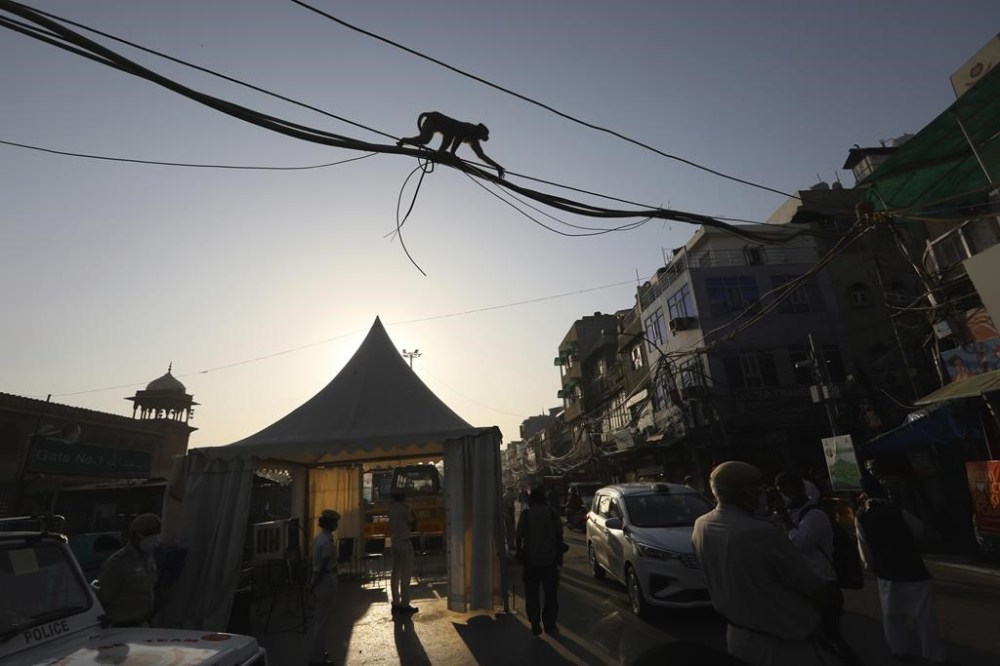
FILE - A monkey walks across power cables near the Jama Mosque in the old quarters of New Delhi, India, Monday, May 25, 2020. Humans’ ancient ancestors had tails, as most vertebrates still do. But somewhere around 20 or 25 million years ago, when apes diverged from monkeys, our branch of the tree of life shed its back appendage. In a paper published in the journal Nature on Wednesday, Feb. 28, 2024, researchers identify at least one of the key genetic tweaks that led to this change. (AP Photo/Manish Swarup, File)

“We found a single mutation in a very important gene,” said Bo Xia, a geneticist at the Broad Institute and co-author of a study published Wednesday in the journal Nature.

The researchers compared the genomes of six species of apes, including humans, and 15 species of monkeys with tails to pinpoint key differences between the groups. Once they identified a significant mutation, they tested their theory by using the gene-editing tool CRISPR to tweak the same spot in mouse embryos. Those mice were born without tails.

Xia cautioned that other genetic changes may also play a role in losing tails.

Another mystery: Did having no tails actually help these ape ancestors — and eventually, humans — survive? Or was it just a chance mutation in a population that thrived for other reasons?

“It could be random chance, but it could have brought a big evolutionary advantage,” said Miriam Konkel, an evolutionary geneticist at Clemson University, who was not involved in the study.

As to why having no tails may have helped, there are many tantalizing theories — including some that link being tailless to humans eventually learning to walk upright.

Rick Potts, who directs the Smithsonian Institution’s Human Origins Project and was not involved in the research, suggests being tailless may have been a first step toward some apes adopting a vertical body posture, even before they left the trees.

Not all apes live on the ground today. Orangutans and gibbons are tailless apes that still live in trees. But Potts notes that they move very differently than monkeys, who scamper along the tops of branches, using their tails for balance. Those apes hang below branches, swinging between them while hanging largely upright.

New York University biologist Itai Yanai, a co-author of the study, said that losing our tails was clearly a major transition. But the only way to certainly know the reason “would be to invent a time machine,” he said.

___

The Associated Press Health and Science Department receives support from the Howard Hughes Medical Institute’s Science and Educational Media Group. The AP is solely responsible for all content.

Report Error Submit a Tip

More Stories

Silver linings at Canadian Lawn Bowling Championships

Grace Penner 1 minute read Preview

Silver linings at Canadian Lawn Bowling Championships

Grace Penner 1 minute read 2:01 AM CDT

There were multiple Manitoban bowls players in the 2026 Canadian Lawn Bowling Championships last week.

Sam Forrest placed silver in the U18 boys’ Canadian Youth and Junior Championships in Hanover, Ont., that was held from Aug. 10-14.

And in the North Vancouver, B.C., leg of the championships that was held Aug. 16-23, the 13-year-old competed with his grandfather, John Bjornson, as well as Rod Rose and Wayne Trindall in the men’s fours. Forrest was honoured with the Spirit Award.

Women’s pairs Shirley Fitzpatrick-Wong and her mother Clarice Fitzpatrick won silver falling short to the B.C. duo they faced.

Read
2:01 AM CDT

City inundated with thousands of complaints after launch of new transit system

Morgan Modjeski 11 minute read Preview

City inundated with thousands of complaints after launch of new transit system

Morgan Modjeski 11 minute read Yesterday at 12:25 PM CDT

Despite complaints from thousands of dissatisfied users, Winnipeg hasn't hit the brakes on the rollout of its new primary transit network. And it appears that ignoring the public response cost Winnipeg Transit millions of dollars in lost revenue and ridership.

Read
Yesterday at 12:25 PM CDT

Ready to crack over late-night ‘snacks’

Maureen Scurfield 4 minute read Yesterday at 2:00 AM CDT

DEAR MISS LONELYHEARTS: My new love has a seriously annoying habit that could break us up now that we’re actually living together.

I’m not getting much sleep, and it has nothing to do with having too much sex! Every night at about 2 a.m., my man gets up and goes to the fridge, makes a giant sandwich and pours a huge glass of apple juice, then sits there scarfing it down, with music on for a bit of entertainment. This often wakes me up, and when I complain he just invites me to join him “for a bite.”

Really? The last thing I need is to eat a fourth meal of the day in the middle of the night. He says it’s an old habit from his football days, when he was so hungry all the time and he still enjoys it. He says he isn’t about to change that for me, so, tough luck.

It’s a big problem as I can’t just fall back to sleep after he rattles around the kitchen and then comes back and jumps back into bed with me.

Winnipegger just one shot off the lead after opening round at Manitoba Open

Mike McIntyre 6 minute read Preview

Winnipegger just one shot off the lead after opening round at Manitoba Open

Mike McIntyre 6 minute read Thursday, Aug. 20, 2026

Braxton Kuntz began the week not knowing if he’d even be able to play in the Manitoba Open.

The 22-year-old Winnipegger will head to Elmhurst early Friday morning just one shot off the lead — hanging tough with the heavyweights from PGA Tour Americas — after firing a fantastic five-under 65 Thursday afternoon.

“Playing in front of friends, family, a nice gallery watching out there…to start out like that, I’m putting myself in contention,” said Kuntz.

He didn’t realize just how close he was until the Free Press informed him that only Kentucky’s Drew Doyle, who has already won on tour earlier this season, had posted a better score among the 156-player field. Doyle shot a six-under 64.

Read
Thursday, Aug. 20, 2026

Executive exodus continues at Shared Health with three recent departures

Chris Kitching 5 minute read Preview

Executive exodus continues at Shared Health with three recent departures

Chris Kitching 5 minute read Updated: Yesterday at 4:18 PM CDT

Manitoba’s provincial health authority is looking for its fourth chief financial officer since 2023 and additional replacements after the recent departures of three executives.

Read
Updated: Yesterday at 4:18 PM CDT

Our ancient animal ancestors had tails. Why don’t we?

Christina Larson, The Associated Press 3 minute read Preview

Our ancient animal ancestors had tails. Why don’t we?

Christina Larson, The Associated Press 3 minute read Wednesday, Feb. 28, 2024

WASHINGTON (AP) — Our very ancient animal ancestors had tails. Why don't we?

Somewhere around 20 million or 25 million years ago, when apes diverged from monkeys, our branch of the tree of life shed its tail. From Darwin's time, scientists have wondered why — and how — this happened.

Now, researchers have identified at least one of the key genetic tweaks that led to this change.

“We found a single mutation in a very important gene,” said Bo Xia, a geneticist at the Broad Institute and co-author of a study published Wednesday in the journal Nature.

Read
Wednesday, Feb. 28, 2024