Our ancient animal ancestors had tails. Why don’t we?

Advertisement

Advertise with us

WASHINGTON (AP) — Our very ancient animal ancestors had tails. Why don't we?

Read this article for free:


or

Already have an account? Log in here »

To continue reading, please subscribe:

Subscribe and receive a limited-edition Free Press branded hat or tote.

Digital Subscription

One year of digital access for only $205*

  • Enjoy unlimited reading on winnipegfreepress.com
  • Read the E-Edition, our digital replica newspaper
  • Access News Break, our award-winning app
  • Play interactive puzzles

*First annual payment billed as $205.00 + GST for one year. This annual subscription will automatically renew at $233.00 + GST every 52 weeks (10% off the regular annual price of $259.35). Offer available to new and qualified returning subscribers only. Cancel any time.

To continue reading, please subscribe:

Add Free Press access to your Brandon Sun subscription for only an additional

$1 for the first 4 weeks*

  • Enjoy unlimited reading on winnipegfreepress.com
  • Read the E-Edition, our digital replica newspaper
  • Access News Break, our award-winning app
  • Play interactive puzzles
Start now

*Your next Brandon Sun subscription payment will increase by $1.00 and you will be charged $17.95 plus GST for four weeks. After four weeks, your payment will increase to $24.95 plus GST every four weeks.

Hey there, time traveller!
This article was published 28/02/2024 (947 days ago), so information in it may no longer be current.

WASHINGTON (AP) — Our very ancient animal ancestors had tails. Why don’t we?

Somewhere around 20 million or 25 million years ago, when apes diverged from monkeys, our branch of the tree of life shed its tail. From Darwin’s time, scientists have wondered why — and how — this happened.

Now, researchers have identified at least one of the key genetic tweaks that led to this change.
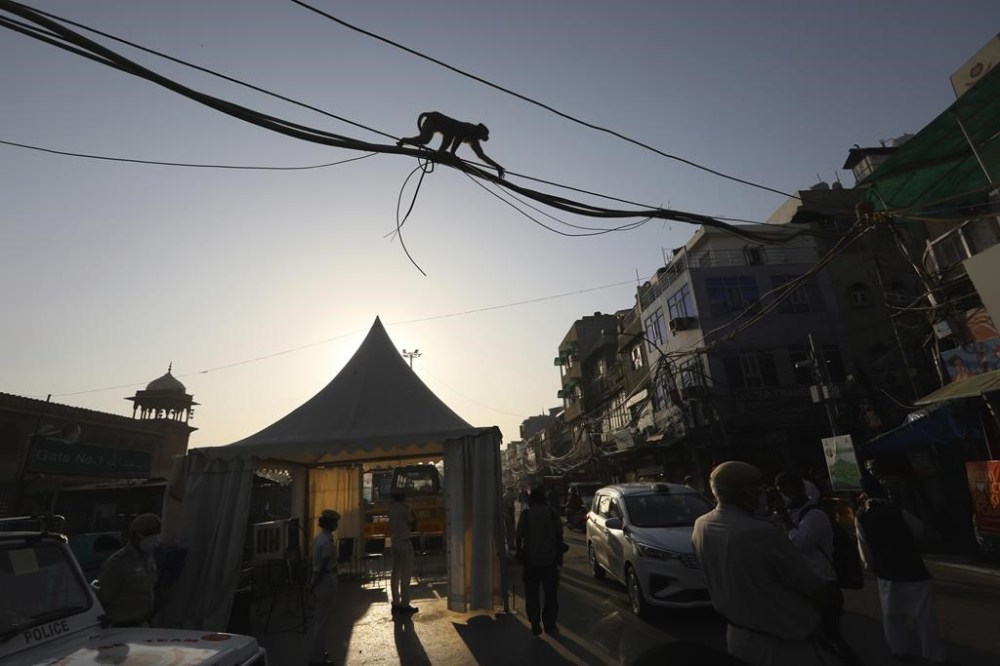
FILE - A monkey walks across power cables near the Jama Mosque in the old quarters of New Delhi, India, Monday, May 25, 2020. Humans’ ancient ancestors had tails, as most vertebrates still do. But somewhere around 20 or 25 million years ago, when apes diverged from monkeys, our branch of the tree of life shed its back appendage. In a paper published in the journal Nature on Wednesday, Feb. 28, 2024, researchers identify at least one of the key genetic tweaks that led to this change. (AP Photo/Manish Swarup, File)

“We found a single mutation in a very important gene,” said Bo Xia, a geneticist at the Broad Institute and co-author of a study published Wednesday in the journal Nature.

The researchers compared the genomes of six species of apes, including humans, and 15 species of monkeys with tails to pinpoint key differences between the groups. Once they identified a significant mutation, they tested their theory by using the gene-editing tool CRISPR to tweak the same spot in mouse embryos. Those mice were born without tails.

Xia cautioned that other genetic changes may also play a role in losing tails.

Another mystery: Did having no tails actually help these ape ancestors — and eventually, humans — survive? Or was it just a chance mutation in a population that thrived for other reasons?

“It could be random chance, but it could have brought a big evolutionary advantage,” said Miriam Konkel, an evolutionary geneticist at Clemson University, who was not involved in the study.

As to why having no tails may have helped, there are many tantalizing theories — including some that link being tailless to humans eventually learning to walk upright.

Rick Potts, who directs the Smithsonian Institution’s Human Origins Project and was not involved in the research, suggests being tailless may have been a first step toward some apes adopting a vertical body posture, even before they left the trees.

Not all apes live on the ground today. Orangutans and gibbons are tailless apes that still live in trees. But Potts notes that they move very differently than monkeys, who scamper along the tops of branches, using their tails for balance. Those apes hang below branches, swinging between them while hanging largely upright.

New York University biologist Itai Yanai, a co-author of the study, said that losing our tails was clearly a major transition. But the only way to certainly know the reason “would be to invent a time machine,” he said.

___

The Associated Press Health and Science Department receives support from the Howard Hughes Medical Institute’s Science and Educational Media Group. The AP is solely responsible for all content.


Report Error Submit a Tip

More Stories

Jets new backup Stevenson ‘stoked’ to be in tandem with Skinner

Mike McIntyre 6 minute read Preview

Jets new backup Stevenson ‘stoked’ to be in tandem with Skinner

Mike McIntyre 6 minute read Yesterday at 4:23 PM CDT

It didn’t take long to get the dirt on the newest member of the Winnipeg Jets.

Meet Clay Stevenson, who has no problem if you prefer to refer to him by his long-standing nickname of “Mud.”

“You know, Clay is in the mud, and there you go. That’s it, right there,” Stevenson said Wednesday with a laugh. “I got it in juniors when I was playing in Coquitlam, and kind of stuck ever since.”

Stevenson is now hoping to make a name for himself in a city that, quite fittingly, translates to “muddy water” in Cree. The 27-year-old from Alberta was placed on waivers by the Washington Capitals and claimed by the Jets, who were looking to clarify a goaltending situation which was as murky as the Red River.

Read
Yesterday at 4:23 PM CDT

Bombers coach happy to be back at work after backbreaking loss to Argos

Taylor Allen 6 minute read Preview

Bombers coach happy to be back at work after backbreaking loss to Argos

Taylor Allen 6 minute read Tuesday, Sep. 29, 2026

It’s the first practice day after a backbreaking loss.

The Winnipeg Blue Bombers are in a challenging predicament with four games remaining — starting Saturday on the road against the Montreal Alouettes (11-3) — that leaves their playoff aspirations far from solidified.

And yet, head coach Mike O’Shea makes his way behind the podium, looks out at a room of reporters and is grinning ear to ear.

Why so happy?

Read
Tuesday, Sep. 29, 2026

Critical mineral development: Grid Metals promotes southeast Manitoba cesium deposit

Gabrielle Piché 3 minute read Preview

Critical mineral development: Grid Metals promotes southeast Manitoba cesium deposit

Gabrielle Piché 3 minute read 8:18 PM CDT

An exploration company says it’s found the second-largest cesium deposit to be developed in the Western world — and it’s looking to mine in southeastern Manitoba.

Cesium is used in the defence sector, solar panels, internet and phone networks and GPS satellites, among other things. Canadian and United States governments have both deemed it a critical mineral.

It’s rare: just six cesium deposits have been found globally, according to the company behind the Manitoba site.

Grid Metals, a Toronto-based firm, spent October 2025 through March drilling holes in land 130 kilometres east of Winnipeg, at its Falcon West property.

Read
8:18 PM CDT

Obsessed stalker who shot, killed young woman at bus stop in 1993 dies behind bars at age 74

Erik Pindera 3 minute read Preview

Obsessed stalker who shot, killed young woman at bus stop in 1993 dies behind bars at age 74

Erik Pindera 3 minute read Tuesday, Sep. 29, 2026

A Winnipeg man who stalked a woman for several years before shooting her dead in the street in 1993 has died in Stony Mountain prison.

On Monday, 74-year-old Ronald Edd Bell died of apparent natural causes at the federal prison just north of Winnipeg, the Correctional Service of Canada said.

Bell had been in prison since May 30, 1994, when he was given a life sentence with no chance of parole for 18 years for killing Terry-Lyn Babb, 25, on Jan. 21, 1993.

Bell walked up behind an unsuspecting Babb, who was waiting at a bus stop at Sherbrook Street and Wolseley Avenue, and shot her in the head with a pistol in front of horrified witnesses, says the Free Press report of his sentencing hearing.

Read
Tuesday, Sep. 29, 2026

Collisions send people to hospital; one fatality

2 minute read Yesterday at 10:42 AM CDT

Five people are in hospital following a two-vehicle collision on Monday at the corner of Pembina Highway and Plaza Drive in which three pedestrians were struck.

On Sept. 28, just after 4:30 p.m., a Ford Fusion was travelling northbound on Pembina Highway through the Plaza Drive intersection with a green light when it was struck by a westbound Honda Fit that failed to stop for a red light at Plaza Drive. The Honda Fit mounted the sidewalk, striking three young children who were with an adult.

The three children were transported to hospital in stable condition with minor injuries. The driver of the Honda, a woman in her 70s, and the passenger, a man in his 80s, were transported to hospital in unstable condition. They were both upgraded to stable condition. The driver was issued a ticket under the Highway Traffic Act.

The Winnipeg Police Service’s Traffic Division is investigating.

Now-independent ex-Tory leader skips legislature’s first question period in four months

Chris Kitching 5 minute read Preview

Now-independent ex-Tory leader skips legislature’s first question period in four months

Chris Kitching 5 minute read Tuesday, Sep. 29, 2026

Crime rates, the cost of living and the state of health care were on the agenda Tuesday when the legislature’s fall sitting began a day after Obby Khan’s abrupt resignation from the Tory caucus.

Read
Tuesday, Sep. 29, 2026