How Chinese is TikTok? US lawmakers see it as China’s tool, even as it distances itself from Beijing
Advertisement
Read this article for free:
or
Already have an account? Log in here »
To continue reading, please subscribe:

Digital Subscription
One year of digital access for only $205*
- Enjoy unlimited reading on winnipegfreepress.com
- Read the E-Edition, our digital replica newspaper
- Access News Break, our award-winning app
- Play interactive puzzles
*First annual payment billed as $205.00 + GST for one year. This annual subscription will automatically renew at $233.00 + GST every 52 weeks (10% off the regular annual price of $259.35). Offer available to new and qualified returning subscribers only. Cancel any time.
To continue reading, please subscribe:
Add Free Press access to your Brandon Sun subscription for only an additional
$1 for the first 4 weeks*
- Enjoy unlimited reading on winnipegfreepress.com
- Read the E-Edition, our digital replica newspaper
- Access News Break, our award-winning app
- Play interactive puzzles
*Your next Brandon Sun subscription payment will increase by $1.00 and you will be charged $17.95 plus GST for four weeks. After four weeks, your payment will increase to $24.95 plus GST every four weeks.
Read unlimited articles for free today:
or
Already have an account? Log in here »
Hey there, time traveller!
This article was published 13/03/2024 (933 days ago), so information in it may no longer be current.
WASHINGTON (AP) — If some U.S. lawmakers have their way, the United States and China could end up with something in common: TikTok might not be available in either country.
The House on Wednesday approved a bill requiring the Beijing-based company ByteDance to sell its subsidiary TikTok or face a nationwide ban. It’s unclear if the bill will ever become law, but it reflects lawmakers’ fears that the social media platform could expose Americans to Beijing’s malign influences and data security risks.
But while U.S. lawmakers associate TikTok with China, the company, headquartered outside China, has strategically kept its distance from its homeland.
Since its inception, the TikTok platform has been intended for non-Chinese markets and is unavailable in mainland China. It pulled out of Hong Kong in 2020 when Beijing imposed a national security law on the territory to curtail speech. As data security concerns started to rise in the U.S., TikTok sought to reassure lawmakers that data gathered on U.S. users stays in the country and is inaccessible to ByteDance employees in Beijing.
TikTok’s parent company is following the same playbook as many other Chinese companies with global ambitions: To win customers and trust in the United States and other Western countries, they are playing down their Chinese roots and connections. Some have insisted they be called “global companies” instead of “Chinese companies.”
But for TikTok, this may not be enough. The House bill passed overwhelmingly on a 352-65 vote. Its prospects in the Senate are uncertain, but if it clears both chambers, President Joe Biden said he would sign it into law. The moves in Washington threaten the app’s survival and cast a spotlight on the quandary that many private Chinese companies have found themselves a part of as they seek to engage Western markets at a time of souring U.S.-China relations.
“It’s the most difficult time for Chinese tech companies and private businesses in decades as tensions and rivalry between the United States and China continue to grow,” said Zhiqun Zhu, professor of political science and international relations at Bucknell University.
“These companies and businesses face squeezing from both sides as they struggle to survive,” Zhu said. “While the U.S. and other Western countries have imposed sanctions or restrictions on these companies, China itself has moved to favor state-owned enterprises in recent years, leaving little room for Chinese tech and private businesses to operate.”
Alex Capri, senior lecturer at the National University of Singapore and research fellow at Hinrich Foundation, agreed that companies like TikTok with Chinese roots are “really stuck in two polar extremes” between the heavy-handed communist party and the deeply suspicious West.
“Any Chinese tech company has to operate under a cloud of suspicion, and that’s because there’s a total breakdown of trust,” Capri said.
With the rise of techno-nationalism, by which technological capabilities are deemed a national strategic asset, China’s tech companies are obligated by Beijing’s laws and rules to turn over data and have become “essentially a de-facto representative” of China’s ruling communist party, Capri said.
”That in itself makes it very challenging for companies like TikTok,” he said.
In 2018, Zhang Yiming, the founder of ByteDance, toed the party line after Beijing shut down ByteDance’s jokes app. He apologized publicly for his company’s deviations from socialistic core values and promised to “comprehensively rectify the algorithm” on its news app and add significantly more layers of censoring — a move considered necessary for any company to survive in China.
That explains the oft-repeated claim by Rep. Mike Gallagher, chair of the House Select Committee on China’s communist party, that “there’s no such thing as a private company in China.”
The bill, as approved by the House, seeks to remove applications from app stores or web hosting services in the U.S. unless the application severs its ties to companies — such as ByteDance — that are subject to the control from foreign adversaries, like China.
“This is my message to TikTok: Break up with the Chinese Communist Party or lose access to your American users,” said Gallagher, the bill’s sponsor. “America’s foremost adversary has no business controlling a dominant media platform in the United States. TikTok’s time in the United States is over unless it ends its relationship with CCP-controlled ByteDance.”
Congressional mistrust of TikTok was evident at a Jan. 31 hearing when Sen. Tom Cotton repeatedly asked CEO Shou Zi Chew if he is a Chinese citizen beholden to the Communist party. Chew, who is Singaporean, repeatedly said no.
On Tuesday, Rep. Nancy Pelosi said it’s problematic that ByteDance, which owns the social platform’s algorithm, is subject to Beijing’s control.
Chew, in another congressional hearing last year, told Congress that “we do not remove or promote content on behalf of the Chinese government.”
In a recent interview with Wired magazine, Chew acknowledged that the company’s Chinese origins have given TikTok a “bigger trust deficit than most other companies.”
“Maybe our trust starting line is behind other businesses, but I also think that there are very serious approaches that we’ve taken to try and earn that trust and to close that gap,” Chew said, citing efforts by TikTok to protect U.S. user data, be transparent and “not be manipulated by any government.”

Short of severance from the home country, Chinese companies chasing global ambitions have tried to distance themselves from China by introducing many foreign investors, hiring foreign executives, moving headquarters to outside China and limiting operations to overseas markets, said Thomas Zhang, China analyst at FrontierView, a U.S.-headquartered market intelligence provider. But “the effects are limited as long as the founder in China does not relinquish control,” Zhang said.
For TikTok, the trust is so lacking that even a full divestiture from its Chinese parent company may not work, because complicated ownership structures can obscure potential Chinese ownership, Capri said.
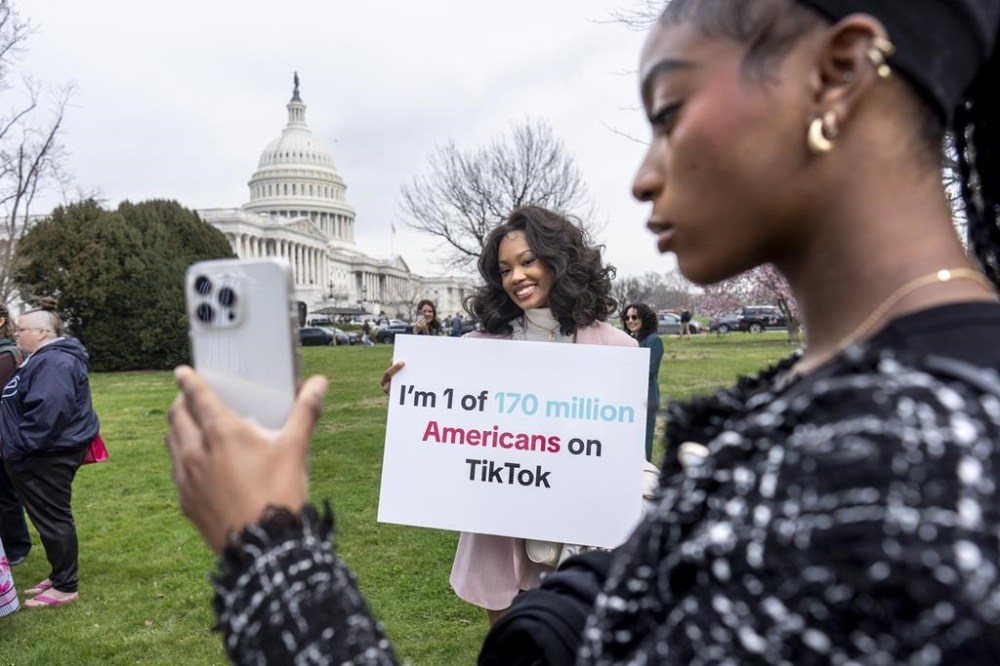
As TikTok fights for survival, it has made a move that is very present in American politics: It’s engaging in heavy lobbying, and appealing to its 170 million U.S. users to contact their lawmakers to say a TikTok ban would infringe on their free speech rights.
It’s won over one powerful critic: Former President Donald Trump, in a reversal, came out against the TikTok legislation. But Trump, for all his sway with congressional Republicans, couldn’t prevent House passage.
If the bill becomes law, Capri said, TikTok could pursue the ultimate American recourse: a lawsuit to challenge the ban.