Former prime minister Kaczyński says Poland needed spyware but he wasn’t interested in the details

Advertisement

Advertise with us

WARSAW, Poland (AP) — Former Polish prime minister Jarosław Kaczyński told a parliamentary committee Friday he believes Poland needed advanced spyware but that, despite his leadership position, he wasn't interested in how or against whom it was used.

Read this article for free:


or

Already have an account? Log in here »

To continue reading, please subscribe:

Subscribe and receive a limited-edition Free Press branded hat or tote.

Digital Subscription

One year of digital access for only $205*

  • Enjoy unlimited reading on winnipegfreepress.com
  • Read the E-Edition, our digital replica newspaper
  • Access News Break, our award-winning app
  • Play interactive puzzles

*First annual payment billed as $205.00 + GST for one year. This annual subscription will automatically renew at $233.00 + GST every 52 weeks (10% off the regular annual price of $259.35). Offer available to new and qualified returning subscribers only. Cancel any time.

To continue reading, please subscribe:

Add Free Press access to your Brandon Sun subscription for only an additional

$1 for the first 4 weeks*

  • Enjoy unlimited reading on winnipegfreepress.com
  • Read the E-Edition, our digital replica newspaper
  • Access News Break, our award-winning app
  • Play interactive puzzles
Start now

*Your next Brandon Sun subscription payment will increase by $1.00 and you will be charged $17.95 plus GST for four weeks. After four weeks, your payment will increase to $24.95 plus GST every four weeks.

Hey there, time traveller!
This article was published 15/03/2024 (914 days ago), so information in it may no longer be current.

WARSAW, Poland (AP) — Former Polish prime minister Jarosław Kaczyński told a parliamentary committee Friday he believes Poland needed advanced spyware but that, despite his leadership position, he wasn’t interested in how or against whom it was used.

Kaczyński testified before the committee in a televised session about the purchase and allegedly illegal use of advanced spyware by a government headed by his Law and Justice party, which was in power from 2015 to 2023. For part of that term he was deputy prime minister for national security.

“As far as Pegasus (spyware) goes, I was aware that it’s a tool for breaking into communication devices, and that Poland needs it, and that other countries also have it,” Kaczyński said. But he stressed that he was “not directly interested in the operational activity of the (security) services.”

FILE - Jaroslaw Kaczynski, the head of the opposition conservative party Law and Justice, speaks to a crowd protesting against the new government of Prime Minister Donald Tusk, in Warsaw, Poland, on Feb. 10, 2024. Kaczynski is testifying Friday March 15, 2024 before a special parliamentary commission that investigates the purchase and allegedly illegal use of advanced spyware under the previous government that was led by Kaczynski’s right-wing party. The Pegasus spyware of the Israeli NSO Group was used to hack portable devices of the government’s opponents. (AP Photo/Czarek Sokolowski, File)

However, he later said the “use of Pegasus was in accordance with the law, there were no shortcomings, and in 99% it was used against criminals.”

Most of the time Kaczyński avoided directly answering questions, saying he did not remember the facts or digressing to praise the Law and Justice government. The questioning went on for many hours.

The Israel-based NSO Group’s Pegasus spyware was used to spy on mobile devices belonging to opponents of the party, according to findings by the University of Toronto’s nonprofit Citizen Lab. Recent details suggest it was also used to eavesdrop on some key members of Kaczyński’s right-wing party.

The revelations, first reported by The Associated Press in 2021, shocked Poland and added to the European Union’s concerns that the Law and Justice government was undermining the rule of law. They also hurt the credentials of Kaczyński’s populist party. The Polish hacks are considered particularly egregious because they occurred in a EU member country.

As the hearing began, Kaczyński sought to avoid testifying and argued he should not have to give evidence, saying that he has only marginal knowledge of how the Pegasus spyware was used but that what he does know is classified and should not be revealed in a public hearing.

Kaczyński refused to repeat the portion of the witness oath that promises “the whole truth,” causing a delay as the committee debated whether he had been properly sworn in.

When the proceedings continued, Kaczyński attacked his political rivals, the current government, saying that the commission’s probe was a “political undertaking” aimed at proving an “illusionary notion that there was dictatorship in Poland” during his party’s term in power.

Kaczyński, 74, was prime minister in 2006-2007, but continued to play a key role in Poland’s politics after leaving the job, especially when his party ruled again in 2015-2023. He was considered Poland’s most powerful politician during the period the spyware was used.

In January 2022, Kaczyński acknowledged that the country bought advanced spyware from the NSO Group, but denied that it was being used to target his political opponents.
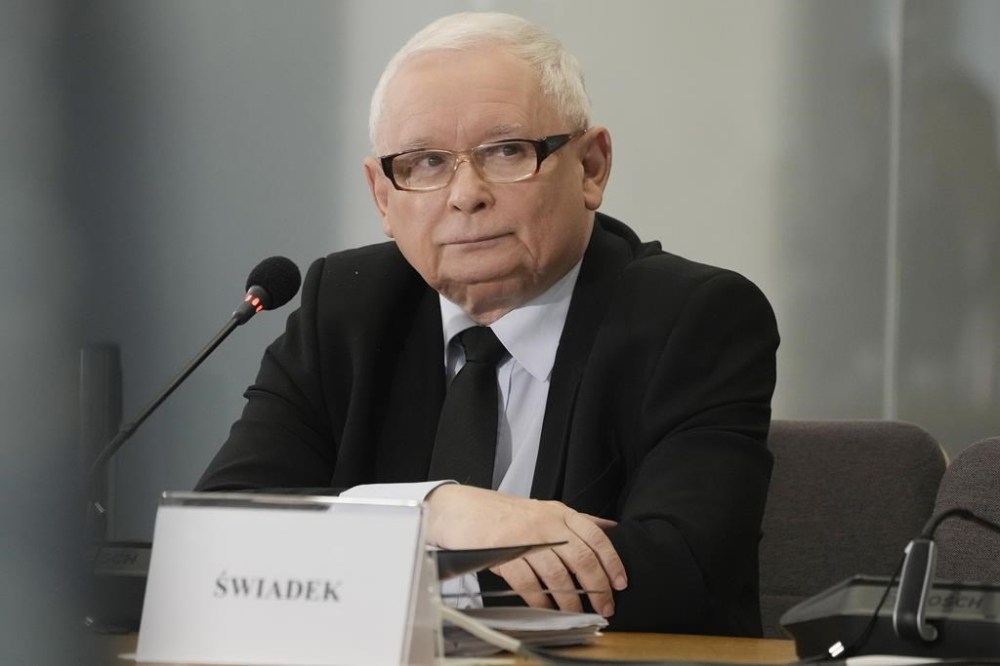
Poland's main opposition leader, Jaroslaw Kaczynski is questioned by a parliamentary commission at the parliament building, in Warsaw, Poland, Friday, March 15, 2024. Kaczynski appeared before a special parliamentary committee Friday to testify about the purchase and allegedly illegal use of advanced spyware by a government headed by his Law and Justice Party. The NSO Group's Pegasus spyware was used to spy on mobile devices belonging to opponents of the party. Recent findings suggest it was also used to eavesdrop on some key members of the right-wing party, as well. (AP Photo/Czarek Sokolowski)

Current Prime Minister Donald Tusk has said the previous government used Pegasus illegally and targeted a “very long” list of victims. Poland’s license for the use of Pegasus was discontinued in 2022, following the reports that the government used it against political opponents.

President Andrzej Duda, who is a Law and Justice ally, has shown little interest in clarifying the serious allegations around the use of spyware.

Pegasus gives operators complete access to targeted mobile device, allowing them to extract passwords and to activate the microphone and camera for real-time eavesdropping.

Law and Justice lost power in December following an electoral defeat. The new parliament dominated by a pro-EU coalition has set up the special committee to dig into the previous government’s use of the spyware. The committee is also to question other members of the Law and Justice government and cyber security experts.

A number of cases of Pegasus abuse have been revealed since 2015, showing the NSO Group spyware was employed to eavesdrop on journalists, politicians, diplomats, lawyers and human rights activists from the Middle East to Mexico.
Report Error Submit a Tip

More Stories

Don’t deny kids a bedtime bond with Gran

Maureen Scurfield 5 minute read Yesterday at 2:00 AM CDT

DEAR MISS LONELYHEARTS: My mother is coming to visit and our little kids want her to sleep in their bedroom, where there’s a double bed and a single. My husband thinks this idea is ridiculous and says grandma needs her sleep, but I disagree.

I remember sleeping with my grandma — who’s now with the angels — and she told us grandkids (two girls) some wonderful bedtime stories she made up herself. She even put our names into them, making us the stars of the stories.

The best part was getting into our pyjamas with our grandmother, who showed us the magic cord from the little thing that ran from her near-deaf ear down to the secret battery pocket hidden in the bra of her slip. It made her hear us better in the daytime. We thought, “Wow!”

Not surprisingly my own mother has inherited her mom’s fantastic storytelling talent and who knows what else she has to teach the kids when she’s alone with them? I want them to be close.

Transit safety drives first mayoral debate

Morgan Modjeski 4 minute read Preview

Transit safety drives first mayoral debate

Morgan Modjeski 4 minute read 2:01 AM CDT

The safety of Winnipeg Transit drivers was front and centre Monday as the first mayoral debate of the 2026 election focused on public transit.

Kevin Klein, the most experienced of the 10 candidates at the Amalgamated Transit Union 1505-hosted debate, said the time for partial safety shields has passed.

“The partial shields have failed drivers. That’s why we need change,” the former PC MLA and city councillor said, adding driver safety is not a staffing issue, but a “protection failure.”

If elected, Klein said he will bring in full-shield implementation across the city within two years and start a nine-bus pilot project immediately.

Read
2:01 AM CDT

A father and son arrested last month are accused of travelling across Canada — and using courier services and Canada Post — to supply their Winnipeg drug-trafficking operation, a recent court filing shows.

Film fest showcases Africa’s best

Ben Waldman 5 minute read Preview

Film fest showcases Africa’s best

Ben Waldman 5 minute read 2:00 AM CDT

Winnipeggers are sometimes accused of living within the Perimeter, meaning a visit to Ouagadougou, the capital city of Burkina Faso, might be out of the question for your weekend travel plans.

Read
2:00 AM CDT

Nothing wrong with planting trees, but it won’t get province very far on path to net zero

Dan Lett 5 minute read Preview

Nothing wrong with planting trees, but it won’t get province very far on path to net zero

Dan Lett 5 minute read Yesterday at 2:39 PM CDT

Manitoba’s new plan to achieve net zero carbon emissions by 2050 is a lot of things. It’s detailed. It’s certainly comprehensive in scope. But when it is all said and done, it is still very much a work in progress.

Read
Yesterday at 2:39 PM CDT

Police cracking down on gangs, organized crime in bars and lounges

Nicole Buffie 2 minute read Preview

Police cracking down on gangs, organized crime in bars and lounges

Nicole Buffie 2 minute read 12:16 PM CDT

Patrons can expect to see more police officers in and around bars and lounges in the coming months as the Winnipeg Police Service plans to crack down on gangs and organized crime.

Uniformed officers will be patrolling bars, lounges and other licensed establishments, targeting gang members and people associated with organized crime. Priority will be given to those who pose the greatest risk to public safety, WPS said in a news release Tuesday.

Under provincial liquor legislation, officers have the authority to remove people whose “presence creates a risk of violence or an increased possibility of violent conduct by or against that individual.”

Police will be working with bar and lounge operators to help them understand the requirements under the Liquor, Gaming and Cannabis Control Act. Manitoba’s liquor regulations say licensed establishments can ban gang identifiers and may refuse entry to, or remove, those who do not comply.

Read
12:16 PM CDT