Record Alberta fires changed forests for decades and destroyed rare habitat: report

Advertisement

Advertise with us

EDMONTON - Last year's record wildfires in Alberta destroyed habitat for threatened species and will change the makeup of the province's forests for decades to come, says a new report.

Read this article for free:


or

Already have an account? Log in here »

To continue reading, please subscribe:

Subscribe and receive a limited-edition Free Press branded hat or tote.

Digital Subscription

One year of digital access for only $205*

  • Enjoy unlimited reading on winnipegfreepress.com
  • Read the E-Edition, our digital replica newspaper
  • Access News Break, our award-winning app
  • Play interactive puzzles

*First annual payment billed as $205.00 + GST for one year. This annual subscription will automatically renew at $233.00 + GST every 52 weeks (10% off the regular annual price of $259.35). Offer available to new and qualified returning subscribers only. Cancel any time.

To continue reading, please subscribe:

Add Free Press access to your Brandon Sun subscription for only an additional

$1 for the first 4 weeks*

  • Enjoy unlimited reading on winnipegfreepress.com
  • Read the E-Edition, our digital replica newspaper
  • Access News Break, our award-winning app
  • Play interactive puzzles
Start now

*Your next Brandon Sun subscription payment will increase by $1.00 and you will be charged $17.95 plus GST for four weeks. After four weeks, your payment will increase to $24.95 plus GST every four weeks.

Hey there, time traveller!
This article was published 04/04/2024 (877 days ago), so information in it may no longer be current.

EDMONTON – Last year’s record wildfires in Alberta destroyed habitat for threatened species and will change the makeup of the province’s forests for decades to come, says a new report.

And the assessment from the Alberta Biodiversity Monitoring Institute — a body funded by the University of Alberta and a provincial research agency — says the chance of a repeat of 2023’s massive burn poses an ongoing challenge for both conservation and industry.

“The future of fire, and how land managers and industries respond to it, will determine the sustainability of Alberta’s forests in the coming years,” the report concludes.
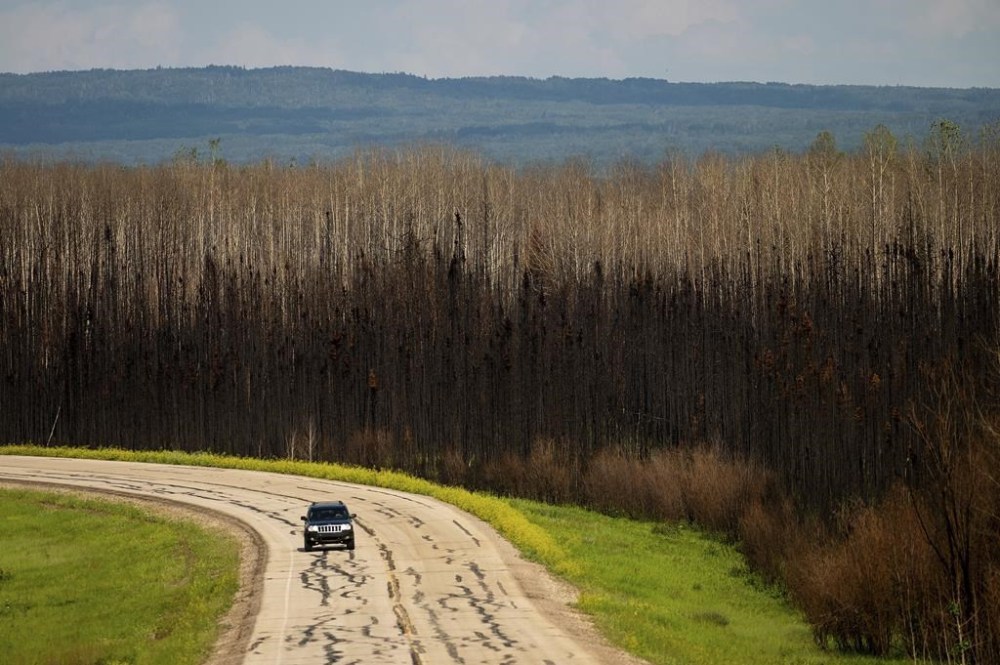
Last year's record wildfires in Alberta destroyed habitat for threatened species and will change the makeup of the province's forests for decades to come, says a new report. A vehicle drives past scorched trees in the East Prairie Metis Settlement, Alta., on Tuesday, July 4, 2023. THE CANADIAN PRESS/AP/Noah Berger

Last summer, a total of 1,088 wildfires burned about 22,000 square kilometres across the province from March 1 to Oct. 31. That’s about five times the five-year average.

Alberta was a major contributor to forest losses across Canada, which were so great they accounted for a 24 per cent increase in global tree cover loss, says a separate report from the World Resources Institute released Thursday.

The Alberta Biodiversity Monitoring Institute report finds more than 28 per cent of the forest in Alberta’s northeast corner burned. That region is remote and little-used.

But more than 10 per cent of the economically vital foothills region was burned. That region is home to much of Alberta’s logging industry, as well as energy development, which also take a toll on the forest.

Several forestry companies lost between a tenth and a third of their harvestable trees.

“This represents the equivalent of more than a decade of forest harvest, impacting assessments of harvest sustainability in the future,” the report says.

The fires also lowered the average age of Alberta’s forests, a crucial figure in determining which forests can be harvested.

Spruce and pine stands, some of the province’s most economically valuable, are now on average six and eight years younger.

The impacts aren’t limited to industry.

“An increased frequency of extreme fire years with the added effects of human disturbances will drive declines in forest age, representing potential rapid, large-scale and ongoing changes in habitats and resulting biodiversity which could undermine ecosystem function,” the report says.

Some species are already suffering.

Caribou herds, which have already lost the vast majority of their ranges to industry, lost more of them to fire. Losses range from more than five per cent in treed lowlands to as much as nearly 14 per cent in northern ranges.

The report warns that shrubs regrowing in burned-over areas attract moose and deer, which are likely to draw predators that also prey on caribou.

“Larger populations of predators will put these threatened herds further at risk,” says the report.

Aspen Dudzic of the Alberta Forest Products Association said industry is still assessing the effects of last year’s fires and how they will affect harvesting plans.

“There still needs to be some work done,” she said.

“We make area-specific adjustments to our plans. It’s difficult to say what those adaptations are going to look like.”

But she said industry is used to working with and around fire.

“We operate in a forest that’s disturbance-driven,” she said.

Increasing wildfires have long been forecast by climate scientists as regions like Alberta become hotter and drier. Much of the province is already under extreme drought and the government moved the start of the wildfire season up by 10 days to begin on Feb. 20.

“The critical question is whether the fire season of 2023 represents a rare event or whether the coming decades will see more fire years like 2023, particularly in the face of a changing climate,” the report says.

This report by The Canadian Press was first published April 4, 2024.

Report Error Submit a Tip

More Stories

Of frogs, roses, kings and a Great Lake

Editorial 4 minute read Preview

Of frogs, roses, kings and a Great Lake

Editorial 4 minute read 2:01 AM CDT

A rose by any other name would smell as sweet, as the saying goes. Basically, if you change something’s name, you don’t actually change the nature of the thing.

That being said, if even 15 years ago an American president had called an entire news conference to announce he was renaming one of the Great Lakes by writing on a map with a red pen and issuing an executive order purporting to rename Lake Ontario as “Lake America,” all and sundry would question his mental health.

Maybe, after witnessing so much from Donald Trump, we’ve all just been hardened off and the foolish is now expected daily. Perhaps it’s the political equivalent of the fable of the boiling frog.

As the fable goes, drop a frog into a pot of boiling water and it will jump right out. But put the frog in room temperature water and bring the pot to a boil, the frog will stay until its death. (It’s unlikely the frog would actually wait.)

Read
2:01 AM CDT

At the city’s busiest fire and paramedic hall, first responders face a relentless workload

Scott Billeck 24 minute read Preview

At the city’s busiest fire and paramedic hall, first responders face a relentless workload

Scott Billeck 24 minute read Yesterday at 6:00 AM CDT

As a soft rain begins to fall between the concrete walls of “Hope Alley,” little feels further away than the place’s namesake.

Winnipeg Fire Paramedic Service crews have been called to the narrow downtown passage, named by Al Wiebe, a formerly homeless man turned advocate. People regularly pass through here, moving between the shelters, drop-ins and resource centres clustered around Main Street between Logan and Higgins avenues.

Against a wall, as the sky switches into night mode, a man sits bleeding from his nose, seemingly unaware of how he ended up with blood running down his T-shirt.

His situation has already set Winnipeg’s emergency response network in motion.

Read
Yesterday at 6:00 AM CDT

Hydro announces CEO out after two years

Chris Kitching 6 minute read Preview

Hydro announces CEO out after two years

Chris Kitching 6 minute read Updated: Yesterday at 9:09 PM CDT

Allan Danroth is out as Manitoba Hydro’s president and CEO — a departure that came as a surprise to some observers — just two years after he was hired.

Danroth left for personal reasons, the Crown corporation’s board chair, Jamie Wilson, said Friday, while announcing chief operating officer Hal Turner as interim president and CEO ahead of a national and international search for a replacement.

“Today’s one of those days where you have a lot of mixed emotions,” Turner told reporters at Hydro’s downtown Winnipeg headquarters. “I just want to say on behalf of all the employees in Manitoba Hydro, we very much appreciate Allan’s leadership over the last two years.”

Turner wouldn’t say whether he will apply to be the next permanent CEO.

Read
Updated: Yesterday at 9:09 PM CDT

Jets’ Hellebuyck trade request marks pivotal moment for the franchise

Ken Wiebe 6 minute read Preview

Jets’ Hellebuyck trade request marks pivotal moment for the franchise

Ken Wiebe 6 minute read Thursday, Aug. 27, 2026

Connor Hellebuyck has broken his silence in an effort to expedite his departure from the Winnipeg Jets.

In a statement released by agent Ray Petkau on Thursday afternoon, Hellebuyck confirmed he has asked to be moved by the team that chose him in the fifth round of the 2012 NHL draft.

“I have never forgotten June 23, 2012. That’s the day the Winnipeg Jets took a chance on a goalie playing in Odessa, Texas. I gave everything I had from that moment to prove the Jets made the right decision,” Hellebuyck said in the statement.

“Several months ago, I privately requested a trade. I have tried to handle the situation quietly and respectfully, while giving the organization time to explore its options. With training camp approaching, I felt it was important to publicly confirm my request. My position has not changed and I believe moving on is the best path forward for me and my family.”

Read
Thursday, Aug. 27, 2026

Manitoba Hydro’s strategy: Deny, deny, deny

Tim Sale 5 minute read Preview

Manitoba Hydro’s strategy: Deny, deny, deny

Tim Sale 5 minute read Yesterday at 2:00 AM CDT

Here’s a good story…

A man walks into your office and says, “Have I got a deal for you! I want $3 billion (plus perhaps a bit more) to build you something that you might use three or even four times a year, for maybe 30-60 hours each time. Sign here.”

You might respond… “and I’ve got a lovely bridge for sale…”

That is exactly what Manitoba Hydro wants — $3 billion or more, plus the fossil fuel bonus for peak load events that happen a few times each year. They assure us that the gas turbines will only be used very occasionally. At the same time, they tell us that we are headed for a crisis of energy supply by 2030.

Read
Yesterday at 2:00 AM CDT

Security guard in stable condition after grocery store assault

Scott Billeck 2 minute read Preview

Security guard in stable condition after grocery store assault

Scott Billeck 2 minute read Updated: 12:35 PM CDT

A security guard was taken to hospital after an assault at a Sargent Avenue FreshCo Friday, just days after another guard was stabbed during a robbery at a St. James Dollarama.

Winnipeg police said officers were called to a store in the 600 block of Sargent Avenue shortly after 1 p.m. for a report of an assault.

An adult victim was taken to hospital in stable condition. Police did not provide details about what led to the assault or whether any arrests were made.

The incident comes three days after a 22-year-old security guard was stabbed during a robbery at a Dollarama in the Courts of St. James.

Read
Updated: 12:35 PM CDT