Japan announces plans to launch upgraded observation satellites on new flagship rocket’s 3rd flight
Advertisement
Read this article for free:
or
Already have an account? Log in here »
To continue reading, please subscribe:

Digital Subscription
One year of digital access for only $205*
- Enjoy unlimited reading on winnipegfreepress.com
- Read the E-Edition, our digital replica newspaper
- Access News Break, our award-winning app
- Play interactive puzzles
*First annual payment billed as $205.00 + GST for one year. This annual subscription will automatically renew at $233.00 + GST every 52 weeks (10% off the regular annual price of $259.35). Offer available to new and qualified returning subscribers only. Cancel any time.
To continue reading, please subscribe:
Add Free Press access to your Brandon Sun subscription for only an additional
$1 for the first 4 weeks*
- Enjoy unlimited reading on winnipegfreepress.com
- Read the E-Edition, our digital replica newspaper
- Access News Break, our award-winning app
- Play interactive puzzles
*Your next Brandon Sun subscription payment will increase by $1.00 and you will be charged $17.95 plus GST for four weeks. After four weeks, your payment will increase to $24.95 plus GST every four weeks.
Read unlimited articles for free today:
or
Already have an account? Log in here »
Hey there, time traveller!
This article was published 26/04/2024 (899 days ago), so information in it may no longer be current.
TOKYO (AP) — Japan’s space agency announced Friday a plan to launch a major upgrade to its satellite imaging system, as a new flagship rocket is put to the test for a third time.
The Japan Aerospace Exploration Agency that an H3 rocket will be launched from the Tanegashima Space Center, on a southwestern Japanese island, early afternoon on June 30, with a launch window that runs through the end of July.
The rocket will be carrying an Advanced Land Observation Satellite, ALOS-4, tasked primarily with Earth observation and data collection for disaster response and mapmaking, as well as with monitoring military activity, such as missile launches, with an infrared sensor developed by the Defense Ministry. The ALOS-4 is a successor to the current ALOS-2 and can observe a much wider area.
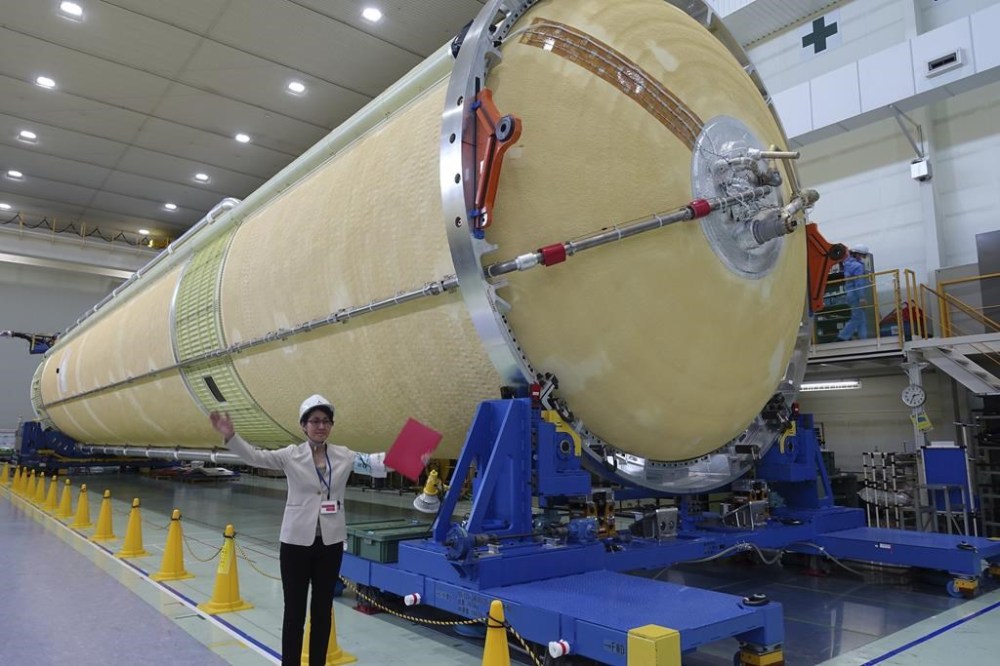
The launch will be the H3’s third, coming after a failed debut in March 2023 and a successful launch on Feb. 17. During the first attempt, the rocket’s second stage engine did not ignite and the rocket had to be destroyed along with its main payload, a satellite that was supposed to be the ALOS-3.
During H3 No. 2’s successful test flight, it carried two commercially-developed observation microsatellites and an ALOS mockup.
JAXA and its main contractor Mitsubishi Heavy Industries have been developing H3 as a successor to its current mainstay, H-2A, which is set to retire after two more flights. MHI will eventually take over H3 production and launches from JAXA and hopes to make it commercially viable.

Japan sees a stable, commercially competitive space transport capability as key to the country’s space program and national security.
The 57-meter (187-foot) long H3 rocket is designed to carry larger payloads than the H-2A at about half its launch cost.