
Google, Justice Department make final arguments about whether search engine is a monopoly

Advertisement

Advertise with us

WASHINGTON (AP) — Google's preeminence as an internet search engine is an illegal monopoly propped up by more than $20 billion spent each year by the tech giant to lock out competition, Justice Department lawyers argued at the closings of a high-stakes antitrust lawsuit.

Read this article for free:


or

Already have an account? Log in here »

To continue reading, please subscribe:

Subscribe and receive a limited-edition Free Press branded hat or tote.

Digital Subscription

One year of digital access for only $205*

  • Enjoy unlimited reading on winnipegfreepress.com
  • Read the E-Edition, our digital replica newspaper
  • Access News Break, our award-winning app
  • Play interactive puzzles

*First annual payment billed as $205.00 + GST for one year. This annual subscription will automatically renew at $233.00 + GST every 52 weeks (10% off the regular annual price of $259.35). Offer available to new and qualified returning subscribers only. Cancel any time.

To continue reading, please subscribe:

Add Free Press access to your Brandon Sun subscription for only an additional

$1 for the first 4 weeks*

  • Enjoy unlimited reading on winnipegfreepress.com
  • Read the E-Edition, our digital replica newspaper
  • Access News Break, our award-winning app
  • Play interactive puzzles
Start now

*Your next Brandon Sun subscription payment will increase by $1.00 and you will be charged $17.95 plus GST for four weeks. After four weeks, your payment will increase to $24.95 plus GST every four weeks.

Hey there, time traveller!
This article was published 03/05/2024 (894 days ago), so information in it may no longer be current.

WASHINGTON (AP) — Google’s preeminence as an internet search engine is an illegal monopoly propped up by more than $20 billion spent each year by the tech giant to lock out competition, Justice Department lawyers argued at the closings of a high-stakes antitrust lawsuit.

Google, on the other hand, maintains that its ubiquity flows from its excellence, and its ability to deliver results customers are looking for.

“It would be an unprecedented decision to punish a company for winning on the merits,” Google’s lawyer, John Schmidtlein, said late Friday afternoon in summation of the company’s closing arguments.
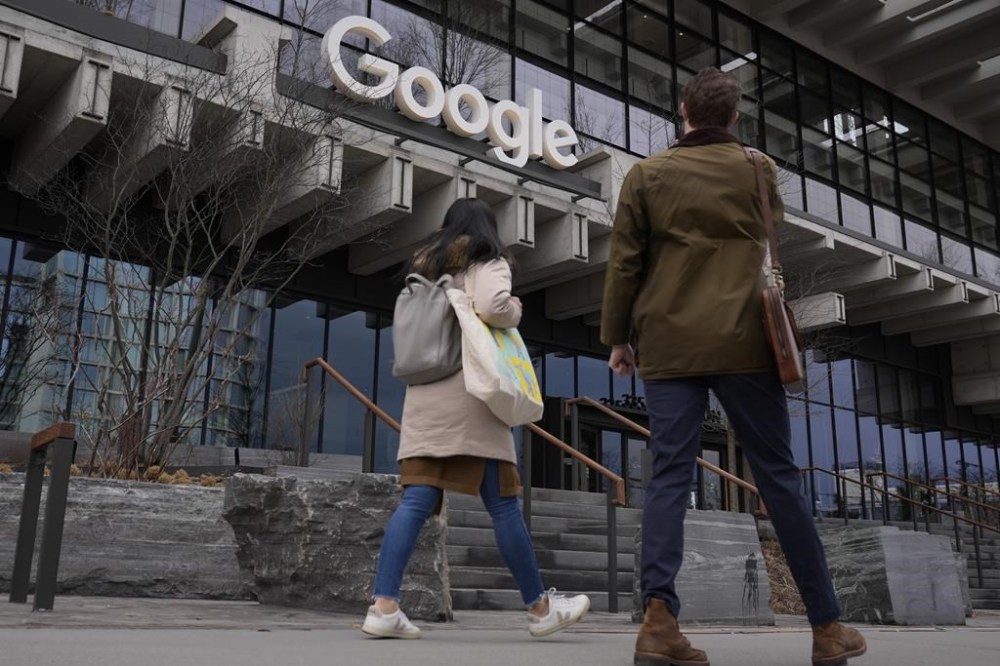
FILE - People arrive at the recently opened Google building in New York, Feb. 26, 2024. The U.S. Justice Department's double-barreled antitrust attack on Google's dominant search and Apple's trendsetting iPhone is reviving memories of another epic battle that hobbled Microsoft before it roared back to yet again become the world's most valuable company. (AP Photo/Seth Wenig, File)

Justice Department lawyer Ken Dintzer told the judge that “today must be the day” for him to step in and stop Google’s monopolistic behavior, which he likened to the tactics used by Microsoft two decades ago that prompted a similar antitrust battle.

The U.S. government, a coalition of states and Google all made their closing arguments Friday in the 10-week lawsuit to U.S. District Judge Amit Mehta, who must now decide whether Google broke the law in maintaining a monopoly status as a search engine.

Much of the case, the biggest antitrust trial in more than two decades, has revolved around how much Google derives its strength from contracts it has in place with companies like Apple to make Google the default search engine preloaded on cellphones and computers.

At trial, evidence showed that Google spends more than $20 billion a year on such contracts. Justice Department lawyers have said the huge sum is indicative of how important it is for Google to make itself the default search engine and block competitors from getting a foothold.

Google responds that customers could easily click away to other search engines if they wanted, but that consumers invariably prefer Google. Companies like Apple testified at trial that they partner with Google because they consider its search engine to be superior.

Google also argues that the government defines the search engine market too narrowly. While it does hold a dominant position over other general search engines like Bing and Yahoo, Google says it faces much more intense competition when consumers make targeted searches. For instance, the tech giant says shoppers may be more likely to search for products on Amazon than Google, vacation planners may run their searches on AirBnB, and hungry diners may be more likely to search for a restaurant on Yelp.

And Google has said that social media companies like Facebook and TikTok also present fierce competition.

During Friday’s arguments, Mehta questioned whether some of those other companies are really in the same market. He said social media companies can generate ad revenue by trying to present ads that seem to match a consumer’s interest. But he said Google can place ads in front of consumers in direct response to queries they submit.

“It’s only Google where we can see that directly declared intent,” Mehta said.

Schmidtlein responded that social media companies “have lots and lots of information about your interests that I would say is just as powerful.”
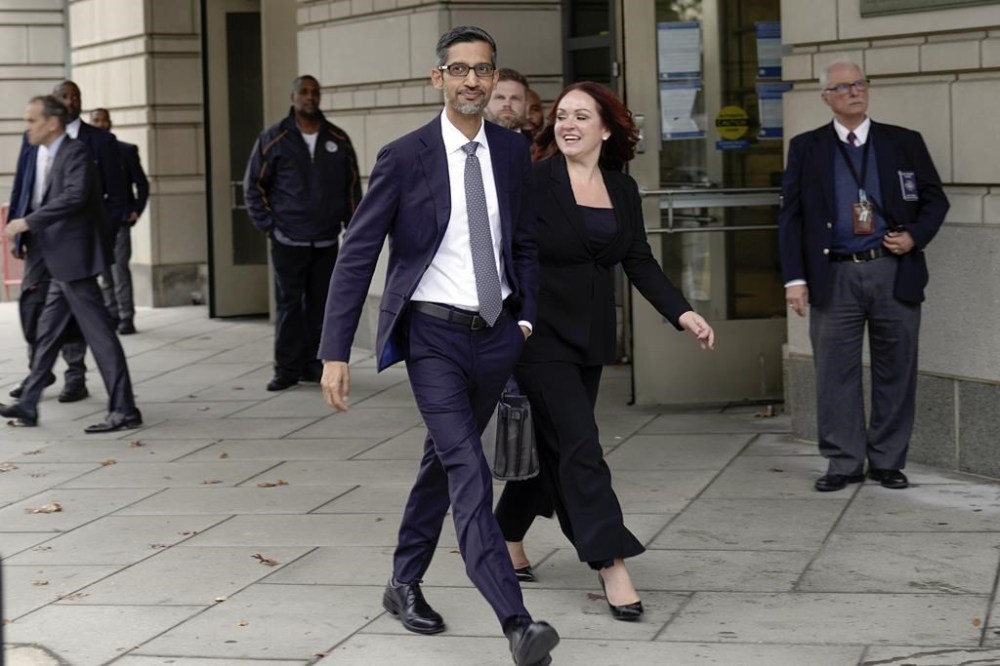
FILE - Google CEO Sundar Pichai leaves the federal courthouse on Oct. 30, 2023, in Washington. The largest U.S. antitrust trial since regulators went after Microsoft a quarter century ago is set to resume May 2, 2024, with government and Google making closing arguments in a case that has targeted the Big Tech company's ubiquitous search engine.(AP Photo/Mariam Zuhaib, File)

The company has also argued that its market strength is tenuous as the internet continually remakes itself. Earlier in the trial, it noted that many experts once considered it irrefutable that Yahoo would always be dominant in search. Today, it said that younger tech consumers sometimes think of Google as “Grandpa Google.”

Government lawyers also argued the tech company should be sanctioned for the “systemic destruction of documents” that they argue was done to purposefully hide evidence of monopolistic intent and practices.

Trial evidence showed that Google lawyers recommended employees ensure that their work chats were not saved because of their potential legal implications.

The government asked Mehta to impose a sanction that allows the judge to infer that all the deleted chats were unfavorable to Google regarding their anticompetitive intent.

Mehta said he was unsure whether he would grant the government’s request but he was sharply critical of their document-retention practices and speculated that there ought to be some kind of sanction.

“Google’s document retention policy leaves a lot to be desired,” he said. “It’s shocking to me, or surprising to me, that a company would leave it to its employees to decide when to preserve documents.”

Google lawyer Colette Connor defended the company’s practice of generally failing to preserve internal company chats. “Given the typical use of chats, it was reasonable,” she said.

While Google’s search services are free to consumers, the company generates revenue from searches by selling ads that accompany a user’s search results.

Justice Department attorney David Dahlquist said during Friday’s arguments that Google was able to increase its ad revenue through growth in the number of queries submitted until about 2015 when query growth slowed and they needed to make more money on each search.
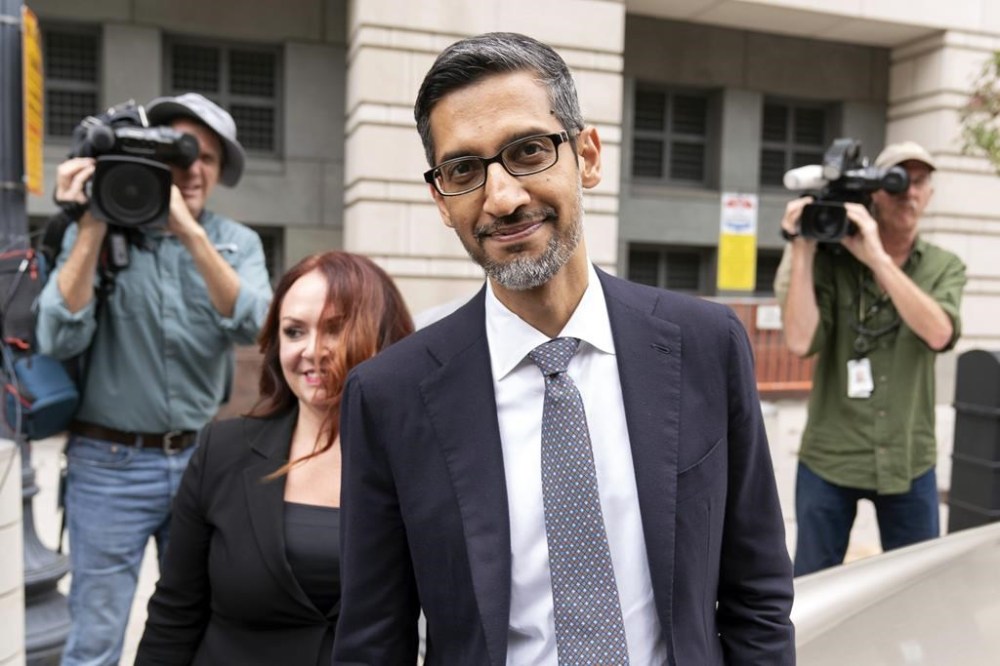
FILE - Google CEO Sundar Pichai leaves the federal courthouse in Washington on Oct. 30, 2023. Lawyers for both the Department of Justice and Google are presenting closing arguments in Washington, D.C., Friday, May 3, 2024, to conclude the biggest antitrust case in a quarter century. (AP Photo/Jose Luis Magana, File)

The government argues that Google’s search engine monopoly allows it to charge artificially higher prices to advertisers, which eventually carry over to consumers.

“Price increases should be bounded by competition,” Dahlquist said. “It should be the market deciding what the price increases are.”

Dahlquist said internal Google documents show that the company, unencumbered by any real competition, began tweaking its ad algorithms to sometimes provide worse search ad results to users if it would increase revenue.

Google’s lawyer, Schmidtlein, said the record shows that its search ads have become more effective and more helpful to consumers over time, increasing from a 10% click rate to 30%.

Mehta has not yet said when he will rule, though there is an expectation that it may take several months.

If he finds that Google violated the law, he would then schedule a “remedies” phase of the trial to determine what should be done to bolster competition in the search-engine market. The government has not yet said what kind of remedy it would seek.


Report Error Submit a Tip

More Stories

Théâtre Cercle Molière opens season with hijinks-filled comedy

Ben Waldman 5 minute read Preview

Théâtre Cercle Molière opens season with hijinks-filled comedy

Ben Waldman 5 minute read 2:00 AM CDT

Molière is back in St. Boniface.

For the opening production of her programming tenure at Théâtre Cercle Molière, artistic director Marie-Ève Fontaine knew that she wanted to highlight the eternal work of her company’s namesake.

She wanted to remind audiences whose cercle they were joining each season on Provencher Boulevard.

“It’s really important to me that our audience has a working knowledge of theatrical references,” says Fontaine, who helmed the company last year during its landmark centennial season.

Read
2:00 AM CDT

White-supremacist highway sign casts pall on Steinbach city council campaign

Matthew Frank 4 minute read Preview

White-supremacist highway sign casts pall on Steinbach city council campaign

Matthew Frank 4 minute read Yesterday at 7:41 PM CDT

The RCMP is investigating a white-nationalist sign near Steinbach with racist messaging and alleged links to a known Canadian far-right group.

A sign hanging on a overpass at the intersection of Highways 1 and 12 read: “STEINBACH VOTES WHITE NOT BROWN,” according to photos posted on social media.

Also written was the name Nationalist-13, a men’s-only neo-Nazi group, also known as NS-13, primarily based in Hamilton, Ont. The Free Press couldn’t independently verify if the group is associated or who hung the sign.

“On Oct. 13, the Steinbach RCMP were made aware of this sign and have opened an investigation,” a spokesperson said in an email statement. They also said the sign has been removed.

Read
Yesterday at 7:41 PM CDT

Tenants battling landlords find help in short supply from province

Scott Billeck 14 minute read Preview

Tenants battling landlords find help in short supply from province

Scott Billeck 14 minute read Yesterday at 6:00 AM CDT

For nearly three years, Quincy Houdayer and Avery Helm repeatedly pressed their landlord to address plumbing failures, water damage and other maintenance problems at their West Broadway apartment, with records showing some issues persisted until the couple turned to the Residential Tenancies Branch.

Emails and text messages between the tenants, Clearwater Management and the RTB reviewed by the Free Press document recurring leaks and flooding, periods without heat or hot water, concerns about mould and basement conditions and repeated followups from the couple seeking repairs.

“Most of the experiences we’ve had with them can be boiled down to, like, they either are very dismissive about it, they act like it’s not their problem… or they will just fully, blatantly ignore you,” Helm said, adding that the only way to get Clearwater to respond was to threaten going to the RTB, a provincial government agency.

RTB data obtained by the Free Press also shows 13 orders involving the three-building complex at 193-197 Furby St. in 2026 alone. All but one favoured the tenant, while the remaining order ruled in favour of both the tenant and landlord on different items.

Read
Yesterday at 6:00 AM CDT

Letters, Oct. 13

7 minute read Preview

Letters, Oct. 13

7 minute read Updated: Yesterday at 8:14 AM CDT

The major assumption Manitoba Hydro undertakes is the weather. Hydro projected a $214 million profit for the 2025-26 fiscal year. On Sept. 29, it reported a $446 million loss. It took on additional debt due to $751 million in operating losses. In addition, Hydro stated the fiscal results for 2025-26 were “significantly influenced by circumstances largely beyond Hydro’s control.”

Read
Updated: Yesterday at 8:14 AM CDT

Civic campaign fails to inspire

Gregory Mason 5 minute read 2:00 AM CDT

When will politicians stop treating me as a child?

In a moment of idleness, I decided to research the mayoral campaign. After a soporific start, the campaign now shows some signs of life, not so much with animated political exchanges, but with candidates trading barbs and accusations of bribes to quit.

So, I turned to my trusty AI assistant (a phrase perilously close to an oxymoron nowadays) to sort out what was on offer from various candidates. Boy, was that a mistake!

Using Perplexity Enterprise, I learned there are 12 aspirants (candidates): 11 men and one woman. Aside from the incumbent, a few have run for mayor in prior years and several have previous council experience. Most lack significant political or management experience.

Police, street groups looking to extend co-ordinated outreach-first approach to drug-use, trafficking crackdown

Chris Kitching 6 minute read Preview

Police, street groups looking to extend co-ordinated outreach-first approach to drug-use, trafficking crackdown

Chris Kitching 6 minute read Updated: Yesterday at 5:36 PM CDT

Winnipeg police and street outreach groups are discussing how to extend an initiative that tries to link people with addictions and homelessness services, while targeting open drug use and dealing.

Read
Updated: Yesterday at 5:36 PM CDT


