Historians, First Nations leader question Quebec history museum concept
Advertisement
Read this article for free:
or
Already have an account? Log in here »
To continue reading, please subscribe:

Digital Subscription
One year of digital access for only $205*
- Enjoy unlimited reading on winnipegfreepress.com
- Read the E-Edition, our digital replica newspaper
- Access News Break, our award-winning app
- Play interactive puzzles
*First annual payment billed as $205.00 + GST for one year. This annual subscription will automatically renew at $233.00 + GST every 52 weeks (10% off the regular annual price of $259.35). Offer available to new and qualified returning subscribers only. Cancel any time.
To continue reading, please subscribe:
Add Free Press access to your Brandon Sun subscription for only an additional
$1 for the first 4 weeks*
- Enjoy unlimited reading on winnipegfreepress.com
- Read the E-Edition, our digital replica newspaper
- Access News Break, our award-winning app
- Play interactive puzzles
*Your next Brandon Sun subscription payment will increase by $1.00 and you will be charged $17.95 plus GST for four weeks. After four weeks, your payment will increase to $24.95 plus GST every four weeks.
Read unlimited articles for free today:
or
Already have an account? Log in here »
Hey there, time traveller!
This article was published 12/05/2024 (856 days ago), so information in it may no longer be current.
MONTREAL – The Quebec government’s framing of a new museum to be dedicated to the history of the Québécois nation is raising questions about how history is told and who it includes, two historians and the leader of a prominent First Nations group say.
Premier François Legault was forced last week to defend comments he made in April about the opening of a new history museum, in which he suggested the province’s history began with the arrival of French explorers Jacques Cartier and Samuel de Champlain in the 16th and 17th centuries.
While he did highlight the presence of Indigenous people on Quebec’s territory in his speech, he was accused by the Assembly of First Nations Quebec-Labrador of trying to erase their history.
Steven High, a history professor at Concordia University, said the premier’s comments are a reminder that history is a political subject that raises tough questions.
“Whose history are we going to centre? Is that a triumphal history or one of tragedy? Where does history begin, who’s included and who’s excluded?” he said in a phone interview.
“In Quebec, this has always been bound up in certain questions in terms of the national question.”
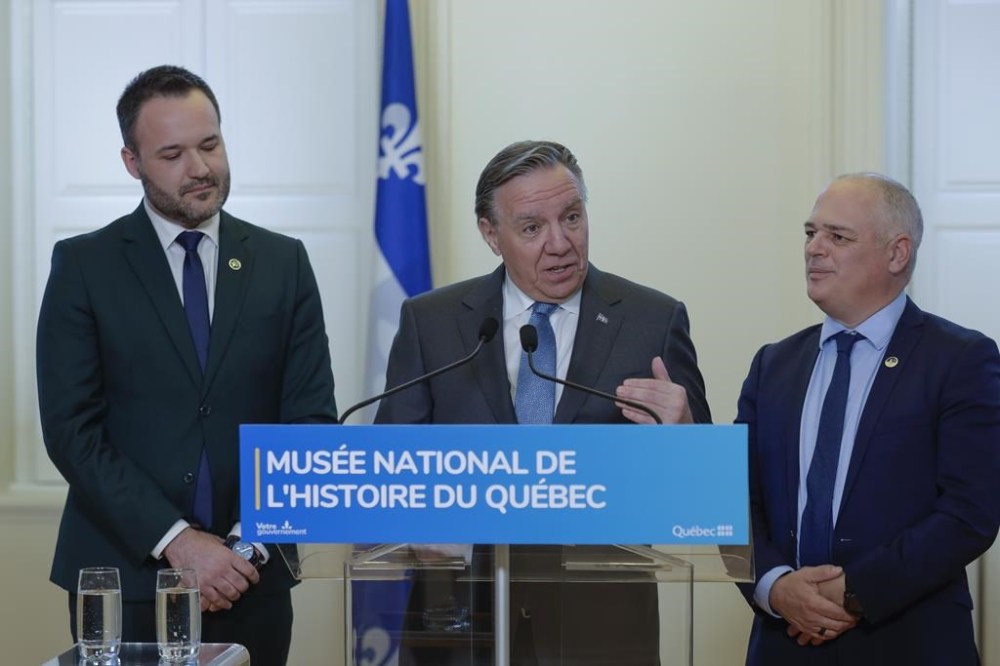
In response to the criticism, Legault told reporters the new Musée national de l’histoire du Québec, set to open in 2026, will focus on the history of the French-speaking Québécois nation. “The idea is to show the history of the nation that was French-Canadian and now Québécois, that started with Champlain,” he said in Quebec City on Wednesday, adding the museum would not exclude Indigenous people.
In his initial April 25 announcement about the museum, Legault also said he hoped the $92 million project would inspire pride in Quebecers through exhibits celebrating artists such as Céline Dion and Les Cowboys Fringants, as well as authors, sporting heroes and business successes.
While the programming for the new museum will be determined by a committee of experts, High said he believes focusing on prominent people represents an old-fashioned approach.
“It’s a return to the old ‘great man’ history, which is uncritical, not really interested in in raising questions or the hard stuff, which is not what history really does,” High said.
Assembly of First Nations Quebec-Labrador Chief Ghislain Picard told The Canadian Press in an interview that the museum announcement is another example of how Indigenous people and their realities are an “afterthought” for the Quebec government.
He said his group wasn’t informed of the announcement, and as far as he knows none of its members were included in the committee of experts shaping its content.
“It’s so easy to pick up the phone and call any leader in the province on the Indigenous side and say, ‘by the way, this is what we have planned,'” he said. “First Nations have to be at the very least informed.”
Picard said it would be impossible to tell the history of the province without mentioning the contribution of Indigenous people.
“To me, the history has told us that, if it wasn’t for our peoples, there wouldn’t even be a Quebec history,” he said.
The Assembly of First Nations also criticized historian Éric Bédard, who was present at the Legault’s April announcement and was quoted telling reporters that history begins with writing, and that therefore “the Indigenous people represent a bit the prehistory of Quebec.”
Ronald Rudin, a professor emeritus of history at Concordia University, said that view represents a “return to an earlier time.”
“It’s a long time since we thought that history began when Europeans showed up in North America,” he said in a phone interview, noting that Canadian courts have accepted oral history as evidence for decades.
Rudin said working only with written history leads to a focus on rich and powerful men, to the exclusion of women, working-class people and Indigenous inhabitants, whose stories often weren’t documented in writing.

“I think (government members) need an introductory history course, because I’m not saying anything that we don’t teach the students in the first year at university,” he said.
Bédard, the historian whose words were criticized, declined an interview request. In a May 7 interview in Le Devoir, he said the new museum’s programming would be determined by a scientific committee and would not just present a “jovialist” view of history.
In an email to The Canadian Press, he said his comments on prehistory at the April announcement were made as he was trying to answer a question he called simple but difficult: when does the history of Quebec begin?
“In our discipline we are accustomed to starting history with writing, hence my answer,” he wrote. “I never said that after the arrival of the French, there would no longer be any question of Indigenous people.”
This report by The Canadian Press was first published May 12, 2024.