Sun shoots out biggest solar flare in almost 2 decades, but Earth should be out of the way this time
Advertisement
Read this article for free:
or
Already have an account? Log in here »
To continue reading, please subscribe:

Digital Subscription
One year of digital access for only $205*
- Enjoy unlimited reading on winnipegfreepress.com
- Read the E-Edition, our digital replica newspaper
- Access News Break, our award-winning app
- Play interactive puzzles
*First annual payment billed as $205.00 + GST for one year. This annual subscription will automatically renew at $233.00 + GST every 52 weeks (10% off the regular annual price of $259.35). Offer available to new and qualified returning subscribers only. Cancel any time.
To continue reading, please subscribe:
Add Free Press access to your Brandon Sun subscription for only an additional
$1 for the first 4 weeks*
- Enjoy unlimited reading on winnipegfreepress.com
- Read the E-Edition, our digital replica newspaper
- Access News Break, our award-winning app
- Play interactive puzzles
*Your next Brandon Sun subscription payment will increase by $1.00 and you will be charged $17.95 plus GST for four weeks. After four weeks, your payment will increase to $24.95 plus GST every four weeks.
Read unlimited articles for free today:
or
Already have an account? Log in here »
Hey there, time traveller!
This article was published 14/05/2024 (876 days ago), so information in it may no longer be current.
CAPE CANAVERAL, Fla. (AP) — The sun produced its biggest flare in nearly two decades Tuesday, just days after severe solar storms pummeled Earth and created dazzling northern lights in unaccustomed places.
“Not done yet!” the National Oceanic and Atmospheric Administration announced in an update.
It’s the biggest flare of this 11-year solar cycle, which is approaching its peak, according to NOAA. The good news is that Earth should be out of the line of fire this time because the flare erupted on a part of the sun rotating away from Earth.
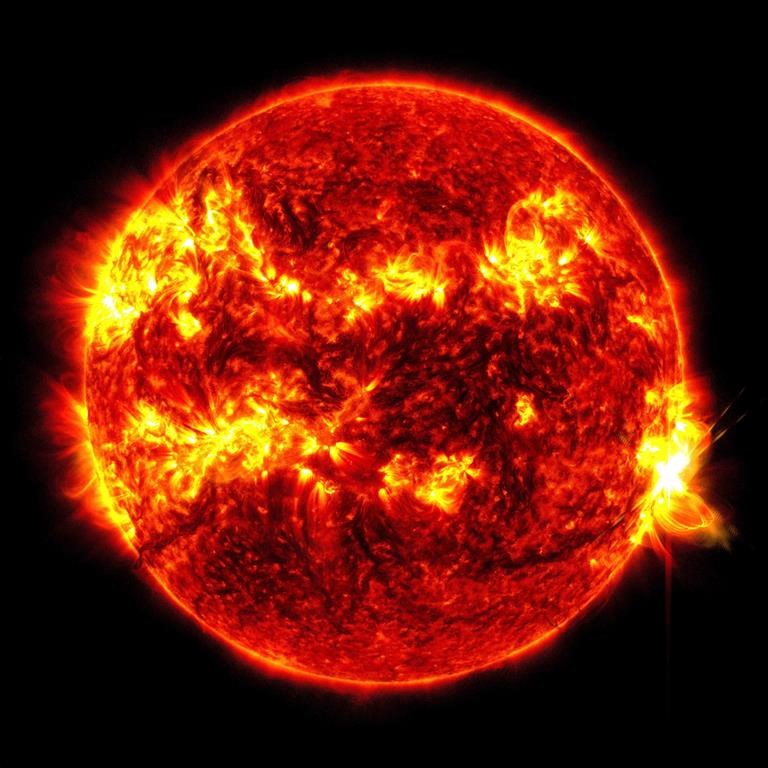
NASA’s Solar Dynamics Observatory captured the bright flash of the X-ray flare. It was the strongest since 2005, rated on the scale for these flares as X8.7.
Bryan Brasher at NOAA’s Space Weather Prediction Center in Boulder, Colorado said it may turn out to have been even stronger when scientists gather data from other sources.
It follows nearly a week of flares and mass ejections of coronal plasma that threatened to disrupt power and communications on Earth and in orbit. An ejection associated with Tuesday’s flare appeared to have been directed away from our planet, although analysis is ongoing, Brasher noted.

NASA said the weekend geomagnetic storm caused one of its environmental satellites to rotate unexpectedly because of reduced altitude from the space weather, and go into a protective hibernation known as safe mode. And at the International Space Station, the seven astronauts were advised to stay in areas with strong radiation shielding. The crew was never in any danger, according to NASA.
___
This story has been updated to correct that it is the biggest solar flare in nearly two decades, not nearly a decade.
___
The Associated Press Health and Science Department receives support from the Howard Hughes Medical Institute’s Science and Educational Media Group. The AP is solely responsible for all content.