When the first warm-blooded dinosaurs roamed Earth

Advertisement

Advertise with us

DALLAS (AP) — Scientists once thought of dinosaurs as sluggish, cold-blooded creatures. Then research suggested that some could control their body temperature, but when and how that shift came about remained a mystery.

Read this article for free:


or

Already have an account? Log in here »

To continue reading, please subscribe:

Subscribe and receive a limited-edition Free Press branded hat or tote.

Digital Subscription

One year of digital access for only $205*

  • Enjoy unlimited reading on winnipegfreepress.com
  • Read the E-Edition, our digital replica newspaper
  • Access News Break, our award-winning app
  • Play interactive puzzles

*First annual payment billed as $205.00 + GST for one year. This annual subscription will automatically renew at $233.00 + GST every 52 weeks (10% off the regular annual price of $259.35). Offer available to new and qualified returning subscribers only. Cancel any time.

To continue reading, please subscribe:

Add Free Press access to your Brandon Sun subscription for only an additional

$1 for the first 4 weeks*

  • Enjoy unlimited reading on winnipegfreepress.com
  • Read the E-Edition, our digital replica newspaper
  • Access News Break, our award-winning app
  • Play interactive puzzles
Start now

*Your next Brandon Sun subscription payment will increase by $1.00 and you will be charged $17.95 plus GST for four weeks. After four weeks, your payment will increase to $24.95 plus GST every four weeks.

Hey there, time traveller!
This article was published 15/05/2024 (850 days ago), so information in it may no longer be current.

DALLAS (AP) — Scientists once thought of dinosaurs as sluggish, cold-blooded creatures. Then research suggested that some could control their body temperature, but when and how that shift came about remained a mystery.

Now, a new study estimates that the first warm-blooded dinosaurs may have roamed the Earth about 180 million years ago, about halfway through the creatures’ time on the planet.

Warm-blooded creatures — including birds, who are descended from dinosaurs, and humans — keep their body temperature constant whether the world around them runs cold or hot. Cold-blooded animals, including reptiles like snakes and lizards, depend on outside sources to control their temperature: For example, basking in the sun to warm up.
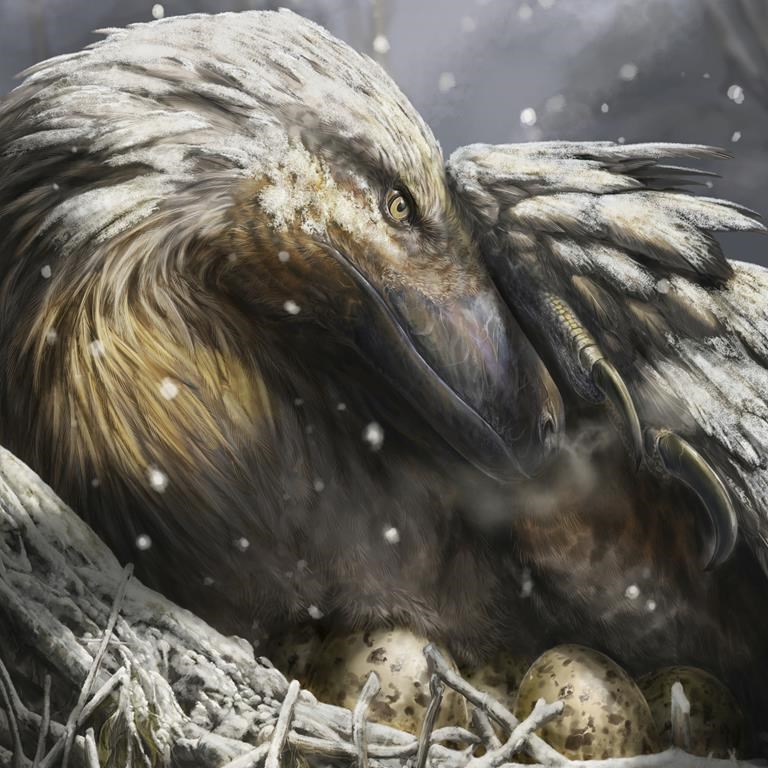
This illustration provided by the University of Vigo and University College London, depicts a dromaeosaur incubating its eggs as snow falls. The raptor, along with other select dinosaurs, may have evolved to be warm-blooded 180 million years ago, generating their own body heat to withstand chilly temperatures, according to research published in the journal Current Biology Wednesday, May 15, 2024. (Davide Bonadonna/University of Vigo/University College London via AP)

Knowing when dinosaurs evolved their stable internal thermometer could help scientists answer other questions about how they lived, including how active and social they were.

To estimate the origin of the first warm-blooded dinosaurs, researchers analyzed over 1,000 fossils, climate models and dinosaurs’ family trees. They found that two major groups of dinosaurs — which include Tyrannosaurus rex, velociraptors and relatives of triceratops — migrated to chillier areas during the Early Jurassic period, indicating they may have developed the ability to stay warm. A third crop of dinosaurs, which includes brontosaurs, stuck to warmer areas.

“If something is capable of living in the Arctic, or very cold regions, it must have some way of heating up,” said Alfio Allesandro Chiarenza, a study author and a postdoctoral fellow at University College London.

The research was published Wednesday in the journal Current Biology.

Jasmina Wiemann, a postdoctoral fellow at the Field Museum in Chicago, said a dinosaur’s location is not the only way to determine whether it is warm-blooded. Research by Wiemann, who was not involved with the latest study, suggests that warm-blooded dinosaurs may have evolved closer to the beginning of their time on Earth, around 250 million years ago.

She said compiling clues from multiple aspects of dinosaurs’ lives — including their body temperatures and diets — may help scientists paint a clearer picture of when they evolved to be warm-blooded.

___

The Associated Press Health and Science Department receives support from the Howard Hughes Medical Institute’s Science and Educational Media Group. The AP is solely responsible for all content.

Report Error Submit a Tip

More Stories

Sex assault charges against basketball referee stayed

Dean Pritchard 3 minute read Preview

Sex assault charges against basketball referee stayed

Dean Pritchard 3 minute read Yesterday at 6:09 PM CDT

A Winnipeg basketball referee accused of sexual offences involving three men has had criminal charges against him stayed.

Michael Shane Maryk, 45, had been set to stand trial July 20 on five counts of sexual assault and two counts of committing an indecent act, but instead agreed to a one-year peace bond prohibiting him from having any contact with the three men.

Maryk was employed by the Manitoba Association of Basketball Officials at the time the offences were alleged to have occurred.

The peace bond requires that Maryk not come within 200 metres of the men’s homes, schools or places of worship and have no contact with their families.

Read
Yesterday at 6:09 PM CDT

Is Trump about to poke Quebec’s political beehive?

Peter McKenna 5 minute read Preview

Is Trump about to poke Quebec’s political beehive?

Peter McKenna 5 minute read 2:00 AM CDT

When was the last time that a U.S. president seriously stirred the hornet’s nest of Quebec politics?

My best recollection is former U.S. president Bill Clinton. During the 1994 Quebec referendum campaign, Clinton made clear that the U.S. wholly endorsed a united and strong federal Canada — as opposed to a dismembered one. He went on to add that an independent Quebec would have no guarantee of joining the North American Free Trade Agreement as a full-fledged member.

Today, we see U.S. President Donald Trump inserting himself — unwittingly or wittingly — into the electoral and sovereignty politics of Quebec. It’s pretty clear that the resurgent Coalition Avenir Québec government is trying to make the Oct. 5 provincial election about anything other than its own governmental record and more about Trump’s economic coercion against Canada. Of course, the Parti Québécois, the odds-on-favourite, wants to make the electoral contest a referendum on the CAQ and its party leader, Christine Fréchette.

But what if Trump really wanted to make his presence felt in Quebec’s political life? How much influence could he have on shaping political outcomes in Quebec? How much of an “X factor” could he be?

Read
2:00 AM CDT

Fallis’s comic thriller infiltrates book club

Ben Sigurdson 3 minute read Preview

Fallis’s comic thriller infiltrates book club

Ben Sigurdson 3 minute read 6:00 AM CDT

The Free Press Book Club and McNally Robinson Booksellers are pleased to welcome Toronto author Terry Fallis to the next virtual meeting on Tuesday, September 29 at 7 p.m. to read from and discuss his novel The Marionette.

Fallis, a former lawyer, bureaucrat and political consultant, is the author of 10 bestselling novels and the two-time winner of the Stephen Leacock Medal for Humour (in 2015 for No Relation and in 2008 for The Best Laid Plans, which also won CBC’s Canada Reads in 2011).

His 11th novel, An End In Itself, will be published in November by McClelland & Stewart, who also published The Marionette in October 2025 (and which was also longlisted for the Leacock medal).

The Marionette follows James Norval, bestselling author of a series of thrillers featuring fictional CIA agent Hunter Chase. While in Tajikistan researching his next Hunter Chase novel, Norval is detained by local officials and subsequently freed and ferried away by the Canadian Security Intelligence Service (CSIS).

Read
6:00 AM CDT

Retired sportscaster Scott Oake determined as fundraising for women's addictions treatment facility enters home stretch

Melissa Martin 4 minute read Preview

Retired sportscaster Scott Oake determined as fundraising for women's addictions treatment facility enters home stretch

Melissa Martin 4 minute read Thursday, Sep. 10, 2026

For now, the patch of land just east of the Victoria Hospital doesn’t look like much: just a field of rocks, mounded dirt, and concrete piles driven into the earth. Yet when Scott Oake looks over the site, he can already imagine how it will look in just over a year’s time, when the new Anne Oake Family Recovery Centre is expected to open.

It’s easier to picture this time around. In 2020, when the recently-retired CBC sportscaster and his late wife, Anne, were building their first labour of intermingled grief and love, the Bruce Oake Recovery Centre for men, it was hard for him to wrap his mind around how a raw construction site could transform into a welcoming addictions treatment facility.

When that centre opened in 2021, Oake found it looked “almost identical” to the architect’s renderings. So it’s easy to hope the Anne Oake Centre will be the same. It will be the first facility of its kind, its founders believe, not only in Canada but in North America: a place where 50 to 70 women can pursue sobriety while staying with their children.

“At Bruce Oake there’s a culture of love, and most of all a culture of hope,” Oake said, speaking at the site Thursday after a media conference to announce the final push of the centre’s fundraising campaign. “I can feel it every time I walk into that building. And I know it will be the same here.”

Read
Thursday, Sep. 10, 2026

City rapped for taking five days to remove animal carcass

Morgan Modjeski 2 minute read Thursday, Sep. 10, 2026

A Winnipeg resident said she’s upset it took the city five days to retrieve a dead fawn from her yard after she reported it to 311.

Amy Gelhorn said she and her family noticed the animal carcass in her garden on Saturday. She called 311 and was told it would be picked up after the long weekend.

“It was removed this afternoon,” the north River Heights resident said Thursday. “So it took six days to remove it and we had to basically phone every day.”

She said neighbours on both sides of her house told her they saw the animal acting strangely on Friday and reported their concerns to 311. It’s believed the animal died overnight. As the days dragged on, the body continued to rot.

Closure of Nomads field massive upset for North End

Joshua Frey-Sam 5 minute read Preview

Closure of Nomads field massive upset for North End

Joshua Frey-Sam 5 minute read Updated: Yesterday at 8:49 AM CDT

The North Winnipeg Nomads have a flag on the field.

The long-standing minor football club was recently informed that its field is unfit to host games and that it would need to find a new home for its five youth and adult teams until repairs are made to the playing surface.

“Our board has made every effort to address the condition of our home field,” the club wrote in a statement. “Unfortunately, following a professional assessment, the field has been determined to be unsafe and unstable for our athletes.”

All five of the club’s teams will play their 2026 season at Frank Whyte Field, part of the Northwood Community Centre, with no confirmed date for when they can play on their home field again.

Read
Updated: Yesterday at 8:49 AM CDT