Experts say coral reef bleaching near record level globally because of ‘crazy’ ocean heat

Advertisement

Advertise with us

Ocean temperatures that have gone “crazy haywire” hot, especially in the Atlantic, are close to making the current global coral bleaching event the worst in history. It's so bad that scientists are hoping for a few hurricanes to cool things off.

Read this article for free:


or

Already have an account? Log in here »

To continue reading, please subscribe:

Subscribe and receive a limited-edition Free Press branded hat or tote.

Digital Subscription

One year of digital access for only $205*

  • Enjoy unlimited reading on winnipegfreepress.com
  • Read the E-Edition, our digital replica newspaper
  • Access News Break, our award-winning app
  • Play interactive puzzles

*First annual payment billed as $205.00 + GST for one year. This annual subscription will automatically renew at $233.00 + GST every 52 weeks (10% off the regular annual price of $259.35). Offer available to new and qualified returning subscribers only. Cancel any time.

To continue reading, please subscribe:

Add Free Press access to your Brandon Sun subscription for only an additional

$1 for the first 4 weeks*

  • Enjoy unlimited reading on winnipegfreepress.com
  • Read the E-Edition, our digital replica newspaper
  • Access News Break, our award-winning app
  • Play interactive puzzles
Start now

*Your next Brandon Sun subscription payment will increase by $1.00 and you will be charged $17.95 plus GST for four weeks. After four weeks, your payment will increase to $24.95 plus GST every four weeks.

Hey there, time traveller!
This article was published 16/05/2024 (870 days ago), so information in it may no longer be current.

Ocean temperatures that have gone “crazy haywire” hot, especially in the Atlantic, are close to making the current global coral bleaching event the worst in history. It’s so bad that scientists are hoping for a few hurricanes to cool things off.

More than three-fifths — 62.9% — of the world’s coral reefs are badly hurting from a bleaching event that began last year and is continuing. That’s nearing the record of 65.7% in 2017, when from 2009 to 2017 about one-seventh of the world’s coral died, said Derek Manzello, coordinator of the National Oceanic and Atmospheric Administration Coral Reef Watch Program.

When water gets too hot, coral, which are living creatures, bleach and sometimes die.
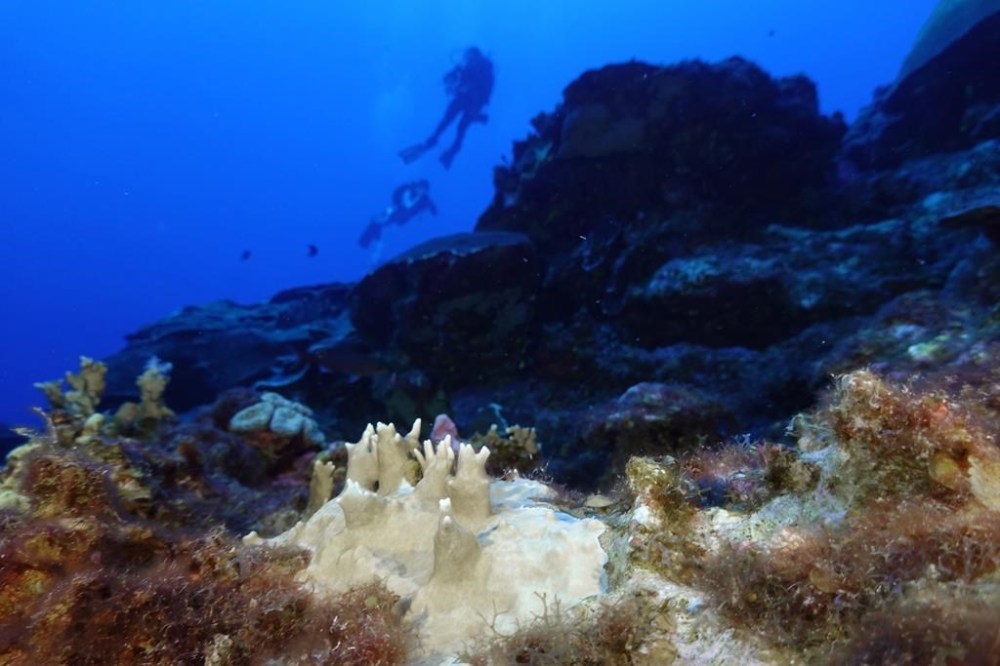
FILE - Bleached coral is visible at the Flower Garden Banks National Marine Sanctuary, off the coast of Galveston, Texas, in the Gulf of Mexico, Sept. 16, 2023. Ocean temperatures that have gone “crazy haywire” hot, especially in the Atlantic, are close to making the current global coral bleaching event the worst in history. It's so bad that scientists are hoping for a few hurricanes to cool things off. (AP Photo/LM Otero, File)

In the Atlantic, off the Florida coast and in the Caribbean, about 99.7% of the coral reefs have been hit with “very very severe” losses in staghorn and elkhorn species, Manzello said Thursday in NOAA’s monthly climate briefing. Sixty-two countries are seeing damaged coral, with Thailand shutting off a tourist-laden island to try to save the coral there.

Meteorologists say a La Nina — a natural cooling of parts of the Pacific that changes the weather worldwide — is forecast to develop soon and perhaps cool oceans a bit, but Manzello said it may be too little and too late.

“I still am very worried about the state of the world’s coral reefs just because we’re seeing things play out right now that are just very unexpected and extreme,” Manzello said.

“This wouldn’t be happening without climate change. That’s basically the cornerstone of all the ocean warming we’re seeing,” Manzello said. But on top of that are changes in El Nino, the reverse of La Nina and a natural warming of ocean waters; reduced sulfur pollution from ships and an undersea volcano eruption.

Former top NASA climate scientist James Hansen said “acceleration of global warming is now hard to deny” in a new analysis and statement Thursday.

For coral, it comes down to how hot the water is and “things have just gone crazy haywire with ocean temperatures in the last year,” Manzello said. He said hurricanes bring up cool water from deep and benefit coral reefs if they don’t hit them directly.

“Hurricanes can be devastating for reefs,” Manzello. “But in the grand scheme of things and given the current situation we are in on planet Earth, they’re now a good thing essentially, which is kind of mind-blowing.”

On Wednesday, parts of the Atlantic where hurricanes often develop had an ocean heat content — which measures water warmth at depths — equivalent to mid-August, said hurricane researchers Brian McNoldy at the University of Miami and Phil Klotzbach at Colorado State University.

The world’s oceans last month broke a record for the hottest April on record. It was the 13th straight month global seas broke records, and because the oceans are slow to cool or warm, more records are likely, said Karin Gleason, NOAA’s climate monitoring chief.

Coral reefs are key to seafood production and tourism worldwide. Scientific reports have long said loss of coral is one of the big tipping points of future warming as the world nears 1.5 degrees Celsius (2.7 degrees Fahrenheit) of warming since pre-industrial time. That’s a limit that countries agreed to try to hold to in the 2015 Paris climate agreement.

“This is one of the most biodiverse ecosystems on the planet,” said Andrew Pershing, a biological oceanographer who is vice president for science of Climate Central. “It’s an ecosystem that we’re literally going to watch disappear in our lifetimes.”

___

Read more of AP’s climate coverage at http://www.apnews.com/climate-and-environment

___

Follow Seth Borenstein on X at @borenbears

______

The Associated Press’ climate and environmental coverage receives financial support from multiple private foundations. AP is solely responsible for all content. Find AP’s standards for working with philanthropies, a list of supporters and funded coverage areas at AP.org.
Report Error Submit a Tip

More Stories

Brandonmeat packer thriving on its own

Abiola Odutola 3 minute read Preview

Brandonmeat packer thriving on its own

Abiola Odutola 3 minute read 2:01 AM CDT

BRANDON — Canada Packers has strengthened its business and laid the foundation for future growth during its first year as an independent company, its president says.

The Brandon-based pork producer, separated from Maple Leaf Foods in October 2025, established its own leadership, strategy, systems, culture and identity while continuing operations across its hog production farms and regional hog barns in southern and eastern Manitoba.

The company’s first year was focused on building a successful standalone business while continuing to serve customers, communities and shareholders, president Dennis Organ said.

“Market conditions over the past year have been more challenging than we anticipated when we became a separate entity,” he said in an email. “Despite that, we continued to execute against our priorities, including increasing processing volumes, maintaining disciplined operations and strengthening the business.”

Read
2:01 AM CDT

Puzzles Palace

1 minute read Monday, Jul. 27, 2026

To solve our puzzles, please subscribe with this special offer: |

Gordon Bell rings in a century

Maggie Macintosh 13 minute read Preview

Gordon Bell rings in a century

Maggie Macintosh 13 minute read Updated: Yesterday at 8:06 PM CDT

Mischka Valencia had gotten used to the hum of heavy machinery at Gordon Bell High School.

“Ever since I’ve been here, it’s all been under construction,” the Grade 12 student said, standing on the sidelines of the brightly painted revamped outdoor basketball court. “I had no idea this was a court.”

The Filipina teenager landed in Winnipeg several months after the inner-city campus had transformed into a construction site.

It was the fall of 2023 and Mischka’s priorities were fitting in, befriending classmates and learning a third language via first-period French.

Read
Updated: Yesterday at 8:06 PM CDT

Free Press staff 2 minute read 2:01 AM CDT

Advance voting for civic and school board elections begins next week.

Voters can cast early ballots for the Oct. 28 election in certain locations from Monday through Oct. 23.

Eligible voters can use their address to search for a convenient location.

Early votes can be cast at the council building at city hall (510 Main St.) every day, except weekends and Thanksgiving, from Monday to Oct. 23.

Health minister warns $1.2 billion in annual federal funding set to expire in March

Scott Billeck 4 minute read Preview

Health minister warns $1.2 billion in annual federal funding set to expire in March

Scott Billeck 4 minute read Thursday, Oct. 1, 2026

Manitoba’s health minister is warning of possible cuts to health care with $1.2 billion in annual funding from Ottawa set to expire next year.

“We’re very concerned that what would be the largest cut to health care in a generation is right in front of us,” Health Minister Uzoma Asagwara said Thursday at the Manitoba legislature. “It means that services that Manitobans depend on will be in jeopardy and be at risk.

“Any reductions, any cuts from Canada, will have direct impacts on the health outcomes of Manitobans.”

Asagwara, who serves as the provincial and territorial health minister lead, chaired a virtual meeting Tuesday with provincial and territorial health ministers to discuss federal funding for health care, mental health care and substance use services, which is scheduled to expire March 31, 2027.

Read
Thursday, Oct. 1, 2026

Mayoral candidate Vogiatzakis criticized for living outside Winnipeg

Malak Abas 4 minute read Preview

Mayoral candidate Vogiatzakis criticized for living outside Winnipeg

Malak Abas 4 minute read Updated: Yesterday at 6:03 PM CDT

A mayoral hopeful took heat from other candidates Friday for living outside Winnipeg while running in the civic election.

Mike Vogiatzakis’s primary residence is in the Rural Municipality of St. Andrews, about 25 kilometres north of Winnipeg — a community with its own mayor and councillors.

But the funeral director said he owns a home in Winnipeg where he divides his time, and he would move to the city full-time if elected mayor.

“It doesn’t matter where a person lives. Why are we dividing St. Andrews and Manitoba and Winnipeg? I’ve met the criteria to run for mayor,” Vogiatzakis said Friday morning.

Read
Updated: Yesterday at 6:03 PM CDT