Webb telescope uncovers merger of two massive black holes from early universe
Advertisement
Read this article for free:
or
Already have an account? Log in here »
To continue reading, please subscribe:

Digital Subscription
One year of digital access for only $205*
- Enjoy unlimited reading on winnipegfreepress.com
- Read the E-Edition, our digital replica newspaper
- Access News Break, our award-winning app
- Play interactive puzzles
*First annual payment billed as $205.00 + GST for one year. This annual subscription will automatically renew at $233.00 + GST every 52 weeks (10% off the regular annual price of $259.35). Offer available to new and qualified returning subscribers only. Cancel any time.
To continue reading, please subscribe:
Add Free Press access to your Brandon Sun subscription for only an additional
$1 for the first 4 weeks*
- Enjoy unlimited reading on winnipegfreepress.com
- Read the E-Edition, our digital replica newspaper
- Access News Break, our award-winning app
- Play interactive puzzles
*Your next Brandon Sun subscription payment will increase by $1.00 and you will be charged $17.95 plus GST for four weeks. After four weeks, your payment will increase to $24.95 plus GST every four weeks.
Read unlimited articles for free today:
or
Already have an account? Log in here »
Hey there, time traveller!
This article was published 16/05/2024 (854 days ago), so information in it may no longer be current.
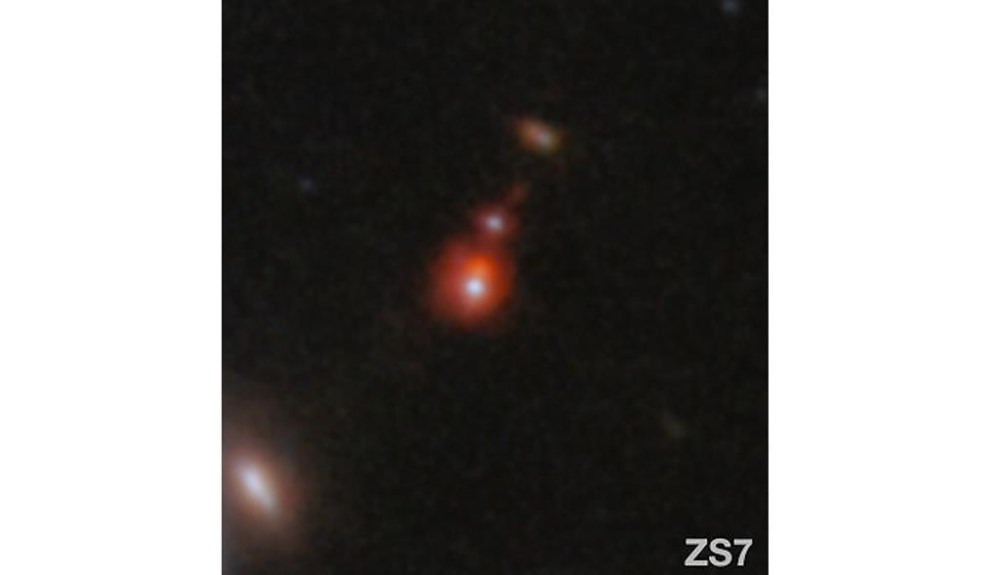
CAPE CANAVERAL, Fla. (AP) — The Webb Space Telescope has discovered the earliest known merger of black holes.
These two gigantic black holes and their galaxies consolidated just 740 million years after the universe-forming Big Bang. It’s the most distant detection ever made of merging black holes, scientists reported Thursday.
One black hole is 50 million times more massive than our sun. The other is thought to be similar in size, but is buried in dense gas, which makes it harder to measure.
Until now, astronomers weren’t sure how supermassive black holes got so big.
The latest findings, published in the Monthly Notices of the Royal Astronomical Society, suggest mergers are how black holes can grow so rapidly — “even at cosmic dawn,” said lead author Hannah Ubler of the University of Cambridge.
“Massive black holes have been shaping the evolution of galaxies from the very beginning,” Ubler said in a statement.
Launched in 2021 as the eventual successor to NASA’s Hubble Space Telescope, Webb is the biggest and most powerful observatory ever sent into space. A joint U.S.-European project, the infrared observatory surveys the universe from a location 1 million miles (1.6 million kilometers) from Earth.
___
The Associated Press Health and Science Department receives support from the Howard Hughes Medical Institute’s Science and Educational Media Group. The AP is solely responsible for all content.