General Sherman passes health check but world’s largest trees face growing climate threats

Advertisement

Advertise with us

SEQUOIA NATIONAL PARK, California (AP) — High in the evergreen canopy of General Sherman, the world’s largest tree, researchers searched for evidence of an emerging threat to giant sequoias: bark beetles.

Read this article for free:


or

Already have an account? Log in here »

To continue reading, please subscribe:

Subscribe and receive a limited-edition Free Press branded hat or tote.

Digital Subscription

One year of digital access for only $205*

  • Enjoy unlimited reading on winnipegfreepress.com
  • Read the E-Edition, our digital replica newspaper
  • Access News Break, our award-winning app
  • Play interactive puzzles

*First annual payment billed as $205.00 + GST for one year. This annual subscription will automatically renew at $233.00 + GST every 52 weeks (10% off the regular annual price of $259.35). Offer available to new and qualified returning subscribers only. Cancel any time.

To continue reading, please subscribe:

Add Free Press access to your Brandon Sun subscription for only an additional

$1 for the first 4 weeks*

  • Enjoy unlimited reading on winnipegfreepress.com
  • Read the E-Edition, our digital replica newspaper
  • Access News Break, our award-winning app
  • Play interactive puzzles
Start now

*Your next Brandon Sun subscription payment will increase by $1.00 and you will be charged $17.95 plus GST for four weeks. After four weeks, your payment will increase to $24.95 plus GST every four weeks.

Hey there, time traveller!
This article was published 23/05/2024 (854 days ago), so information in it may no longer be current.

SEQUOIA NATIONAL PARK, California (AP) — High in the evergreen canopy of General Sherman, the world’s largest tree, researchers searched for evidence of an emerging threat to giant sequoias: bark beetles.

The climbers descended the towering 2,200-year-old tree with good news on Tuesday.

“The General Sherman tree is doing fine right now,” said Anthony Ambrose, executive director of the Ancient Forest Society, who led the expedition. “It seems to be a very healthy tree that’s able to fend off any beetle attack.”
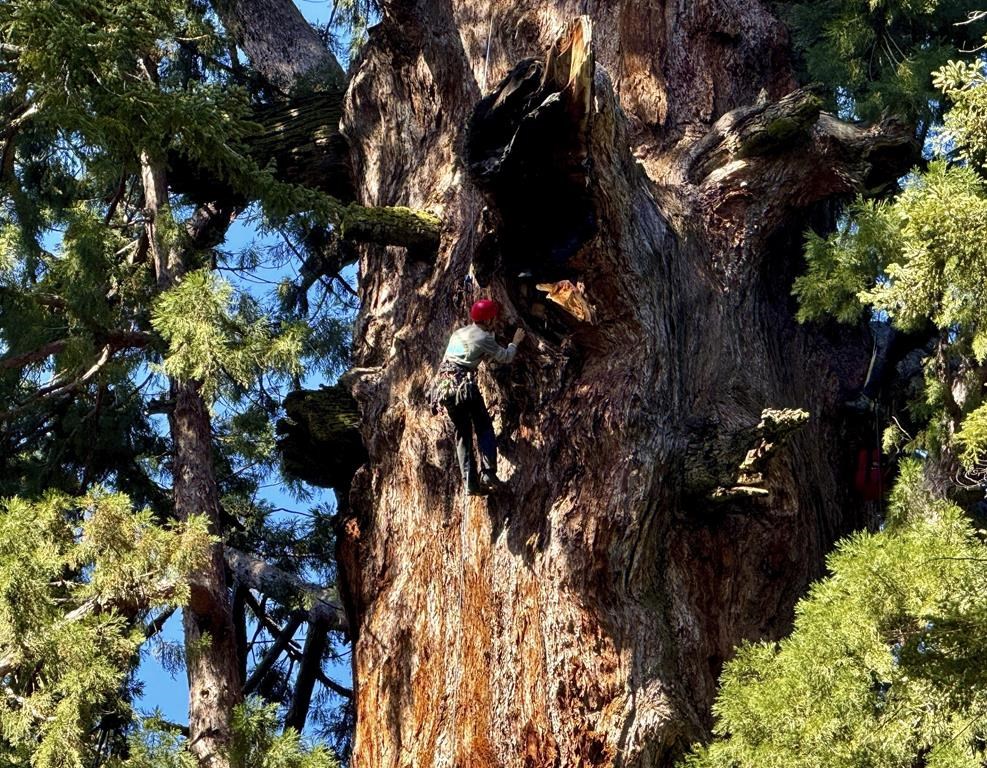
A researcher examines General Sherman, the world's largest tree, in Sequoia National Park, Calif. on Tuesday, May 21, 2024. The research team inspected the 275-foot tree for evidence of bark beetles, an emerging threat to giant sequoias. (AP Photo/Terry Chea)

It was the first time climbers had scaled the iconic 275-foot (85-meter) sequoia tree, which draws tourists from around the world to Sequoia National Park.

Giant sequoias, the Earth’s largest living things, have survived for thousands of years in California’s western Sierra Nevada range, the only place where the species is native.

But as the climate grows hotter and drier, giant sequoias previously thought to be almost indestructible are increasingly threatened by extreme heat, drought and wildfires.

In 2020 and 2021, record-setting wildfires killed as much as 20 percent of the world’s 75,000 mature sequoias, according to park officials.

“The most significant threat to giant sequoias is climate-driven wildfires,” said Ben Blom, director of stewardship and restoration at Save the Redwoods League. “But we certainly don’t want to be caught by surprise by a new threat, which is why we’re studying these beetles now.”

But researchers are growing more worried about bark beetles, which didn’t pose a serious threat in the past.

The beetles are native to California and have co-existed with sequoias for thousands of years. But only recently have they been able to kill the trees. Scientists say they recently discovered about 40 sequoia trees that have died from beetle infestations, mostly within the national parks.

“We’re documenting some trees that are actually dying from kind of a combination of drought and fire that have weakened them to a point where they’re not able to defend themselves from the beetle attack,” Ambrose said.

The beetles attack the trees from the canopy, boring into branches and working their way down the trunk. If left unchecked, the tiny beetles can kill a tree within six months.
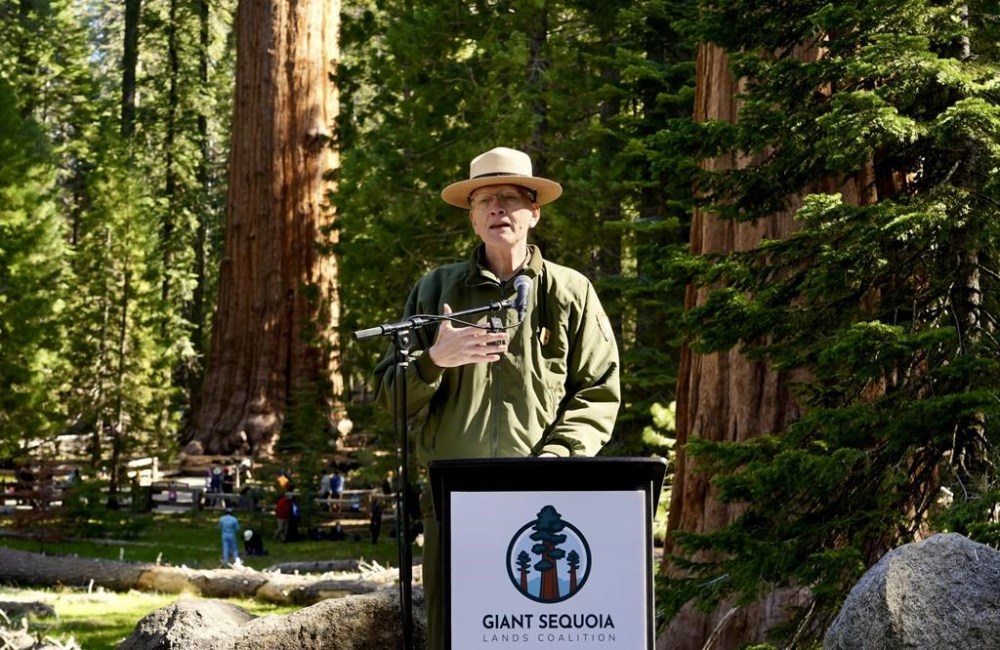
Clay Jordan, superintendent of Sequoia and Kings Canyon National Parks, speaks in front of General Sherman, the world's largest tree, in Sequoia National Park, Calif. on Tuesday, May 21, 2024. A research team inspected the 275-foot tree for evidence of bark beetles, an emerging threat to giant sequoias. (AP Photo/Terry Chea)

That’s why park officials allowed Ambrose and his colleagues to climb General Sherman. They conducted the tree health inspection as journalists and visitors watched them pull themselves up ropes dangling from the canopy. They examined the branches and trunk, looking for the tiny holes that inidicate beetle activity.

But it’s not possible to climb every sequoia tree to directly inspect the canopy in person. That’s why they’re also testing whether drones equipped with sensors and aided by satellite imagery can be used to monitor and detect beetle infestations on a larger scale within the forests.

Tuesday’s health inspection of General Sherman was organized by the Giant Sequoia Lands Coalition, a group of government agencies, Native tribes and environmental groups. They hope to establish a health monitoring program for the towering trees.

If they discover beetle infestations, officials say, they could try to combat the attacks by spraying water, removing branches or using chemical treatments.

Bark beetles have ravaged pine and fir forests throughout the Western United States in recent years, but they previously didn’t pose a threat to giant sequoias, which can live 3,000 years.

“They have really withstood insect attacks for a lot of years. So why now? Why are we seeing this change?” said Clay Jordan, superintendent for Sequoia and Kings Canyon National Parks. “There’s a lot that we need to learn in order to ensure good stewardship of these trees for a long time.”

Report Error Submit a Tip

More Stories

Safety officers responded to three assaults in first 4 1/2 months at downtown Hydro HQ

Carol Sanders 5 minute read Preview

Safety officers responded to three assaults in first 4 1/2 months at downtown Hydro HQ

Carol Sanders 5 minute read Yesterday at 6:38 PM CDT

Manitoba Hydro Place beefed up its security after an employee was assaulted in the main-floor gallery while leaving work in January leading the Crown corporation to close the building to the public for several weeks while it hired and trained institutional safety officers.

Read
Yesterday at 6:38 PM CDT

Relief, reproach from law school staff after disgraced ex-dean’s arrest in France

Maggie Macintosh 5 minute read Preview

Relief, reproach from law school staff after disgraced ex-dean’s arrest in France

Maggie Macintosh 5 minute read Yesterday at 5:43 PM CDT

The overseas arrest of a disgraced former law dean who defrauded the University of Manitoba out of more than $600,000 is being met both with relief and renewed frustration in the local legal community.

Read
Yesterday at 5:43 PM CDT

Manitoba budget reveals province underspent on crucial departments related to justice, public safety

Carol Sanders 5 minute read Preview

Manitoba budget reveals province underspent on crucial departments related to justice, public safety

Carol Sanders 5 minute read Updated: Yesterday at 8:09 AM CDT

While concerns about homelessness and public safety continue to make headlines in Manitoba, the two government departments mainly responsible for addressing them came in under budget last year.

The 2025-26 public accounts, released Monday, show Housing, Addictions and Homelessness underspent its budget of $869 million by $18 million. Manitoba Justice underspent its budget of $994 million by $34 million.

The 247-page public accounts report attributes the underspending in justice mainly to “reduced impacts of contingency liabilities,” such as a court ruling or legal settlement.

The report did not explain how and why Housing, Addictions and Homelessness underspent its budget last year as the province addresses those critical issues.

Read
Updated: Yesterday at 8:09 AM CDT

Labour leaders, councillors urge Wyatt to reconsider re-election bid

Malak Abas 5 minute read Preview

Labour leaders, councillors urge Wyatt to reconsider re-election bid

Malak Abas 5 minute read Tuesday, Sep. 22, 2026

City councillors and labour leaders called on incumbent Transcona councillor Russ Wyatt to reconsider his decision to seek re-election while facing sexual assault charges.

A day after the longtime councillor announced he would be running again, the Canadian Union of Public Employees Local 500 and the Winnipeg Labour Council, joined by Couns. Cindy Gilroy and Evan Duncan, told reporters Wyatt would not be able to serve Transcona while fighting multiple sexual assault charges in court and should step aside.

The community of Transcona, traditionally known for its working-class roots, has “been through enough drama,” the president of the city’s largest union said.

“I am not declaring him guilty of anything, the courts will decide that, and his lawyer says that he is innocent. I’m stating a plain fact about capacity. Every hour spent on legal defence is an hour not spent on Transcona,” CUPE 500 president Patrick Troughton said at city hall Tuesday afternoon.

Read
Tuesday, Sep. 22, 2026

Letters, Sept. 24

7 minute read 2:01 AM CDT

Poor choice

Manitoba’s move to end seasonal time changes appears to be an edict by extrapolation.

A voluntary online questionnaire produced 72,000 self‑selected responses, of which 58 per cent (41,760 people) preferred permanent daylight time. This is not a scientific poll, yet it is being used to set time policy for 1.4 million Manitobans — without legislative debate, committee review, or a vote in the Assembly.

If a one‑hour shift twice a year is considered “harmful,” then by the same logic we should question every activity involving time‑zone changes.

Well-known Brandon-born rock drummer Sutherland dies at age 58

Rylee Gerrard 3 minute read Preview

Well-known Brandon-born rock drummer Sutherland dies at age 58

Rylee Gerrard 3 minute read Yesterday at 7:19 PM CDT

Chris (Suds) Sutherland, a Brandon-born drummer who was the driving force behind many top artists in the Canadian music industry, has died at 58.

Sutherland is widely praised throughout North America as a talented percussionist with an extensive discography.

He performed with such Canadian music legends as Kim Mitchell, Randy Bachman, Burton Cummings, Streetheart and others.

Sutherland brought presence and “plow” when he played, Tina Faye said about her husband.

Read
Yesterday at 7:19 PM CDT