

Lava spurts from Iceland volcano for second day as its fissure extends 2 miles
Advertisement
Read this article for free:
or
Already have an account? Log in here »
To continue reading, please subscribe:
Monthly Digital Subscription
$0 for the first 4 weeks*
- Enjoy unlimited reading on winnipegfreepress.com
- Read the E-Edition, our digital replica newspaper
- Access News Break, our award-winning app
- Play interactive puzzles
*No charge for 4 weeks then price increases to the regular rate of $19.00 plus GST every four weeks. Offer available to new and qualified returning subscribers only. Cancel any time.
Monthly Digital Subscription
$4.75/week*
- Enjoy unlimited reading on winnipegfreepress.com
- Read the E-Edition, our digital replica newspaper
- Access News Break, our award-winning app
- Play interactive puzzles
*Billed as $19 plus GST every four weeks. Cancel any time.
To continue reading, please subscribe:
Add Free Press access to your Brandon Sun subscription for only an additional
$1 for the first 4 weeks*
*Your next subscription payment will increase by $1.00 and you will be charged $16.99 plus GST for four weeks. After four weeks, your payment will increase to $23.99 plus GST every four weeks.
Read unlimited articles for free today:
or
Already have an account? Log in here »
Hey there, time traveller!
This article was published 30/05/2024 (555 days ago), so information in it may no longer be current.
GRINDAVIK, Iceland (AP) — Lava continued to spurt from a volcano in southwestern Iceland on Thursday but the activity had calmed significantly from when it erupted a day earlier.
The eruption Wednesday was the fifth and most powerful since the volcanic system near Grindavik reawakened in December after 800 years, gushing record levels of lava as its fissure grew to 3.5 kilometers (2.1 miles) in length.
Volcanologist Dave McGarvie calculated that the amount of lava initially flowing from the crater could have buried the soccer pitch at Wembley Stadium in London under 15 meters (49 feet) of lava every minute.
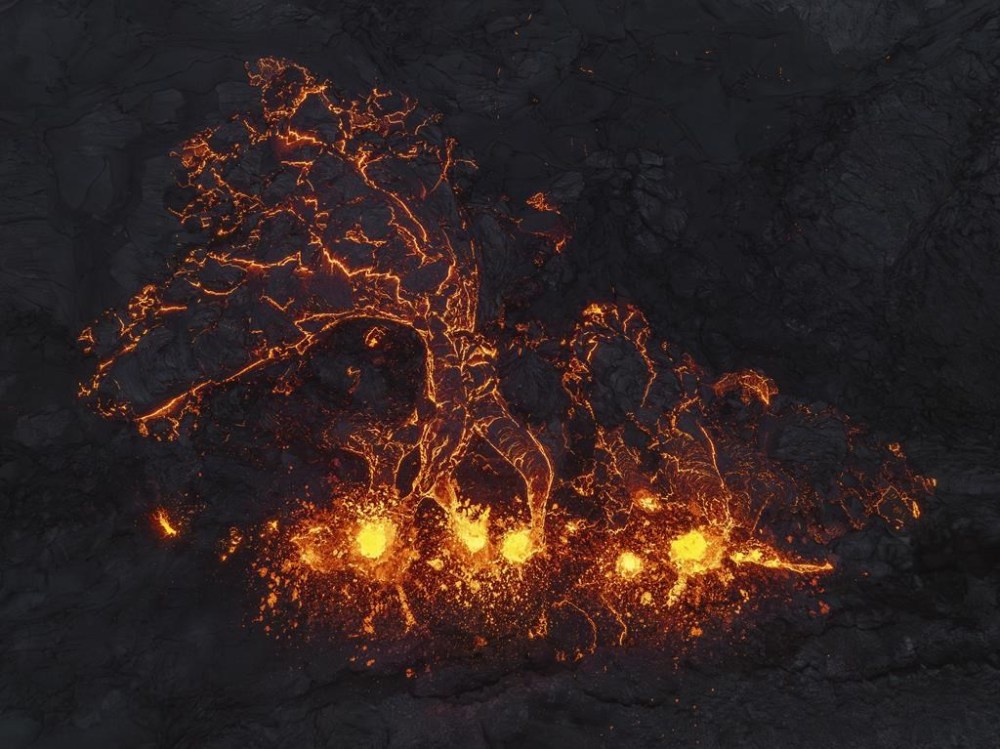
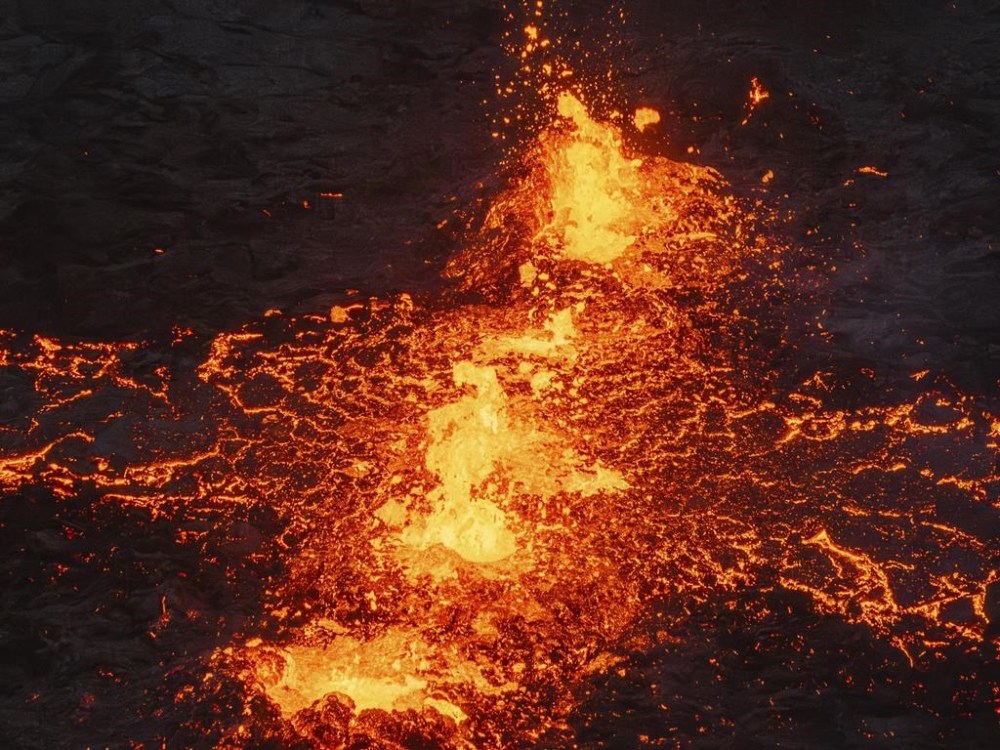
“These jets of magma are reaching like 50 meters (165 feet), into the atmosphere,” said McGarvie, an honorary researcher at Lancaster University. “That just immediately strikes me as a powerful eruption. And that was my first impression … then some numbers came out, estimating how much was coming out per minute or per second and it was, ‘wow.’”
The activity once again threatened Grindavik, a coastal town of 3,800 people, and led to the evacuation of the popular Blue Lagoon geothermal spa, one of Iceland’s biggest tourist attractions.
Grindavik, which is about 50 kilometers (30 miles) southwest of Iceland’s capital, Reykjavik, has been threatened since a swarm of earthquakes in November forced an evacuation in advance of the initial Dec. 18 eruption. A subsequent eruption consumed several buildings.
Protective barriers outside Grindavik deflected the lava Wednesday but the evacuated town remained without electricity and two of the three roads into town were inundated with lava.
“I just like the situation quite well compared to how it looked at the beginning of the eruption yesterday,” Grindavik Mayor Fannar Jónasson told national broadcaster RUV.
McGarvie said the eruption was more powerful than the four that preceded it because the largest amount of magma had accumulated in a chamber underground before breaking the earth’s surface and shooting into the sky.
The rapid and powerful start of the eruption followed by it diminishing quickly several hours later is the pattern researchers have witnessed with this volcano, McGarvie said. It’s unknown when eruptions at this volcano will end.

“It could go on for quite some considerable time,” McGarvie said. “We’re really in new territory here because eruptions like this have never been witnessed, carefully, in this part of Iceland.”
Iceland, which sits above a volcanic hot spot in the North Atlantic, sees regular eruptions. The most disruptive in recent times was the 2010 eruption of the Eyjafjallajokull volcano, which spewed huge clouds of ash into the atmosphere and led to widespread airspace closures over Europe.
None of the current cycle of eruptions have had an impact on aviation.
___
Associated Press writer Brian Melley contributed from London.
Advertisement Advertise With Us
Advertisement Advertise With Us