NASA’s Voyager 1, the most distant spacecraft from Earth, is doing science again after problem
Advertisement
Read this article for free:
or
Already have an account? Log in here »
To continue reading, please subscribe:

Digital Subscription
One year of digital access for only $205*
- Enjoy unlimited reading on winnipegfreepress.com
- Read the E-Edition, our digital replica newspaper
- Access News Break, our award-winning app
- Play interactive puzzles
*First annual payment billed as $205.00 + GST for one year. This annual subscription will automatically renew at $233.00 + GST every 52 weeks (10% off the regular annual price of $259.35). Offer available to new and qualified returning subscribers only. Cancel any time.
To continue reading, please subscribe:
Add Free Press access to your Brandon Sun subscription for only an additional
$1 for the first 4 weeks*
- Enjoy unlimited reading on winnipegfreepress.com
- Read the E-Edition, our digital replica newspaper
- Access News Break, our award-winning app
- Play interactive puzzles
*Your next Brandon Sun subscription payment will increase by $1.00 and you will be charged $17.95 plus GST for four weeks. After four weeks, your payment will increase to $24.95 plus GST every four weeks.
Read unlimited articles for free today:
or
Already have an account? Log in here »
Hey there, time traveller!
This article was published 14/06/2024 (838 days ago), so information in it may no longer be current.
DALLAS (AP) — NASA’s Voyager 1, the most distant spacecraft from Earth, is sending science data again.
Voyager 1’s four instruments are back in business after a computer problem in November, the Jet Propulsion Laboratory said this week. The team first received meaningful information again from Voyager 1 in April, and recently commanded it to start studying its environment again.
Launched in 1977, Voyager 1 is drifting through interstellar space, or the space between star systems. Before reaching this region, the spacecraft discovered a thin ring around Jupiter and several of Saturn’s moons. Its instruments are designed to collect information about plasma waves, magnetic fields and particles.
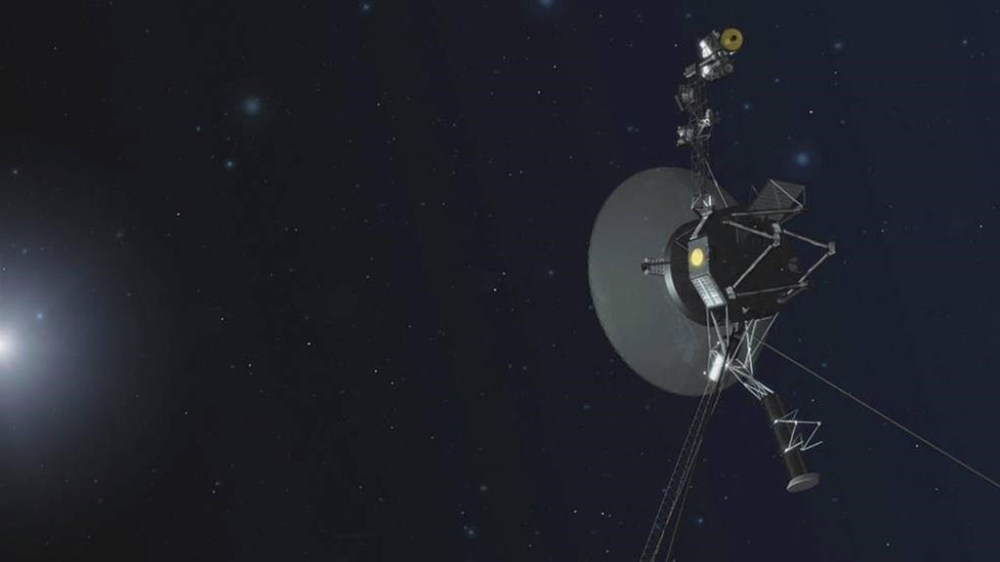
Voyager 1 is over 15 billion miles (24.14 billion kilometers) from Earth. Its twin Voyager 2 — also in interstellar space — is more than 12 billion miles (19.31 billion kilometers) away.
___
This story was first published on June 14, 2024. It was updated on June 17, 2024 to correct the metric distance Voyager 1 and Voyager 2 spacecraft are from Earth.
___
The Associated Press Health and Science Department receives support from the Howard Hughes Medical Institute’s Science and Educational Media Group. The AP is solely responsible for all content.