As AI gains a workplace foothold, states are trying to make sure workers don’t get left behind
Advertisement
Read this article for free:
or
Already have an account? Log in here »
To continue reading, please subscribe:

Digital Subscription
One year of digital access for only $205*
- Enjoy unlimited reading on winnipegfreepress.com
- Read the E-Edition, our digital replica newspaper
- Access News Break, our award-winning app
- Play interactive puzzles
*First annual payment billed as $205.00 + GST for one year. This annual subscription will automatically renew at $233.00 + GST every 52 weeks (10% off the regular annual price of $259.35). Offer available to new and qualified returning subscribers only. Cancel any time.
To continue reading, please subscribe:
Add Free Press access to your Brandon Sun subscription for only an additional
$1 for the first 4 weeks*
- Enjoy unlimited reading on winnipegfreepress.com
- Read the E-Edition, our digital replica newspaper
- Access News Break, our award-winning app
- Play interactive puzzles
*Your next Brandon Sun subscription payment will increase by $1.00 and you will be charged $17.95 plus GST for four weeks. After four weeks, your payment will increase to $24.95 plus GST every four weeks.
Read unlimited articles for free today:
or
Already have an account? Log in here »
Hey there, time traveller!
This article was published 28/06/2024 (809 days ago), so information in it may no longer be current.
HARTFORD, Conn. (AP) — With many jobs expected to eventually rely on generative artificial intelligence, states are trying to help workers beef up their tech skills before they become outdated and get outfoxed by machines that are becoming increasingly smarter.
Connecticut is working to create what proponents believe will be the country’s first Citizens AI Academy, a free online repository of curated classes that users can take to learn basic skills or obtain a certificate needed for employment.
“This is a rapidly evolving area,” said state Democratic Sen. James Maroney. “So we need to all learn what are the best sources for staying current. How can we update our skills? Who can be trusted sources?”
Determining what skills are necessary in an AI world can be a challenge for state legislators given the fast-moving nature of the technology and differing opinions about what approach is best.
Gregory LaBlanc, professor of Finance, Strategy and Law at the Haas School of Business at Berkeley Law School in California, says workers should be taught how to use and manage generative AI rather than how the technology works, partly because computers will soon be better able to perform certain tasks previously performed by humans.
“What we need is to lean into things that complement AI as opposed to learning to be really bad imitators of AI,” he said. “We need to figure out what is AI not good at and then teach those things. And those things are generally things like creativity, empathy, high level problem solving.”
He said historically people have not needed to understand technological advancements in order for them to succeed.
“When when electricity came along, we didn’t tell everybody that they needed to become electrical engineers,” LeBlanc said.
This year, at least four states — Connecticut, California, Mississippi and Maryland — proposed legislation that attempted to deal with AI in the classroom somehow. They ranged from Connecticut’s planned AI Academy, which was originally included in a wide-ranging AI regulation bill that failed but the concept is still being developed by state education officials, to proposed working groups that examine how AI can be incorporated safely in public schools. Such a bill died in the Mississippi legislature while the others remain in flux.
One bill in California would require a state working group to consider incorporating AI literacy skills into math, science, history and social science curriculums.
“AI has the potential to positively impact the way we live, but only if we know how to use it, and use it responsibly,” said the bill’s author, Assemblymember Marc Berman, in a statement. “No matter their future profession, we must ensure that all students understand basic AI principles and applications, that they have the skills to recognize when AI is employed, and are aware of AI’s implications, limitations, and ethical considerations.”
The bill is backed by the California Chamber of Commerce. CalChamber Policy Advocate Ronak Daylami said in a statement that incorporating information into existing school curricula will “dispel the stigma and mystique of the technology, not only helping students become more discerning and intentional users and consumers of AI, but also better positioning future generations of workers to succeed in an AI-driven workforce and hopefully inspiring the next generation of computer scientists.”
While Connecticut’s planned AI Academy is expected to offer certificates to people who complete certain skills programs that might be needed for careers, Maroney said the academy will also include the basics, from digital literacy to how to pose questions to a chatbot.
He said it’s important for people to have the skills to understand, evaluate and effectively interact with AI technologies, whether it’s a chatbot or machines that learn to identify problems and make decisions that mimic human decision-making.
“Most jobs are going to require some form of literacy,” Maroney said. “I think that if you aren’t learning how to use it, you’ll be at a disadvantage.”
A September 2023 study released by the job-search company Indeed found all U.S. jobs listed on the platform had skills that could be performed or augmented by generative AI. Nearly 20% of the jobs were considered “highly exposed,” which means the technology is considered good or excellent at 80% or more of the skills that were mentioned in the Indeed job listings.
Nearly 46% of the jobs on the platform were “moderately exposed,” which means the GenAI can perform 50% to 80% of the skills.
Maroney said he is concerned how that skills gap — coupled with a lack of access to high-speed internet, computers and smart phones in some underserved communities — will exacerbate the inequity problem.
A report released in February from McKinsey and Company, a global management consulting firm, projected that generative AI could increase household wealth in the U.S. by nearly $500 billion by 2045, but it would also increase the wealth gap between Black and white households by $43 billion annually.
Advocates have been working for years to narrow the nation’s digital skills gap, often focusing on the basics of computer literacy and improving access to reliable internet and devices, especially for people living in urban and rural areas. The advent of AI brings additional challenges to that task, said Marvin Venay, chief external affairs and advocacy officer for the Massachusetts-based organization Bring Tech Home.
“Education must be included in order for this to really take off publicly … in a manner which is going to give people the ability to eliminate their barriers,” he said of AI. “And it has to be able to explain to the most common individual why it is not only a useful tool, but why this tool will be something that can be trusted.”
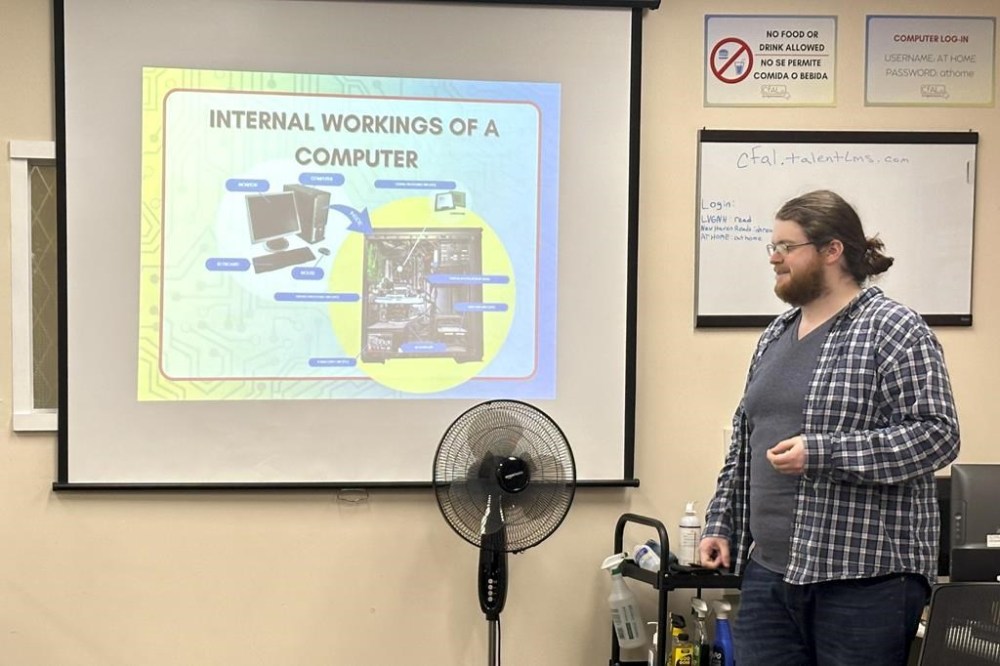
Tesha Tramontano-Kelly, executive director of the Connecticut-based group CfAL for Digital Inclusion, said she worries lawmakers are “putting the cart before the horse” when it comes to talking about AI training. Ninety percent of the youths and adults who use her organization’s free digital literacy classes don’t have a computer in the home.
While Connecticut is considered technologically advanced compared to many other states and nearly every household can get internet service, a recent state digital equity study found only about three-quarters subscribe to broadband. A survey conducted as part of the study found 47% of respondents find it somewhat or very difficult to afford internet service.
Of residents who reported household income at or below 150% of the federal poverty level, 32% don’t own a computer and 13% don’t own any internet enabled device.
Tramontano-Kelly said ensuring the internet is accessible and technology equipment is affordable are important first steps.
“So teaching people about AI is super important. I 100% agree with this,” she said. “But the conversation also needs to be about everything else that goes along with AI.”