Crew of NASA’s earthbound simulated Mars habitat emerge after a year

Advertisement

Advertise with us

The crew of a NASA mission to Mars emerged from their craft after a yearlong voyage that never left Earth.

Read this article for free:


or

Already have an account? Log in here »

To continue reading, please subscribe:

Subscribe and receive a limited-edition Free Press branded hat or tote.

Digital Subscription

One year of digital access for only $205*

  • Enjoy unlimited reading on winnipegfreepress.com
  • Read the E-Edition, our digital replica newspaper
  • Access News Break, our award-winning app
  • Play interactive puzzles

*First annual payment billed as $205.00 + GST for one year. This annual subscription will automatically renew at $233.00 + GST every 52 weeks (10% off the regular annual price of $259.35). Offer available to new and qualified returning subscribers only. Cancel any time.

To continue reading, please subscribe:

Add Free Press access to your Brandon Sun subscription for only an additional

$1 for the first 4 weeks*

  • Enjoy unlimited reading on winnipegfreepress.com
  • Read the E-Edition, our digital replica newspaper
  • Access News Break, our award-winning app
  • Play interactive puzzles
Start now

*Your next Brandon Sun subscription payment will increase by $1.00 and you will be charged $17.95 plus GST for four weeks. After four weeks, your payment will increase to $24.95 plus GST every four weeks.

Hey there, time traveller!
This article was published 07/07/2024 (816 days ago), so information in it may no longer be current.

The crew of a NASA mission to Mars emerged from their craft after a yearlong voyage that never left Earth.

The four volunteer crew members spent more than 12 months inside NASA’s first simulated Mars environment at Johnson Space Center in Houston, coming out of the artificial alien enviroment Saturday around 5 p.m.

Kelly Haston, Anca Selariu, Ross Brockwell and Nathan Jones entered the 3D-printed habitat on June 25, 2023, as the maiden crew of the space agency’s Crew Health and Performance Exploration Analog project.
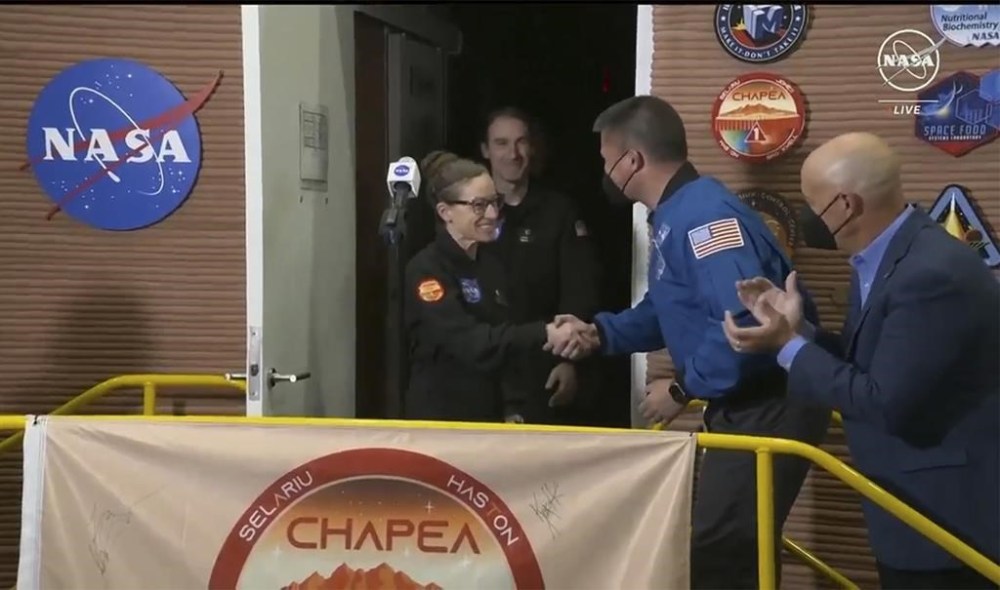
In this image made from video provided by NASA, the crew members of the first CHAPEA mission, Kelly Haston, center, shakes hands with NASA Deputy Director Flight Missions Kjell Lindgren, second right, as other crew Ross Brockwell, emerges from their craft, Saturday, July 6, 2024, at Johnson Space Center in Houston, Texas. The crew of a NASA mission to Mars emerged from their craft after a yearlong voyage that never left Earth. The four volunteers crew members spent more than 12 months inside NASA's first simulated Mars environment at Johnson Space Center in Houston, coming out of the artificial alien environment Saturday. (NASA via AP)

Haston, the mission commander, began with a simple, “Hello.”

“It’s actually just so wonderful to be able to say ‘hello’ to you all,” she said.

Jones, a physician and the mission medical officer, said their 378 days in confinement “went by quickly.”

The quartet lived and worked inside the space of 1,700 square feet (157 square meters) to simulate a mission to the red planet, the fourth from the sun and a frequent focus of discussion among scientists and sci-fi fans alike concerning a possible voyage taking humans beyond our moon.

The first CHAPEA crew focused on establishing possible conditions for future Mars operations through simulated spacewalks, dubbed “Marswalks,” as well as growing and harvesting vegetables to supplement their provisions and maintaining the habitat and their equipment.

They also worked through challenges a real Mars crew would be expected to experience including limited resources, isolation and delays in communication of up to 22 minutes with their home planet on the other side of the habitat’s walls, NASA said.

Two additional CHAPEA missions are planned and crews will continue conducting simulated spacewalks and gathering data on factors related to physical and behavioral health and performance, NASA said.

Steve Koerner, deputy director of Johnson Space Center, said most of the first crew’s experimentation focused on nutrition and how that affected their performance. The work was “crucial science as we prepare to send people on to the red planet,” he said.

“They’ve been separated from their families, placed on a carefully prescribed meal plan and undergone a lot of observation,” Koerner said.

“Mars is our goal,” he said, calling the project an important step in America’s intent to be a leader in the global space exploration effort.

Emerging after a knock on the habitat’s door by Kjell Lindgren, an astronaut and the deputy director of flight operations, the four volunteers spoke of the gratitude they had for each other and those who waited patiently outside, as well as lessons learned about a prospective manned mission to Mars and life on Earth.
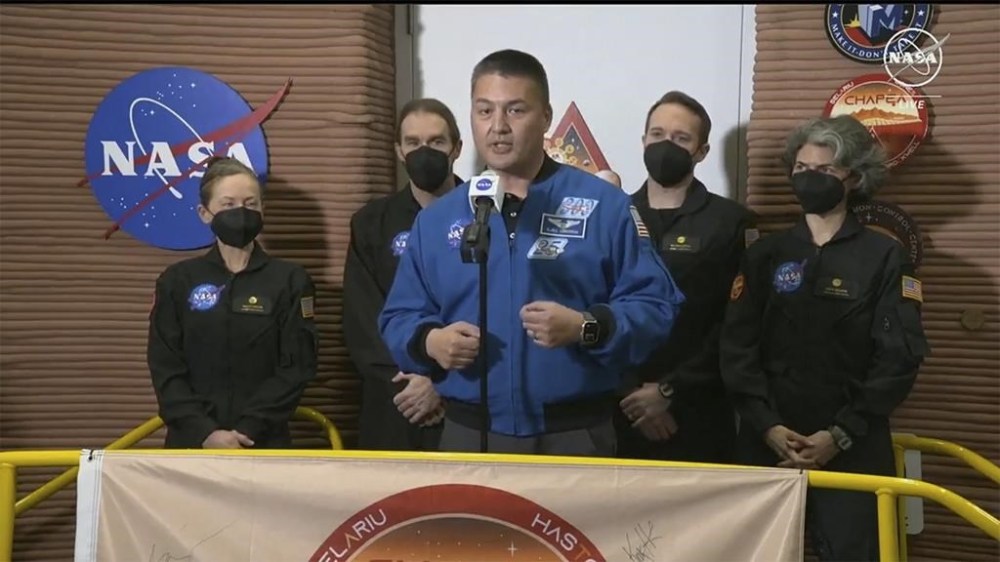
In this image made from video provided by NASA, NASA Deputy Director Flight Missions Kjell Lindgren, center, speaks in front of the crew members of the first CHAPEA mission, from left to right, Kelly Haston, Ross Brockwell, Nathan Jones, and Anca Selariu, after they emerged from their craft, Saturday, July 6, 2024, at Johnson Space Center in Houston, Texas. The crew of a NASA mission to Mars emerged from their craft after a yearlong voyage that never left Earth. (NASA via AP)

Brockwell, the crew’s flight engineer, said the mission showed him the importance of living sustainably for the benefit of everyone on Earth.

“I’m very grateful to have had this incredible opportunity to live for a year within the spirit of planetary adventure towards an exciting future, and I’m grateful for the chance to live the idea that we must utilise resources no faster than they can be replenished and produce waste no faster than they can be processed back into resources,” Brockwell said.

“We cannot live, dream, create or explore on any significant timeframe if we don’t live these principles, but if we do, we can achieve and sustain amazing and inspiring things like exploring other worlds,” he said.

Science officer Anca Selariu said she had been asked many times why there is a fixation on Mars.

“Why go to Mars? Because it’s possible,” she said. “Because space can unite and bring out the best in us. Because it’s one defining step that ‘Earthlings’ will take to light the way into the next centuries.”

____

This story has been updated to correct that the crew members lived in 1,700 square feet of space, not 17,000.


Report Error Submit a Tip

More Stories

Letters, Oct. 1

7 minute read Preview

Letters, Oct. 1

7 minute read Updated: 7:45 AM CDT

Did anyone else see the irony when Premier Wab Kinew announced at the Selkirk Mental Health Centre that Manitoba would adopt permanent Daylight Time (DT) and had hired 17 new psychiatrists this year?

Read
Updated: 7:45 AM CDT

Hero fought to remember children lost at residential school

Niigaan Sinclair 5 minute read Preview

Hero fought to remember children lost at residential school

Niigaan Sinclair 5 minute read Tuesday, Sep. 29, 2026

The story of the gravesites of students who attended the Brandon Indian Residential School underneath the Turtle Crossing Campground is truly a Manitoba tragedy.

Read
Tuesday, Sep. 29, 2026

Port of Churchill signs agreement with Dutch port

Aaron Epp 2 minute read Preview

Port of Churchill signs agreement with Dutch port

Aaron Epp 2 minute read Tuesday, Sep. 29, 2026

Arctic Gateway Group, operator of the Port of Churchill, has signed an agreement with the Port of Rotterdam in the Netherlands to attract business and strengthen supply chains linking Western Canada and Europe.

The agreement enables the two ports to work together to develop new trade in critical minerals and energy products, connect Canadian producers with European buyers, and identify opportunities to improve the supply chain from Western Canadian resource projects through Churchill and into European markets.

The Port of Rotterdam is Europe’s largest port and home to more than 3,000 businesses across its industrial complex, serving as a major gateway for critical raw materials and energy.

Meanwhile, the Port of Churchill has been identified as a transformative national strategy for Canada and is emerging as a northern trade corridor connecting Western Canada’s resources to global markets.

Read
Tuesday, Sep. 29, 2026

What’s up

5 minute read Preview

What’s up

5 minute read Updated: 8:22 AM CDT

Connection: Recent Work from Artist Moms 2.0Community Art Gallery at the Pavilion, Assiniboine Park, 55 Pavilion Cres.Artist talk Saturday, 2 p.m.FreeWhat does it mean to mother in a time of global, social and environmental uncertainty? What does it mean to be the village?

This group exhibition featuring 20 Winnipeg artist mothers affiliated with Mentoring Artists for Women’s Art connects the individual experiences of motherhood with broader concerns, exploring themes of memory, nostalgia, grief, loss and care through embroidery, painting, printmaking, poetry, sculpture, installation and mixed media.

“My work is both personal and political, concerned not only with our responsibilities to our own families but also with what it means to be a caregiver in a world threatened by greed, violence and environmental harm,” said artist and group organizer Allison Moore in a release.

The gallery will host a series of artist talks on Saturdays, Oct. 3, 17 and 24, from 2 to 4 p.m. Connection is on view until Nov. 22.

Read
Updated: 8:22 AM CDT

What’s open, what’s closed, what’s up in Winnipeg on National Day for Truth and Reconciliation Sept. 30, 2026

Free Press staff 4 minute read Preview

What’s open, what’s closed, what’s up in Winnipeg on National Day for Truth and Reconciliation Sept. 30, 2026

Free Press staff 4 minute read Sunday, Sep. 27, 2026

The National Day of Truth and Reconciliation, or Orange Shirt Day, as it's known in Manitoba, happens Sept. 30 with many commemorative community events scheduled.

Read
Sunday, Sep. 27, 2026

Man accused of killing five family members fires second legal team, but murder trial won’t be delayed, judge warns

Dean Pritchard 3 minute read Preview

Man accused of killing five family members fires second legal team, but murder trial won’t be delayed, judge warns

Dean Pritchard 3 minute read 2:52 PM CDT

A Manitoba man accused of killing five family members is once again looking for new lawyers to represent him at trial.

But Ryan Manoakeesick will stand trial, with or without a lawyer in April 2027, a judge warned him Thursday.

“I want to be clear, Mr. Manoakeesick, that the trial dates that have been set are going to remain,” King’s Bench Justice Candace Grammond told him. “Those trial dates are effectively written in stone.

“You may think that is a long time in the future, but in a trial of this kind you need to make sure you have appropriate representation and you will be ready to attend to the matter on that date.”

Read
2:52 PM CDT