Older Americans prepare themselves for a world altered by artificial intelligence
Advertisement
Read this article for free:
or
Already have an account? Log in here »
To continue reading, please subscribe:

Digital Subscription
One year of digital access for only $205*
- Enjoy unlimited reading on winnipegfreepress.com
- Read the E-Edition, our digital replica newspaper
- Access News Break, our award-winning app
- Play interactive puzzles
*First annual payment billed as $205.00 + GST for one year. This annual subscription will automatically renew at $233.00 + GST every 52 weeks (10% off the regular annual price of $259.35). Offer available to new and qualified returning subscribers only. Cancel any time.
To continue reading, please subscribe:
Add Free Press access to your Brandon Sun subscription for only an additional
$1 for the first 4 weeks*
- Enjoy unlimited reading on winnipegfreepress.com
- Read the E-Edition, our digital replica newspaper
- Access News Break, our award-winning app
- Play interactive puzzles
*Your next Brandon Sun subscription payment will increase by $1.00 and you will be charged $17.95 plus GST for four weeks. After four weeks, your payment will increase to $24.95 plus GST every four weeks.
Read unlimited articles for free today:
or
Already have an account? Log in here »
Hey there, time traveller!
This article was published 12/08/2024 (775 days ago), so information in it may no longer be current.
NORTHFIELD, Ill. (AP) — The students — most with gray hair, some with canes, all at least in their 60s — couldn’t believe what they were hearing.
“Oh, my God,” whispered a retired college professor.
“Does it come with viruses?” wondered a bewildered woman scribbling notes in the second row.
A 79-year-old in a black-and-white floral shirt then asked the question on many minds: “How do you know if it is fake or not?”
This is how older adults — many of whom lived through the advent of refrigeration, the transition from radio to television and the invention of the internet — are grappling with artificial intelligence: taking a class. Sitting in a classroom in an airy senior center in a Chicago suburb, the dozen students were learning about the latest — and possibly greatest — technological leap in their lives.
And they are not alone. Across the country, scores of such classes have sprung up to teach seniors about AI’s ability to transform their lives and the threats the technology poses.
“I saw ice boxes turn into refrigerators, that is how long I have been around,” said Barbara Winston, 89, who paid to attend the class put on at the North Shore Senior Center in Northfield. “And I think this is probably the greatest technical revolution that I will see in my lifetime.”
Older adults find themselves in a unique moment with technology. Artificial intelligence offers significant benefits for seniors, from the ability to curb loneliness to making it easier for them to get to medical appointments.
But it also has drawbacks that are uniquely threatening to this older group of Americans: A series of studies have found that senior citizens are more susceptible to both scams perpetrated using artificial intelligence and believing the types of misinformation that are being supercharged by the technology. Experts are particularly concerned about the role deepfakes and other AI-produced misinformation could play in politics.
Winston left the class to start her own AI journey, even if others remained skeptical. When she got home, the retired professor downloaded books on the technology, researched the platforms she wanted to use from her kitchen table and eventually queried ChatGPT about how to treat a personal medical ailment.
“This is the beginning of my education,” she said, her floral cup of coffee nearby. “I’m not worried about protecting myself. I’m too old to worry about that.”
Classes like these aim to familiarize aging early adopters with the myriad ways the technology could better their lives but also encourage skepticism about how artificial intelligence can distort the truth.
Balanced skepticism, say experts on the technology, is critical for seniors who plan to interact with AI.

“It’s tricky,” said Michael Gershbein, the instructor of the class in Northfield. “Overall, the suspicion that is there on the part of seniors is good but I don’t want them to become paralyzed from their fears and not be willing to do anything online.”
The questions in his class outside Chicago ranged from the absurd to the practical to the academic. Why are so many new shoes no longer including shoelaces? Can AI create a multiday itinerary for a visit to Charleston, South Carolina? What are the geopolitical implications of artificial intelligence?
Gershbein, who teaches classes on a range of technological topics, said interest in AI has ballooned in the last nine months. The 52-year-old teaches an AI course once or twice a week, he said, and aims to create a “safe space where (seniors) can come in and we can discuss all the issues they may be hearing bits and pieces of but we can put it all together and they can ask questions.”
During a 90-minute-long session on a June Thursday, Gershbein discussed deepfakes — videos that use generative AI to make it appear someone said something they did not. When he played a few deepfakes, the seniors sat agog. They could not believe how real the fakes seemed. There are widespread concerns that such videos could be used to trick voters, especially seniors.
The threats to seniors go beyond politics, however, and range from basic misinformation on social media sites to scams that use voice-cloning technology to trick them. An AARP report published last year said that Americans over 60 lose $28.3 billion annually to financial extortion schemes, some assisted by AI.
Experts from the National Council on Aging, an organization established in 1950 to advocate for seniors, said classes on AI at senior centers have increased in recent years and are at the forefront of digital literacy efforts.
“There’s a myth out there that older adults don’t use technology. We know that that’s not true,” said Dianne Stone, associate director at the National Council on Aging who ran a senior center in Connecticut for over two decades. Such courses, she said, are meant to foster a “healthy skepticism” in what the technology can do, arming older Americans with the knowledge “that not everything you hear is true, it’s good to get the information, but you have to kind of sort it out for yourself.”
Striking that balance, said Siwei Lyu, a University at Buffalo professor, can be difficult, and classes tend to either promote AI’s benefits or focus on its dangers.
“We need this kind of education for seniors, but the approach we take has to be very balanced and well-designed,” said Lyu, who has lectured to seniors and other groups.
Seniors who have taken such AI classes said they came away with a clear understanding of AI’s benefits and pitfalls.
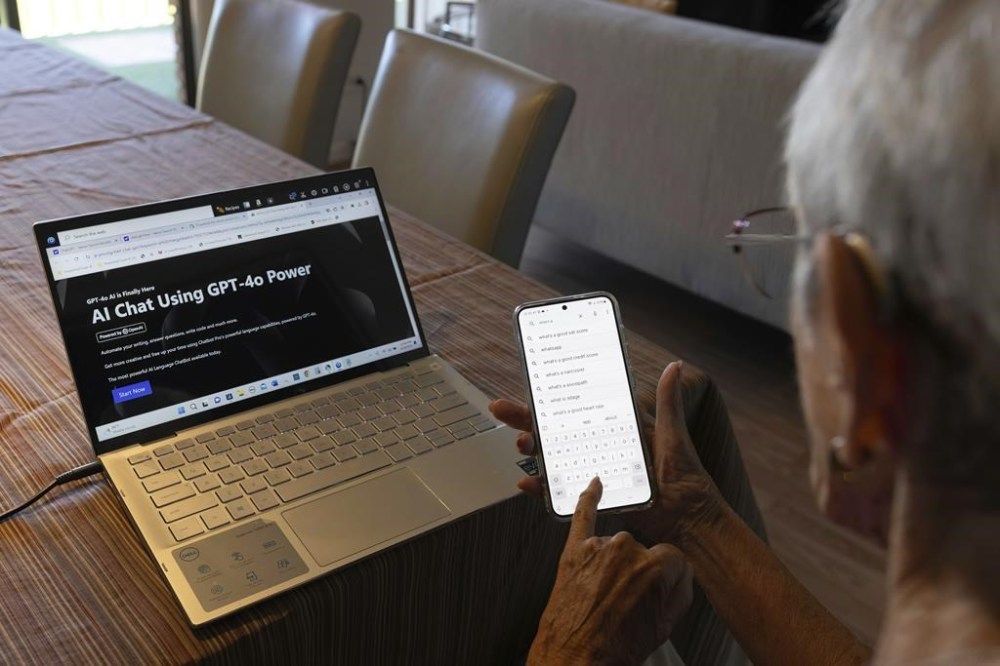
“It’s only as good as the people who program it, and the users need to understand that. You really have to question it,” said Linda Chipko, a 70-year-old who attended an AI class in June in suburban Atlanta.
Chipko said she took the class because she wanted to “understand” AI, but on her way out said, “It’s not for me.”
Others have even embraced it. Ruth Schneiderman, 77, used AI to help illustrate a children’s book she was writing, and that experience sparked her interest in taking the Northfield class to learn more about the technology.
“My mother lived until she was 90,” Schneiderman said, “and I learned from her if you want to survive in this world, you have to adjust to the change. Otherwise you are left behind.”
___
The Associated Press receives financial assistance from the Omidyar Network to support coverage of artificial intelligence and its impact on society. AP is solely responsible for all content. Find AP’s standards for working with philanthropies, a list of supporters and funded coverage areas at AP.org