Google faces a new antitrust trial after ruling declaring search engine a monopoly

Advertisement

Advertise with us

ALEXANDRIA, Va. (AP) — One month after a judge declared Google's search engine an illegal monopoly, the tech giant faces another antitrust lawsuit that threatens to break up the company, this time over its advertising technology.

Read this article for free:


or

Already have an account? Log in here »

To continue reading, please subscribe:

Subscribe and receive a limited-edition Free Press branded hat or tote.

Digital Subscription

One year of digital access for only $205*

  • Enjoy unlimited reading on winnipegfreepress.com
  • Read the E-Edition, our digital replica newspaper
  • Access News Break, our award-winning app
  • Play interactive puzzles

*First annual payment billed as $205.00 + GST for one year. This annual subscription will automatically renew at $233.00 + GST every 52 weeks (10% off the regular annual price of $259.35). Offer available to new and qualified returning subscribers only. Cancel any time.

To continue reading, please subscribe:

Add Free Press access to your Brandon Sun subscription for only an additional

$1 for the first 4 weeks*

  • Enjoy unlimited reading on winnipegfreepress.com
  • Read the E-Edition, our digital replica newspaper
  • Access News Break, our award-winning app
  • Play interactive puzzles
Start now

*Your next Brandon Sun subscription payment will increase by $1.00 and you will be charged $17.95 plus GST for four weeks. After four weeks, your payment will increase to $24.95 plus GST every four weeks.

Hey there, time traveller!
This article was published 08/09/2024 (735 days ago), so information in it may no longer be current.

ALEXANDRIA, Va. (AP) — One month after a judge declared Google’s search engine an illegal monopoly, the tech giant faces another antitrust lawsuit that threatens to break up the company, this time over its advertising technology.

The Justice Department, joined by a coalition of states, and Google each made opening statements Monday to a federal judge in Alexandria, Virginia, who will decide whether Google holds a monopoly over online advertising technology.

The regulators contend that Google built, acquired and maintains a monopoly over the technology that matches online publishers to advertisers. Dominance over the software on both the buy side and the sell side of the transaction enables Google to keep as much as 36 cents on the dollar when it brokers sales between publishers and advertisers, the government contends.

FILE - A sign at Google headquarters in Mountain View, Calif. is shown on Oct. 8, 2010. (AP Photo/Paul Sakuma, File)

They allege that Google also controls the ad exchange market, which matches the buy side to the sell side.

“One monopoly is bad enough. But a trifecta of monopolies is what we have here,” Justice Department lawyer Julia Tarver Wood said during her opening statement.

Google says the government’s case is based on an internet of yesteryear, when desktop computers ruled and internet users carefully typed precise World Wide Web addresses into URL fields. Advertisers now are more likely to turn to social media companies like TikTok or streaming TV services like Peacock.

In her opening statement, Google lawyer Karen Dunn likened the government’s case to a “time capsule with a Blackberry, an iPod and a Blockbuster video card.”

Dunn said Supreme Court precedents warn judges about “the serious risk of error or unintended consequences” when dealing with rapidly emerging technology and considering whether antitrust law requires intervention. She also warned that any action taken against Google won’t benefit small businesses but will simply allow other tech behemoths like Amazon, Microsoft and TikTok to fill the void.

According to Google’s annual reports, revenue has actually declined in recent years for Google Networks, the division of the Mountain View, California-based tech giant that includes such services as AdSense and Google Ad Manager that are at the heart of the case, from $31.7 billion in 2021 to $31.3 billion in 2023.

The case will now be decided by U.S. District Judge Leonie Brinkema, who is best known for high-profile terrorism trials including that of Sept. 11 defendant Zacarias Moussaoui. Brinkema, though, also has experience with highly technical civil trials, working in a courthouse that sees an outsize number of patent infringement cases.

The Virginia case comes on the heels of a major defeat for Google over its search engine. A judge in the District of Columbia declared the search engine a monopoly, maintained in part by tens of billions of dollars Google pays each year to companies like Apple to lock in Google as the default search engine presented to consumers when they buy iPhones and other gadgets.

And in December, a judge declared Google’s Android app store a monopoly in a case brought by a private gaming company.

In the search engine case, the judge has not yet imposed any remedies. The government hasn’t offered its proposed sanctions, though there could be close scrutiny over whether Google should be allowed to continue to make exclusivity deals that ensure its search engine is consumers’ default option.
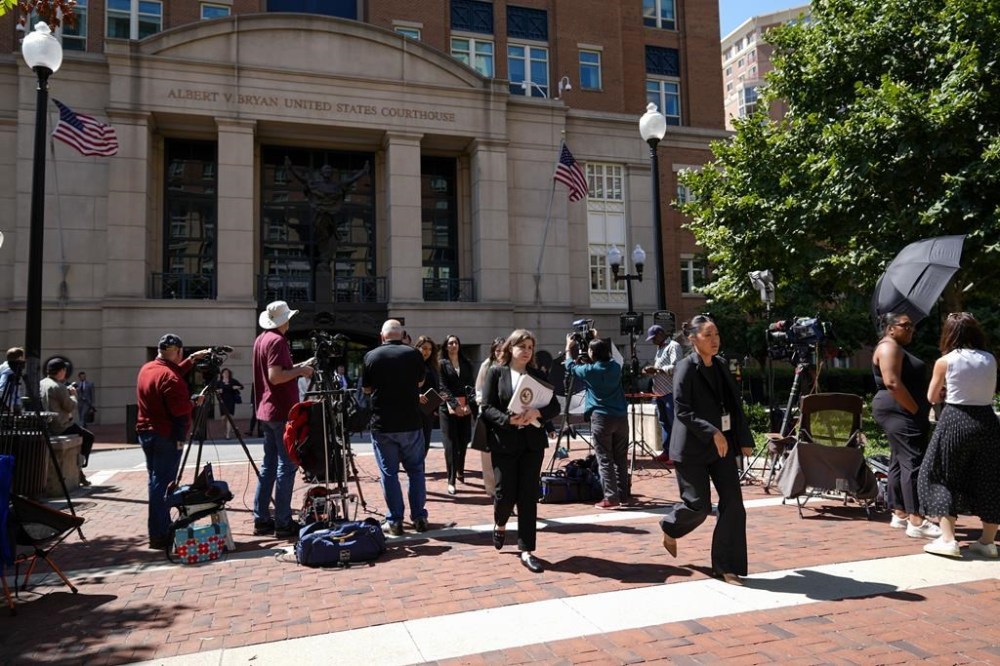
Lawyers and legal assistants leave the U.S. District Court for the Eastern District of Virginia for a lunch break in the Department of Justice's antitrust trial against tech giant Google, Monday, Sept. 9, 2024, in Alexandria, Va. (AP Photo/Stephanie Scarbrough)

Peter Cohan, a professor of management practice at Babson College, said the Virginia case could potentially be more harmful to Google because the obvious remedy would be requiring it to sell off parts of its ad tech business that generate billions of dollars in annual revenue.

“Divestitures are definitely a possible remedy for this second case,” Cohan said “It could be potentially more significant than initially meets the eye.”

Google is also facing intensifying pressure over its ad tech business across the Atlantic. British competition regulators last week accused the company of abusing its dominance in the country’s digital ad market and giving preference to its own services. European Union antitrust enforcers carrying out their own investigation suggested last year that breaking up the company was the only way to satisfy competition concerns about its digital ad business

In the Virginia trial, the government’s witnesses will include executives from newspaper publishers that the government contends have faced particular harm from Google’s practices.

“Google extracted extraordinary fees at the expense of the website publishers who make the open internet vibrant and valuable,” government lawyers wrote in court papers.

The government’s first witness was Tim Wolfe, an executive with Gannett Co., a newspaper chain that publishes USA Today as its flagship. Wolfe said Gannett feels like it has no choice but to continue to use Google’s ad tech products, even thought the company keeps 20 cents on the dollar from every ad purchase, not even accounting for what it takes from the advertisers. He said Gannett simply can’t give up access to the huge stable of advertisers that Google brings to the ad exchange.

On cross-examination, Wolfe acknowledged that despite Google’s supposed monopoly, Gannett was able to work with other competitors to sell its available inventory to advertisers.

The government’s case also attempts to use the words of Google’s own employees against them. In openings, Justice Department lawyers cited an email sent by a Google employee wondering whether Google’s control of the technology on all three sides presented “a deeper issue” to consider.

“The analogy would be if Goldman or Citibank owned the NYSE (New York Stock Exchange),” wrote the employee Jonathan Bellack.
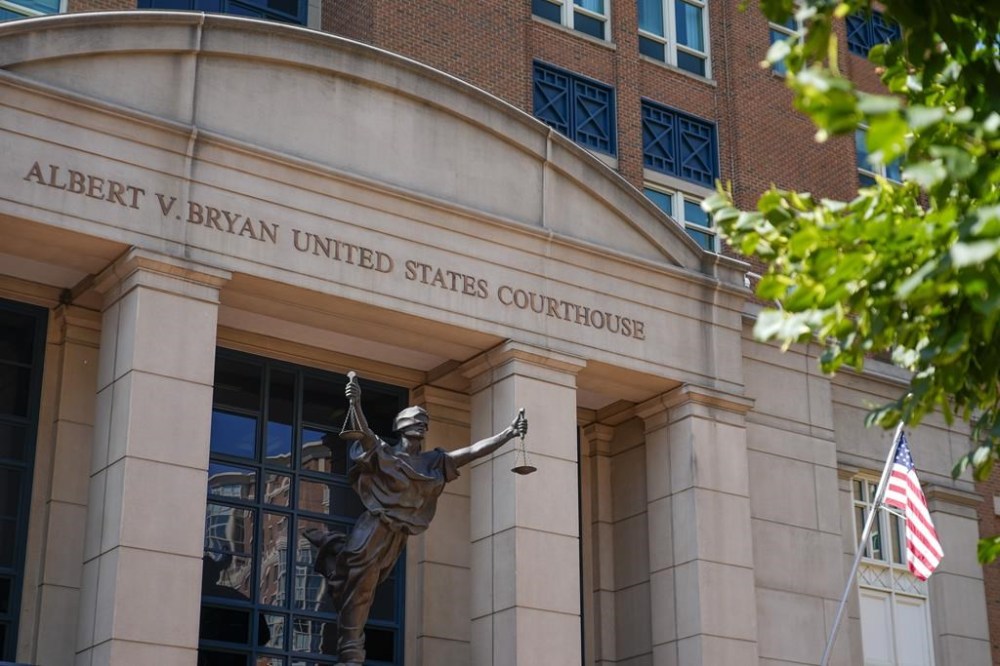
The U.S. District Court for the Eastern District of Virginia is seen Monday, Sept. 9, 2024, in Alexandria, Va. One month after a judge declared Google's search engine an illegal monopoly, the tech giant faces another antitrust lawsuit that threatens to break up the company, this time over its advertising technology. (AP Photo/Stephanie Scarbrough)

Google asserts the integration of its technology on the buy side, sell side and in the middle assures ads and web pages load quickly and enhance security.

Google says the government’s case is improperly focused on display ads and banner ads that load on web pages accessed through a desktop computer and fails to take into account consumers’ migration to mobile apps and the boom in ads placed on social media sites over the last 15 years.

The government’s case “focuses on a limited type of advertising viewed on a narrow subset of websites when user attention migrated elsewhere years ago,” Google’s lawyers wrote in a pretrial filing.

The trial is expected to last several weeks.

___

AP Business Writer Kelvin Chan contributed to this report from London.

Report Error Submit a Tip

More Stories

The port of Churchill — but done right

Editorial 4 minute read Preview

The port of Churchill — but done right

Editorial 4 minute read Yesterday at 2:00 AM CDT

The seagoing grain carrier wasn’t christened with a champagne bottle. There was no confetti or streamers. Nevertheless, the Aug. 31 event marking the first shipment of grain to be loaded at the Port of Churchill since 2020 was celebrated like the launch of a brand new vessel.

The presence of the federal minister of northern and arctic affairs, provincial cabinet ministers and leaders and elders from several northern First Nations signalled that the fast-tracked process of refurbishing and buffing up Manitoba’s deep-water seaport gem is gaining momentum.

For OneNorth, the partnership of 29 First Nations and 12 northern communities which owns the Port of Churchill and the Hudson Bay Railway (both operated by the Arctic Gateway Group) the event heralded a new beginning. It’s been eight years since OneNorth purchased the port and railroad, and six years since grain was moved by rail through Manitoba and then by ship to European markets. Two more grain shipments, plus shipments of potash and critical minerals, will continue through the fall.

When Prime Minister Mark Carney solicited the premiers to suggest “nation-building” projects following his election in 2025, Premier Wab Kinew pitched a Manitoba trade corridor that would move wheat, critical minerals, potash and energy (oil or liquid natural gas) through the Port of Churchill.

Read
Yesterday at 2:00 AM CDT

Retired sportscaster Scott Oake determined as fundraising for women's addictions treatment facility enters home stretch

Melissa Martin 5 minute read Preview

Retired sportscaster Scott Oake determined as fundraising for women's addictions treatment facility enters home stretch

Melissa Martin 5 minute read Thursday, Sep. 10, 2026

For now, the patch of land just east of the Victoria Hospital doesn’t look like much: just a field of rocks, mounded dirt, and concrete piles driven into the earth. Yet when Scott Oake looks over the site, he can already imagine how it will look in just over a year’s time, when the new Anne Oake Family Recovery Centre is expected to open.

It’s easier to picture this time around. In 2020, when the recently-retired CBC sportscaster and his late wife, Anne, were building their first labour of intermingled grief and love, the Bruce Oake Recovery Centre for men, it was hard for him to wrap his mind around how a raw construction site could transform into a welcoming addictions treatment facility.

When that centre opened in 2021, Oake found it looked “almost identical” to the architect’s renderings. So it’s easy to hope the Anne Oake Centre will be the same. It will be the first facility of its kind, its founders believe, not only in Canada but in North America: a place where 50 to 70 women can pursue sobriety while staying with their children.

“At Bruce Oake there’s a culture of love, and most of all a culture of hope,” Oake said, speaking at the site Thursday after a media conference to announce the final push of the centre’s fundraising campaign. “I can feel it every time I walk into that building. And I know it will be the same here.”

Read
Thursday, Sep. 10, 2026

Port of Churchill expansion could chase belugas away, U of M researcher says

Nicole Buffie 4 minute read Preview

Port of Churchill expansion could chase belugas away, U of M researcher says

Nicole Buffie 4 minute read 9:07 AM CDT

As plans to expand the Port of Churchill into a four-season trade corridor gathers momentum, a University of Manitoba researcher has published a report on what ship traffic could mean for the beluga whales that gather in the Churchill River estuary each summer.

Veronica Coppolaro said more vessels in the waterways bring a risk that belugas will stop using the estuary for migration, which would impact the ecological landscape, tourism and communities that rely on the animals for food and cultural purposes.

“There are studies showing that (noises) change the way they swim, they change the way (the whales) are vocalizing, they change their main activity, and so this (expansion) can have consequences at different levels,” she said.

The Churchill river estuary is a marine habitat where the Churchill River empties into Hudson Bay. During the summer months belugas gather in the area to feed and give birth.

Read
9:07 AM CDT

Child hospitalized after being hit in Walmart parking lot

1 minute read Yesterday at 3:46 PM CDT

Police are investigating after a child was struck by a vehicle in a Walmart parking lot on Kenaston Boulevard Friday evening.

At 9 p.m. officers from the Winnipeg Police Service traffic division attended to a motor vehicle-pedestrian collision in the 1600 block of Kenaston, police said Saturday.

A school-aged child was taken to hospital in unstable condition, police said, but the child was later upgraded to stable condition.

Police said the child sustained minor injuries and an investigation is ongoing.

Tory health critic ‘disappointed’ after being rebuffed by health officials

Carol Sanders 4 minute read Preview

Tory health critic ‘disappointed’ after being rebuffed by health officials

Carol Sanders 4 minute read Yesterday at 11:53 AM CDT

The health critic for the Progressive Conservative party says her ability to get information about the accelerated reopening of Dauphin’s emergency department was stymied by Prairie Mountain Health officials because they refused to meet with her.

“I wanted to meet with PMH staff to discuss the status of the facility and the challenges they’re facing and getting services back online,” Kathleen Cook said Friday.

“I was very disappointed that Prairie Mountain Health declined me that opportunity.”

Cook said she asked for a meeting a few days after the Sept. 7 reopening of a temporary ER at the hospital, that was severely damaged by flooding.

Read
Yesterday at 11:53 AM CDT

Pokemon thieves clear out collectibles shop

Scott Billeck 5 minute read Preview

Pokemon thieves clear out collectibles shop

Scott Billeck 5 minute read Friday, Sep. 11, 2026

Terri Settle loved watching children walk into her collectibles shop to hunt for their favourite Pokemon cards.

After the latest break in stripped her shelves of much of the inventory, she’s not sure she’ll get to see it again.

Thieves broke into Terri’s Trinkets and Toys on Tuesday evening, punching through a grate and then the store’s bathroom wall to reach the storefront.

They made off with about $6,000 worth of merchandise, including all of the store’s Pokemon cards — about 7,000 of them — along with toys, Lego, jewelry, video games, a debit machine and personal laptop. They even took her vacuum cleaner.

Read
Friday, Sep. 11, 2026