Deadly flooding in Central Europe made twice as likely by climate change

Advertisement

Advertise with us

WASHINGTON (AP) — Human-caused climate change doubled the likelihood and intensified the heavy rains that led to devastating flooding in Central Europe earlier this month, a new flash study found.

Read this article for free:


or

Already have an account? Log in here »

To continue reading, please subscribe:

Subscribe and receive a limited-edition Free Press branded hat or tote.

Digital Subscription

One year of digital access for only $205*

  • Enjoy unlimited reading on winnipegfreepress.com
  • Read the E-Edition, our digital replica newspaper
  • Access News Break, our award-winning app
  • Play interactive puzzles

*First annual payment billed as $205.00 + GST for one year. This annual subscription will automatically renew at $233.00 + GST every 52 weeks (10% off the regular annual price of $259.35). Offer available to new and qualified returning subscribers only. Cancel any time.

To continue reading, please subscribe:

Add Free Press access to your Brandon Sun subscription for only an additional

$1 for the first 4 weeks*

  • Enjoy unlimited reading on winnipegfreepress.com
  • Read the E-Edition, our digital replica newspaper
  • Access News Break, our award-winning app
  • Play interactive puzzles
Start now

*Your next Brandon Sun subscription payment will increase by $1.00 and you will be charged $17.95 plus GST for four weeks. After four weeks, your payment will increase to $24.95 plus GST every four weeks.

Hey there, time traveller!
This article was published 24/09/2024 (715 days ago), so information in it may no longer be current.

WASHINGTON (AP) — Human-caused climate change doubled the likelihood and intensified the heavy rains that led to devastating flooding in Central Europe earlier this month, a new flash study found.

Torrential rain in mid-September from Storm Boris pummeled a large part of central Europe, including Romania, Poland, Czechia, Austria, Hungary, Slovakia and Germany, and caused widespread damage. The floods killed 24 people, damaged bridges, submerged cars, left towns without power and in need of significant infrastructure repairs.

The severe four-day rainfall was “by far” the heaviest ever recorded in Central Europe and twice as likely because of warming from the burning of coal, oil and natural gas, World Weather Attribution, a collection of scientists that run rapid climate attribution studies, said Wednesday from Europe. Climate change also made the rains between 7% and 10% more intense, the study found.
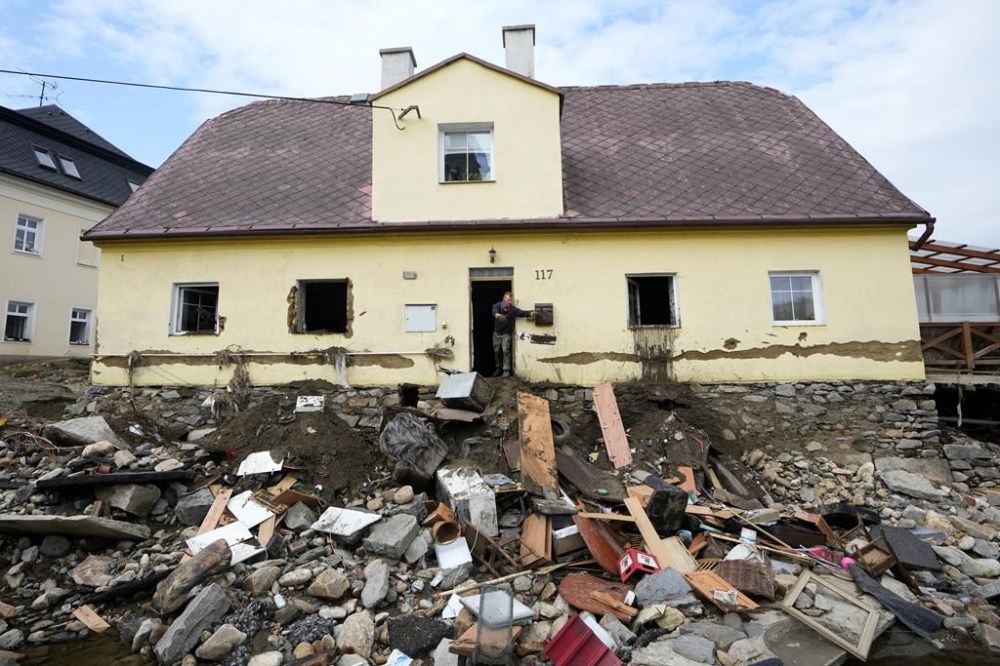
FILE - A man throws damaged goods and furniture off a house as residents return to clean up after recent floods in Mikulovice, Czech Republic, Sept. 19, 2024. (AP Photo/Petr David Josek, File)

“Yet again, these floods highlight the devastating results of fossil fuel-driven warming,” said Joyce Kimutai, the study’s lead author and a climate researcher at Imperial College, London.

To test the influence of human-caused climate change, the team of scientists analyzed weather data and used climate models to compare how such events have changed since cooler preindustrial times to today. Such models simulate a world without the current 1.3 degrees Celsius (2.3 degrees Fahrenheit) of global warming since preindustrial times, and see how likely a rainfall event that severe would be in such a world.

The study analyzed four-day rainfall events, focusing on the countries that felt severe impacts.

Though the rapid study hasn’t been peer-reviewed, it follows scientifically accepted techniques.

“In any climate, you would expect to occasionally see records broken,” said Friederike Otto, an Imperial College, London, climate scientist who coordinates the attribution study team. But, “to see records being broken by such large margins, that is really the fingerprint of climate change. And that is only something that we see in a warming world.”

Some of the most severe impacts were felt in the Polish-Czech border region and Austria, mainly in urban areas along major rivers. The study noted that the death toll from this month’s flooding was considerably lower than during catastrophic floods in the region in 1997 and 2002. Still, infrastructure and emergency management systems were overwhelmed in many cases and will require billions of euros to fix.

Last week, European Union chief Ursula von der Leyen pledged billions of euros in aid for countries that suffered damage to infrastructure and housing from the floods.

The World Weather Attribution study also warned that in a world with even more warming — specifically 2 degrees Celsius (3.6 degrees Fahrenheit) of warming since preindustrial times, the likelihood of ferocious four-day storms would grow by 50% compared to current levels. Such storms would grow in intensity, too, the authors found.

The heavy rainfall across Central Europe was caused by what’s known as a “Vb depression” that forms when cold polar air flows from the north over the Alps and meets warm air from Southern Europe. The study’s authors found no observable change in the number of similar Vb depressions since the 1950s.

The World Weather Attribution group launched in 2015 largely due to frustration that it took so long to determine whether climate change was behind an extreme weather event. Studies like theirs, within attribution science, use real-world weather observations and computer modeling to determine the likelihood of a particular happening before and after climate change, and whether global warming affected its intensity.
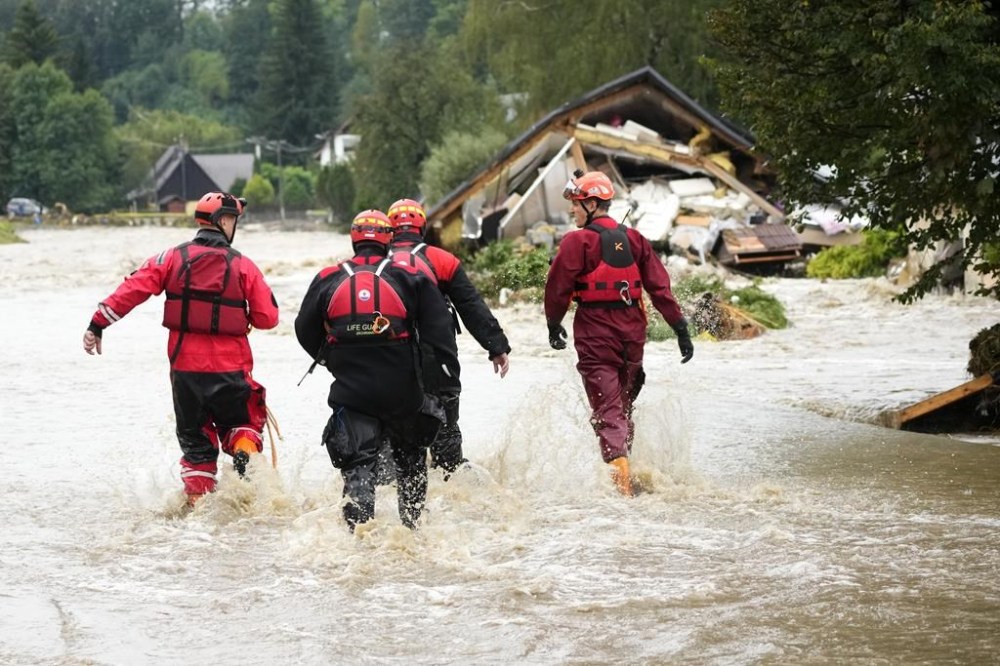
FILE - Firefighters walk through a flooded road of Jesenik, Czech Republic, Sept. 15, 2024. (AP Photo/Petr David Josek, File)

___

This story has corrected the range of increased intensity of rains due to climate change to 7% to 10%, rather than 7% to 20%, based on a data correction issued by World Weather Attribution.

___

Read more of AP’s climate coverage at http://www.apnews.com/climate-and-environment

___

The Associated Press’ climate and environmental coverage receives financial support from multiple private foundations. AP is solely responsible for all content. Find AP’s standards for working with philanthropies, a list of supporters and funded coverage areas at AP.org.

Report Error Submit a Tip

More Stories

Why our democracy depends on your vote

Erna Buffie 5 minute read 2:00 AM CDT

Some years ago, I did some pretty in-depth research on ancient Athens and its democratic system of government as part of a documentary film I was pitching. It was actually a lot of fun, because I was looking at ways their democratic beliefs and practices were both similar to and different from ours.

Some of the differences were quite striking, such as the fact that only Athenian-born males 18 years of age and over could participate. Or the fact their executive branch was selected by a totally random lottery system — a system one expert described as akin to picking names out of a phone book.

Then there was the practice of ostracism, a procedure I found particularly attractive. Essentially, every year the citizens of Athens chose a political figure who was becoming too powerful or pushing for a more authoritarian regime and voted to banish him from the city for 10 years.

Needless to say, I can think of quite a few politicians I’d like to see subjected to that procedure.

Climate: ‘No good outcomes’

Gwynne Dyer 5 minute read 2:00 AM CDT

‘EL NIÑO is being supersized before our eyes,’ United Nations Secretary-General António Guterres said last week.

“The science leaves no room for doubt: the planet is in uncharted waters, and those waters are heating up. The world is in the danger zone of extreme weather.”

He’s right — we are in even deeper trouble than we thought on the climate front.

Zeke Hausfather, a leading American climate scientist, warns that 2027 is almost certain to be the hottest year. It will be, he said, “a climate time-machine, temporarily driving global average temperatures to levels not normally expected until the late 2030s.” (Note the “temporarily.” We’ll get back to that.)

Carney warns of tough times ahead in national address as retaliatory tariffs begin

Nick Murray, The Canadian Press 5 minute read Preview

Carney warns of tough times ahead in national address as retaliatory tariffs begin

Nick Murray, The Canadian Press 5 minute read Updated: Yesterday at 4:10 PM CDT

OTTAWA - Canada's pivot away from the United States will "come at a cost" but the alternative would be far worse, Prime Minister Mark Carney said Tuesday.

Carney made the remarks in a video released just hours after his government made good on a promise to implement retaliatory tariffs on the United States. Those tariffs respond to American duties imposed last month by U.S. President Donald Trump, after the two countries could not come to an agreement to settle some outstanding trade irritants.

Carney spent much of the video laying out Canada's response to Trump's protectionist trade policies, including expanding trade with other countries and building more capacity domestically.

But he said it "won't be easy."

Read
Updated: Yesterday at 4:10 PM CDT

Labour board ruling halts Dynacare strike

Carol Sanders and Erik Pindera 6 minute read Preview

Labour board ruling halts Dynacare strike

Carol Sanders and Erik Pindera 6 minute read Updated: Yesterday at 5:58 PM CDT

The Manitoba Labour Board has cut short a strike by 350 lab workers employed by Dynacare who administer blood and urine tests for patients in Winnipeg, Brandon and surrounding communities.

The board ruled late Tuesday afternoon that the workers, who hit the picket line at 6 a.m., must return to work Wednesday.

Jason Linklater, president of their union, the Manitoba Association of Health Care Professionals, slammed the board’s decision.

“The Manitoba Labour Board is doing exactly what the government asked them to do: they are taking away our members’ right to fight for fairness,” he said in a statement.

Read
Updated: Yesterday at 5:58 PM CDT

Trump ramps up retaliation against Canada, banning imports of booze, other products

Kelly Geraldine Malone, The Canadian Press 6 minute read Preview

Trump ramps up retaliation against Canada, banning imports of booze, other products

Kelly Geraldine Malone, The Canadian Press 6 minute read Updated: Yesterday at 10:13 PM CDT

WASHINGTON - U.S. President Donald Trump signed new executive orders on Tuesday, ramping up retaliation after Canada imposed its latest set of duties on the United States. 

The five orders, which will take effect later this month, will completely bar imports of certain Canadian goods, including motorcycles, some dairy products and alcoholic beverages.

U.S. Trade Representative Jamieson Greer, in a statement later Tuesday, said the decision was a "natural consequence" of Canada's "discriminatory" treatment of American exports.

"After weeks of good faith and intensive efforts between U.S. and Canadian negotiators, Canada walked away from a near-final trade deal that offered better treatment than any other trading partner, and instead Canada chose to embark on senseless retaliation against the United States," Greer said in the statement.

Read
Updated: Yesterday at 10:13 PM CDT

Flash, bang … oops: police raid leads to lawsuit

Erik Pindera 4 minute read Preview

Flash, bang … oops: police raid leads to lawsuit

Erik Pindera 4 minute read 6:00 AM CDT

A couple suing the city allege Winnipeg Police Service officers trying to execute a search warrant at their condominium complex rappelled down the side of the building, broke in their glass patio door and fired off a stun grenade before realizing they were in the wrong unit.

Saeid Ghavami and Shahla Shojaei, a married couple who are academics and scientific researchers at the University of Manitoba, filed the lawsuit in Court of King’s Bench last month over the Jan. 31, 2025 incident.

The claim names the City of Winnipeg and several officers involved in the operation, whose identities are, at this point, unknown to the couple, and are referred to as “John Does.”

Officers were attempting to execute the warrant on the third floor of the eight-storey Pembina Highway building, the court filing says. The couple lives on the fourth floor.

Read
6:00 AM CDT