Mysteries of universe revealed? Hardly. But CERN still fascinates, discovers on its 70th anniversary
Advertisement
Read this article for free:
or
Already have an account? Log in here »
To continue reading, please subscribe:
Digital Subscription
One year of digital access for only $1.44 a week*
- Enjoy unlimited reading on winnipegfreepress.com
- Read the E-Edition, our digital replica newspaper
- Access News Break, our award-winning app
- Play interactive puzzles
*Billed as $5.77 plus GST every four weeks. After 52 weeks, price increases to the regular rate of $19.95 plus GST every four weeks. Offer available to new and qualified returning subscribers only. Cancel any time.
To continue reading, please subscribe:
Add Free Press access to your Brandon Sun subscription for only an additional
$1 for the first 4 weeks*
- Enjoy unlimited reading on winnipegfreepress.com
- Read the E-Edition, our digital replica newspaper
- Access News Break, our award-winning app
- Play interactive puzzles
*Your next Brandon Sun subscription payment will increase by $1.00 and you will be charged $17.95 plus GST for four weeks. After four weeks, your payment will increase to $24.95 plus GST every four weeks.
Read unlimited articles for free today:
or
Already have an account? Log in here »
Hey there, time traveller!
This article was published 01/10/2024 (747 days ago), so information in it may no longer be current.
GENEVA (AP) — The research center that is home to the world’s largest particle accelerator is celebrating its 70th anniversary on Tuesday, with the physicists who run it aiming to unlock secrets about dark matter and other mysteries to promote science for peace in today’s conflict-darkened world.
Over the last seven decades, CERN, the sprawling research center on the Swiss-French border at Geneva, has become a household name in Europe, the West and beyond, but its complex inner workings remain a puzzle to many people.
Here’s a look at CERN and how its discoveries have changed the world and our view of the universe — and could change them more in coming years.
What is CERN?
The European Organization for Nuclear Research, which has retained the French-language acronym CERN for its predecessor outfit, had its origins in a 1951 meeting of the U.N.’s scientific organization that sought to build a state-of-the-art physics research facility in Europe and ease a brain drain toward America after World War II. Groundbreaking was on May 17, 1954.
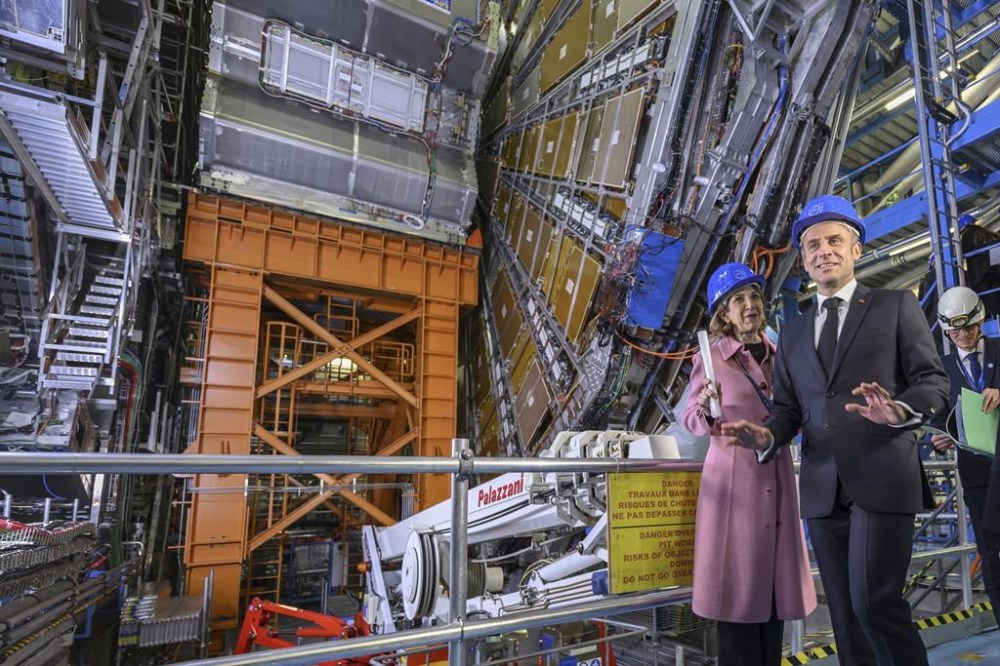
Today, for cognoscenti, CERN is probably best known as home to the Large Hadron Collider, trumpeted as the world’s biggest machine, which powers a network of magnets to accelerate particles through a 27-kilometer (17-mile) underground loop in and around Geneva and slam them together at velocities approaching the speed of light.
By capturing and interpreting the results of the collisions — as many as a billion per second — of such beams of particles, thousands of scientists both on hand at the center and remotely around the world pore over the reams of resulting data and strive to explain how fundamental physics works.
CERN says collisions inside the LHC generate temperatures more than 100,000 times hotter than the core of the sun, on a small scale and in its controlled environment.
At the LHC, “we are able to reproduce every day the conditions of the primordial Universe as they were a millionth of a millionth of a second after the Big Bang. Yet, many crucial open questions remain,” CERN Director-General Fabiola Gianotti said in a prepared speech she was to make before many leaders of its 24 member countries.
Over the years, CERN and its experimental facilities have grown into a vast research hub with applications in many scientific fields and industries.
“In a world where conflicts between countries, cultures and religions sadly persist, this is a truly precious gift that cannot be taken for granted,” Gianotti added in an advance copy of the speech provided to the AP.
How has CERN changed our world and our understanding of the universe?
Experiments in the collider helped confirm in 2012 the subatomic Higgs boson, an infinitesimal particle whose existence had been theorized decades earlier and whose confirmation completed the Standard Model of particle physics.
CERN is also where the World Wide Web was born, in the mind of British scientist Tim Berners-Lee 35 years ago, as a way to help universities and institutes share information. In 1993, the software behind the web was put into the public domain — and the rest is history, in smartphones and on computers worldwide.
The spillover science and tools generated at CERN have rippled through the world economy. Thousands of smaller particle accelerators operate around the world today, plumbing applications in fields as diverse as medicine and computer chip manufacturing.
Crystals developed for CERN experiments roughly four decades ago are now widely used in PET scanners that can detect early signs of health troubles like cancer and heart disease.
Some skeptics have over the years stirred fears about CERN. Insiders variously argue and explain that such fears are overblown or inaccurate, and CERN has issued its own retort to some of the theories out there.
What the future holds
For the most part, CERN technicians, researchers and theoreticians of more than 110 nationalities today carry out new experiments that aim to punch holes in the Standard Model — smashing up conventional understandings to move science forward — and explain a long list of lingering scientific unknowns.
Its scientific whizzes hope to solve riddles about dark energy — which makes up about 68% of the universe and has a role in speeding up its expansion — and test hypotheses about dark matter, whose existence is only inferred and which appears to outweigh visible matter nearly six-to-one, making up slightly more than a quarter of the universe.
CERN has two big projects on its horizon. The first is the High-Luminosity LHC project that aims to ramp up the number of collisions — and thus the potential for new discoveries — starting in 2029.

The second, over the much longer term, is the Future Circular Collider, which is estimated to cost 15 billion Swiss francs (about 16 billion euros or $17.2 billion) and is hoped to start operating in an initial phase by 2040.
Despite its aim to foster scientific progress in the cause of peace and humanity, CERN has found itself ensnared in politics.
Its constitution says the organization “shall have no concern with work for military requirements.” In 2022, CERN’s governing council voted to pause ties with institutes in Russia because of President Vladimir Putin’s order for Russian troops to invade Ukraine earlier that year. Some fear that applications from CERN’s research could make their way into Moscow’s war machine.
On Nov. 30, CERN will formally exclude Russia — affecting some 500 scientists, about 100 of whom have joined non-Russian institutes in order to maintain their research with the center.
The suspension will come at a cost, depriving CERN of some 40 million Swiss francs in Russian financing for the High-Luminosity LHC. It amounts to about 4.5% of the budget for its experiment, which will now have to be shouldered by other CERN participants.