World on pace for significantly more warming without immediate climate action, report warns
Advertisement
Read this article for free:
or
Already have an account? Log in here »
To continue reading, please subscribe:
Digital Subscription
One year of digital access for only $1.44 a week*
- Enjoy unlimited reading on winnipegfreepress.com
- Read the E-Edition, our digital replica newspaper
- Access News Break, our award-winning app
- Play interactive puzzles
*Billed as $5.77 plus GST every four weeks. After 52 weeks, price increases to the regular rate of $19.95 plus GST every four weeks. Offer available to new and qualified returning subscribers only. Cancel any time.
To continue reading, please subscribe:
Add Free Press access to your Brandon Sun subscription for only an additional
$1 for the first 4 weeks*
- Enjoy unlimited reading on winnipegfreepress.com
- Read the E-Edition, our digital replica newspaper
- Access News Break, our award-winning app
- Play interactive puzzles
*Your next Brandon Sun subscription payment will increase by $1.00 and you will be charged $17.95 plus GST for four weeks. After four weeks, your payment will increase to $24.95 plus GST every four weeks.
Read unlimited articles for free today:
or
Already have an account? Log in here »
Hey there, time traveller!
This article was published 24/10/2024 (725 days ago), so information in it may no longer be current.
The world is on a path to get 1.8 degrees Celsius (3.2 Fahrenheit) warmer than it is now, but could trim half a degree of that projected future heating if countries do everything they promise to fight climate change, a United Nations report said Thursday.
But it still won’t be near enough to curb warming’s worst impacts such as nastier heat waves, wildfires, storms and droughts, the report said.
Under every scenario but the “most optimistic” with the biggest cuts in fossil fuels burning, the chance of curbing warming so it stays within the internationally agreed-upon limit “would be virtually zero,” the United Nations Environment Programme’s annual Emissions Gap Report said. The goal, set in the 2015 Paris Agreement, is to limit human-caused warming to 1.5 degrees Celsius (2.7 degrees Fahrenheit) since pre-industrial times. The report said that since the mid-1800s, the world has already heated up by 1.3 degrees Celsius (2.3 degrees Fahrenheit), up from previous estimates of 1.1 or 1.2 degrees because it includes the record heat last year.
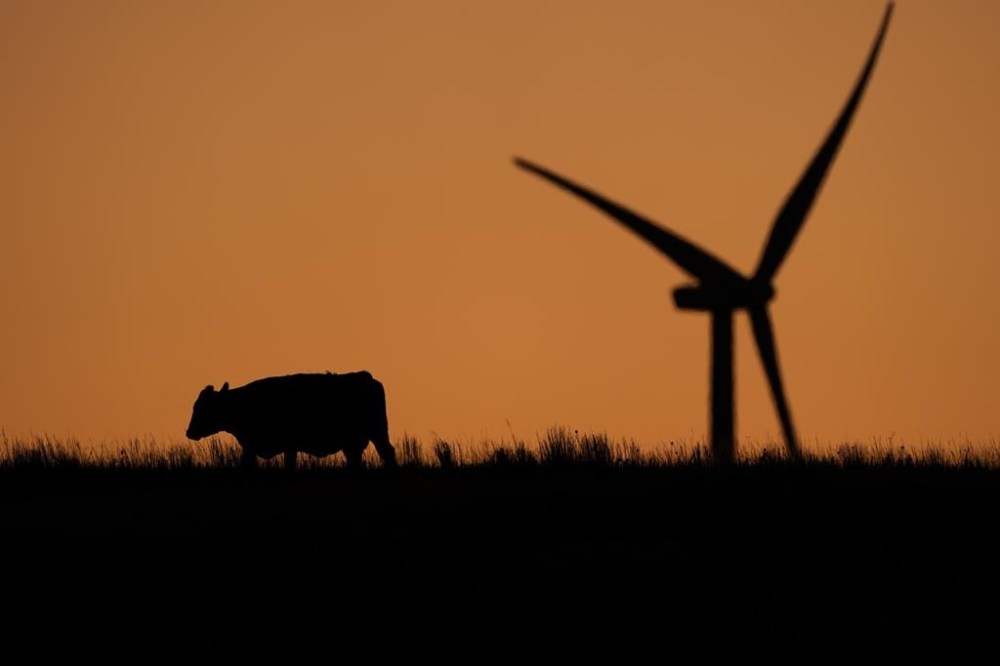
Instead the world is on pace to hit 3.1 degrees Celsius (5.6 degrees Fahrenheit) since pre-industrial times. But if nations somehow do all of what they promised in targets they submitted to the United Nations that warming could be limited to 2.6 degrees Celsius (4.7 degrees Fahrenheit), the report said.
In that super-stringent cuts scenario where nations have zero net carbon emissions after mid-century, there’s a 23% chance of keeping warming at or below the 1.5 degrees goal. It’s far more likely that even that optimistic scenario will keep warming to 1.9 degrees above pre-industrial times, the report said.
“The main message is that action right now and right here before 2030 is critical if we want to lower the temperature,” said report main editor Anne Olhoff, an economist and chief climate advisor to the UNEP Copenhagen Climate Centre. “It is now or never really if we want to keep 1.5 alive.”
Without swift and dramatic emission cuts “on a scale and pace never seen before,” UNEP Director Inger Andersen said “the 1.5 degree C goal will soon be dead and (the less stringent Paris goal of) well below 2 degrees C will take its place in the intensive care unit.”
Olhoff said Earth’s on a trajectory to slam the door on 1.5 sometime in 2029.
“Winning slowly is the same as losing when it comes to climate change,” said author Neil Grant of Climate Analytics. “And so I think we are at risk of a lost decade.”
One of the problems is that even though nations pledged climate action in their targets submitted as part of the Paris Agreement, there’s a big gap between what they said they will do and what they are doing based on their existing policies, report authors said.
The world’s 20 richest countries — which are responsible for 77% of the carbon pollution in the air — are falling short of their stated emission-cutting goals, with only 11 meeting their individual targets, the report said.
Emission cuts strong enough to limit warming to the 1.5 degree goal are more than technically and economically possible, the report found. They just aren’t being proposed or done.
The report ”shows that yet again governments are sleepwalking towards climate chaos,” said climate scientist Bill Hare, CEO of Climate Analytics, who wasn’t part of the report.
Another outside scientist, Johan Rockstrom, director of the Potsdam Institute for Climate Impact Research, said the report confirms his worst concerns: “We are not making progress and are now following a 3.1 degree path, which is, with next to zero uncertainty, a path to disaster.”
Both the 3.1 degree and 2.6 degree calculations are a tenth of a degree Celsius warmer than last year’s version of the UN report, which experts said is within the margin of uncertainty.
Mostly the problem is “there’s one year less time to cut emissions and avoid climate catastrophe,” said MIT’s John Sterman, who models different warming scenarios based on emissions and countries policies. “Catastrophe is a strong word and I don’t use it lightly,” he said, citing the Intergovernmental Panel on Climate Change’s latest report saying 3 degrees of warming would trigger severe and irreversible damage.
The report focuses on what’s called an emissions gap. It calculates a budget of how many billions of tons of greenhouse gases — mostly carbon dioxide and methane — the world can spew and stay under 1.5 degrees, 1.8 degrees and 2 degrees of warming since pre-industrial times. It then figures how much annual emissions have to be slashed by 2030 to keep at those levels.
To keep at or below 1.5 degrees, the world must slash emissions by 42%, and to keep at or below 2 degrees, the cut has to be 28%, the report, named, “No more hot air… please !” said.
In 2023, the world spewed 57.1 billion metric tons (62.9 billion U.S. tons) of greenhouse gases, the report said. That’s 1,810 metric tons (1,995 U.S. tons) of heat-trapping gases a second.
“There is a direct link between increasing emissions and increasingly frequent and intense climate disasters,” United Nations Secretary-General Antonio Guterres said in a video messaged released with the report. “We’re playing with fire, but there can be no more playing for time. We’re out of time.”
__
Read more of AP’s climate coverage at http://www.apnews.com/climate-and-environment
___
Follow Seth Borenstein on X at @borenbears
______
The Associated Press’ climate and environmental coverage receives financial support from multiple private foundations. AP is solely responsible for all content. Find AP’s standards for working with philanthropies, a list of supporters and funded coverage areas at AP.org.