Archaeologists discover 4,000-year-old canals used to fish by predecessors of ancient Maya

Advertisement

Advertise with us

WASHINGTON (AP) — Long before the ancient Maya built temples, their predecessors were already altering the landscape of Central America’s Yucatan peninsula.

Read this article for free:


or

Already have an account? Log in here »

To continue reading, please subscribe:

Subscribe and receive a limited-edition Free Press branded hat or tote.

Digital Subscription

One year of digital access for only $205*

  • Enjoy unlimited reading on winnipegfreepress.com
  • Read the E-Edition, our digital replica newspaper
  • Access News Break, our award-winning app
  • Play interactive puzzles

*First annual payment billed as $205.00 + GST for one year. This annual subscription will automatically renew at $233.00 + GST every 52 weeks (10% off the regular annual price of $259.35). Offer available to new and qualified returning subscribers only. Cancel any time.

To continue reading, please subscribe:

Add Free Press access to your Brandon Sun subscription for only an additional

$1 for the first 4 weeks*

  • Enjoy unlimited reading on winnipegfreepress.com
  • Read the E-Edition, our digital replica newspaper
  • Access News Break, our award-winning app
  • Play interactive puzzles
Start now

*Your next Brandon Sun subscription payment will increase by $1.00 and you will be charged $17.95 plus GST for four weeks. After four weeks, your payment will increase to $24.95 plus GST every four weeks.

Hey there, time traveller!
This article was published 22/11/2024 (673 days ago), so information in it may no longer be current.

WASHINGTON (AP) — Long before the ancient Maya built temples, their predecessors were already altering the landscape of Central America’s Yucatan peninsula.

Using drones and Google Earth imagery, archaeologists have discovered a 4,000-year-old network of earthen canals in what’s now Belize. The findings were published Friday in Science Advances.

“The aerial imagery was crucial to identify this really distinctive pattern of zigzag linear canals” running for several miles through wetlands, said study co-author Eleanor Harrison-Buck of the University of New Hampshire.
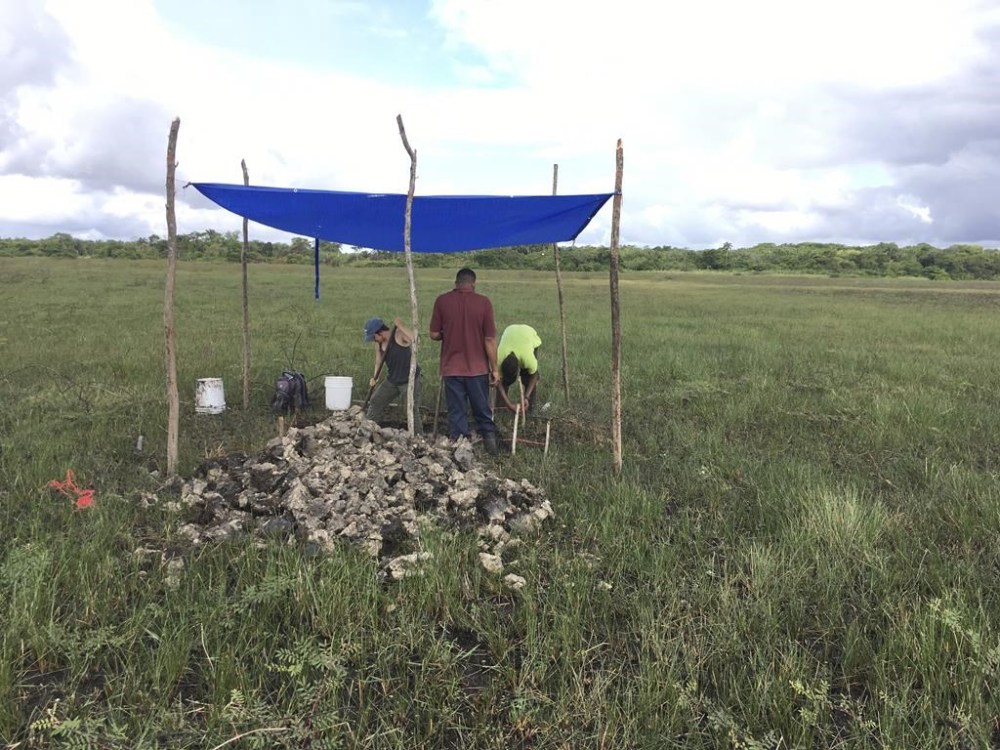
This 2019 photo provided by the Belize River East Archaeology project, researchers excavate sediment that will be sequenced to help them date the evidence of a large-scale pre-Columbian fish-trapping facility in Belize. (Belize River East Archaeology project via AP)

The team then conducted digs in Belize’s Crooked Tree Wildlife Sanctuary. The ancient fish canals, paired with holding ponds, were used to channel and catch freshwater species such as catfish.

“Barbed spearpoints” found nearby may have been tied to sticks and used to spear fish, said study co-author Marieka Brouwer Burg of the University of Vermont.

The canal networks were built as early as 4,000 years ago by semi-nomadic people in the Yucatan coastal plain. According to the study, the canals were used for around 1,000 years or longer, including during the “formative” period when the Maya began to settle in permanent farming villages and a distinctive culture started to emerge.

“It’s really interesting to see such large-scale modifications of the landscape so early — it shows people were already building things,” said University of Pittsburgh archaeologist Claire Ebert, who was not involved in the study.

At the height of Maya civilization, people in this region built temples, roads, pyramids and other monuments. They also developed complex systems of writing, mathematics and astronomy. Scientists know far more about this era because there are many more significant archaeological sites, said Ebert.

But this new study reveals a link between the earlier people on the landscape and the later emergence of Maya culture. These ancient channels for catching fish may have played a role in helping later Maya pyramids rise above the Yucatan rainforest.

“This shows continuity,” said University of Pennsylvania archaeologist Jeremy Sabloff, who wasn’t part of the research.

On a practical level, the fish-trapping canals helped the early people in the region to diversify their diets and feed a growing population, building a foundation for later cultural heights.

___

The Associated Press Health and Science Department receives support from the Howard Hughes Medical Institute’s Science and Educational Media Group. The AP is solely responsible for all content.
Report Error Submit a Tip

More Stories

Sequestered skivvies seem like last straw

Maureen Scurfield 5 minute read Yesterday at 2:00 AM CDT

DEAR MISS LONELYHEARTS: My husband, who earns a hefty income, stayed in the city most of the summer working, except for a few long weekends with the kids and me at the cottage. He has giant work projects that need daily tending.

I work hard, too, with our four kids, two dogs and a cat. But I have to tell you I got a shock last week after coming home to organize my family team for a thorough cleaning of our three-storey home.

You’ll never guess what they found up in the attic — hidden boxes of sexy women’s lingerie that all looks brand-new.

I’ve kept my mouth shut so far, but my mind is spinning.

How confusing; seems there’s more than one candidate in Hanover named Shayne Barkman

Dan Lett 5 minute read Preview

How confusing; seems there’s more than one candidate in Hanover named Shayne Barkman

Dan Lett 5 minute read Thursday, Sep. 24, 2026

It’s not entirely clear when or why Hanover trustee Shayne Barkman became one of Manitoba’s best-known anti-LGBTTQ+ crusaders.

Back in 2022, when he ran as a candidate for Hanover school board for the first time, there was nary a hint that socially conservative culture wars were going to be a large part of his identity as an elected official.

In a Steinbach Online profile published before the 2022 municipal elections, Barkman highlighted his background as a successful farmer. He said he was entering politics to be a “listening ear” who could promote understanding.

“I would love to kind of just be a voice of reason amongst all the problems coming down the pipe,” Barkman said

Read
Thursday, Sep. 24, 2026

New series terrific addition to RWB repertoire

Holly Harris 5 minute read Preview

New series terrific addition to RWB repertoire

Holly Harris 5 minute read 2:01 AM CDT

‘See the music, hear the dance,” is a famous quote from quintessential ballet influencer George Balanchine, whose pithy bons mots have defined much of American classical dance since the legendary Russian-born choreographer first blazed a trail with the New York City Ballet.

Local balletomanes were given a golden opportunity to experience both up-close-and-personal Thursday when the Royal Winnipeg Ballet officially kicked off its 87th season with its newly minted Studio Series, which runs until Sunday.

The brainchild of the company’s artistic director, Christopher Stowell, the series features an abridged “concert version” of Balanchine’s seminal Who Cares?, set to a playlist of catchy George Gershwin tunes that make up the backbone of the Great American Songbook.

The Studio Series is the latest initiative taken by Stowell as he settles into his arguably still new position. Some of those endeavours will invariably stumble; others will hit their mark. This venture belongs in the latter category, bringing a 500-plus-year-old art form, often perceived as rarified, to audience members who may be hesitant, shy or just plain intimidated to visit the cavernous Centennial Concert Hall.

Read
2:01 AM CDT

U of W marks 10 years of Indigenous education requirement

Maggie Macintosh 5 minute read Preview

U of W marks 10 years of Indigenous education requirement

Maggie Macintosh 5 minute read Yesterday at 2:00 AM CDT

The University of Winnipeg is collecting course outlines, historic concerns about systemic racism on campus and related records to mark the 10-year anniversary of mandating Indigenous studies.

The unveiling of a new archive drew nearly 200 people to Centennial Hall on Thursday afternoon to reflect on how the Indigenous course requirement, also known as “the ICR,” came to be.

University archivist Brett Lougheed told the crowd its inception is “an amazing story” of student activism that, until now, wasn’t accurately reflected in U of W records.

“What little material we had told the story of administration’s role in developing the ICR as though it was the ultimate driver… and not a student-led response to racism,” Lougheed said.

Read
Yesterday at 2:00 AM CDT

Concrete doc befits brutalist Winnipeg

Ben Waldman 4 minute read Preview

Concrete doc befits brutalist Winnipeg

Ben Waldman 4 minute read Thursday, Sep. 24, 2026

Moviegoers across North America are pounding the pavement and lining up around the block to see The History of Concrete, small-screen documentarian John Wilson’s feature-length debut.

Read
Thursday, Sep. 24, 2026

Perfecting profitability

Joel Schlesinger 6 minute read Preview

Perfecting profitability

Joel Schlesinger 6 minute read 2:01 AM CDT

More jaded of investors may roll their eyes at another book offering up a formula for the “perfect portfolio.”

Veteran portfolio manager Peter Lazaroff, based in St. Louis, and host of the Long Term Investor podcast understands the scepticism around his recently published book The Perfect Portfolio: a Proven Guide to Smart Investing for Long-Term Success.

Yet the chief investment officer at Plancorp Wealth Management, which has about US$10.2 billion in assets under management, has a caveat to the notion of the perfect portfolio.

“The perfect portfolio on paper is probably a lot different than the perfect portfolio for you in real life because what’s ‘perfect’ is a formula you can stick with for decades on end.”

Read
2:01 AM CDT