European satellites launched to create artificial solar eclipses in a tech demo
Advertisement
Read this article for free:
or
Already have an account? Log in here »
To continue reading, please subscribe:

Digital Subscription
One year of digital access for only $205*
- Enjoy unlimited reading on winnipegfreepress.com
- Read the E-Edition, our digital replica newspaper
- Access News Break, our award-winning app
- Play interactive puzzles
*First annual payment billed as $205.00 + GST for one year. This annual subscription will automatically renew at $233.00 + GST every 52 weeks (10% off the regular annual price of $259.35). Offer available to new and qualified returning subscribers only. Cancel any time.
To continue reading, please subscribe:
Add Free Press access to your Brandon Sun subscription for only an additional
$1 for the first 4 weeks*
- Enjoy unlimited reading on winnipegfreepress.com
- Read the E-Edition, our digital replica newspaper
- Access News Break, our award-winning app
- Play interactive puzzles
*Your next Brandon Sun subscription payment will increase by $1.00 and you will be charged $17.95 plus GST for four weeks. After four weeks, your payment will increase to $24.95 plus GST every four weeks.
Read unlimited articles for free today:
or
Already have an account? Log in here »
Hey there, time traveller!
This article was published 05/12/2024 (652 days ago), so information in it may no longer be current.
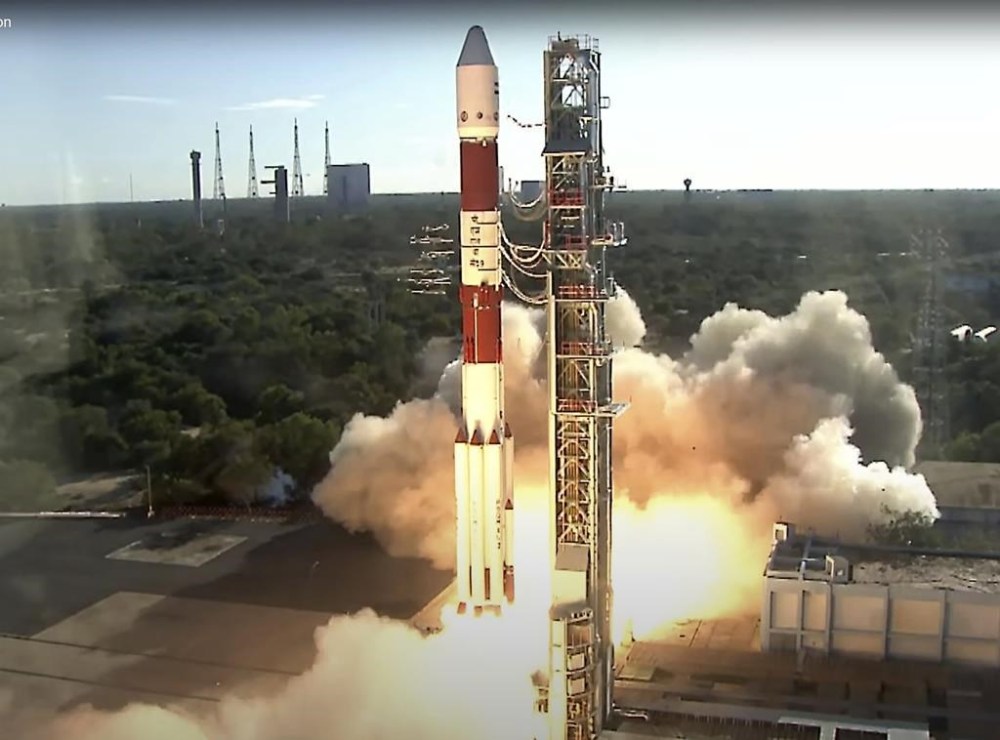
CAPE CANAVERAL, Fla. (AP) — A pair of European satellites rocketed into orbit Thursday on the first mission to create artificial solar eclipses through fancy formation flying in space.
Each fake eclipse should last six hours once operations begin next year. That’s considerably longer than the few minutes of totality offered by a natural eclipse here on Earth, allowing for prolonged study of the sun’s corona, or outer atmosphere.
The launch took place from India.

“We are a very happy science team here” in India, the European Space Agency’s mission scientist Joe Zender said via email.
Billed as a tech demo, the two satellites will separate in a month or so and fly 492 feet (150 meters) apart once reaching their destination high above Earth, lining up with the sun so that one spacecraft casts a shadow on the other.
This will require extreme precision, within just one millimeter, equivalent to a fingernail’s thickness, according to the European Space Agency. To maintain their position, the satellites will rely on GPS, star trackers, lasers and radio links, flying autonomously.
Each cube-shaped spacecraft is less than 5 feet (1.5 meters) across. The shadow-casting satellite holds a disk to block the sun from the telescope on the other satellite. This disk will mimic the moon in a natural total solar eclipse, with the darkened satellite posing as Earth.
“This has a huge scientific relevance” in addition to testing high-precision formation flying,” said the European Space Agency’s technology and engineering director Dietmar Pilz.
Scientists need the glaring face of the sun completely blocked in order to scrutinize the wispy crown-like corona encircling it, getting an especially good look close to the solar rim on this mission. They’re particularly interested to learn why the corona is hotter than the surface of the sun, and also want to better understand coronal mass ejections, eruptions of billions of tons of plasma with magnetic fields out into space.
The resulting geomagnetic storms can disrupt power and communication on Earth and in orbit. Such outbursts can also produce stunning auroras in unexpected places.
With a lopsided orbit stretching from 370 miles (600 kilometers) to 37,000 miles (60,000 kilometers) away, the satellites will take nearly 20 hours to circle the world. Six of those hours — at the farther end of certain orbits — will be spent generating an eclipse. Other orbits will be strictly for formation flying experiments, according to the European Space Agency.
The first eclipse results should be available in March, following checkout of both craft.

Zender said eclipses will be created at least twice a week, with six hours of totality each time for corona observations. The frequency will depend on solar activity, he noted, and prove a boon for scientists who now must travel across the world for a mere three to five minutes of totality during the occasional eclipse.
The $210 million mission, dubbed Proba-3, is aiming for at least 1,000 hours of “on demand” totality during its two-year operation. Once their job is done, both satellites will gradually drop lower until they burn up in the atmosphere, likely within five years.
Liftoff was delayed a day by a last-minute issue with the backup propulsion system of one of the satellites, crucial for precision formation flying. The European Space Agency said engineers relied on a computer software fix.
___
The Associated Press Health and Science Department receives support from the Howard Hughes Medical Institute’s Science and Educational Media Group. The AP is solely responsible for all content.