A Nobel Prize-powered gift from Geoffrey Hinton is boosting a Canadian water charity

Advertisement

Advertise with us

The Canadian winner of this year's Nobel Prize in physics is pouring hundreds of thousands of dollars from his winnings into a small Ontario-based organization.

Read this article for free:


or

Already have an account? Log in here »

To continue reading, please subscribe:

Subscribe and receive a limited-edition Free Press branded hat or tote.

Digital Subscription

One year of digital access for only $205*

  • Enjoy unlimited reading on winnipegfreepress.com
  • Read the E-Edition, our digital replica newspaper
  • Access News Break, our award-winning app
  • Play interactive puzzles

*First annual payment billed as $205.00 + GST for one year. This annual subscription will automatically renew at $233.00 + GST every 52 weeks (10% off the regular annual price of $259.35). Offer available to new and qualified returning subscribers only. Cancel any time.

To continue reading, please subscribe:

Add Free Press access to your Brandon Sun subscription for only an additional

$1 for the first 4 weeks*

  • Enjoy unlimited reading on winnipegfreepress.com
  • Read the E-Edition, our digital replica newspaper
  • Access News Break, our award-winning app
  • Play interactive puzzles
Start now

*Your next Brandon Sun subscription payment will increase by $1.00 and you will be charged $17.95 plus GST for four weeks. After four weeks, your payment will increase to $24.95 plus GST every four weeks.

Hey there, time traveller!
This article was published 10/12/2024 (665 days ago), so information in it may no longer be current.

The Canadian winner of this year’s Nobel Prize in physics is pouring hundreds of thousands of dollars from his winnings into a small Ontario-based organization.

Geoffrey Hinton, a so-called godfather of artificial intelligence, is not boosting the latest tech startup or funding an initiative to counter the dangers of AI that he so often warns about.

He is instead helping a group focused on something more down to Earth: supporting Indigenous Peoples in accessing fresh water.
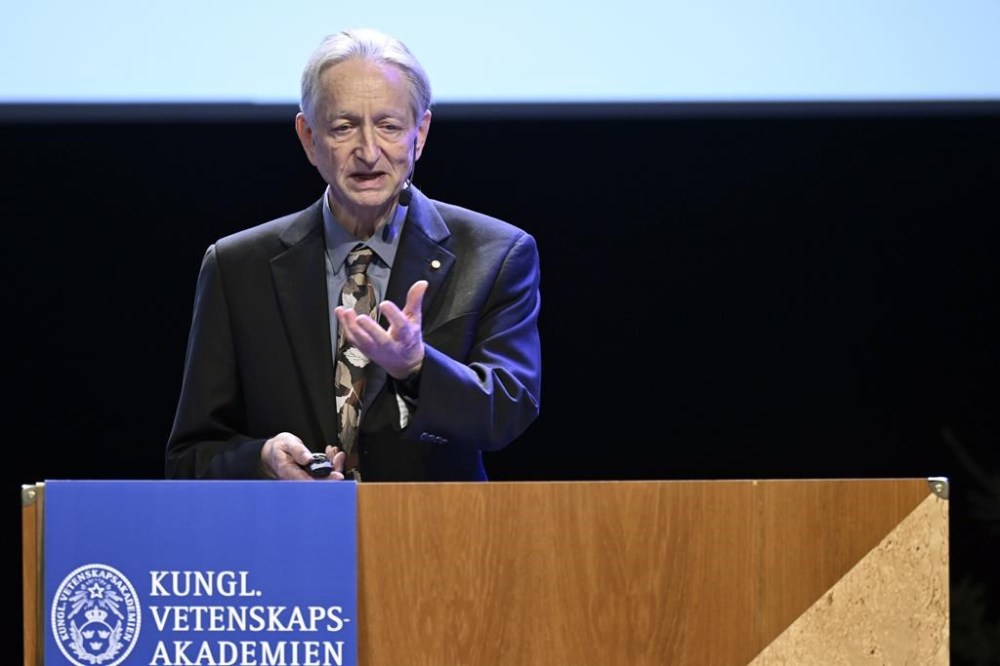
Nobel laureate in physics Geoffrey Hinton gives a Nobel Prize lecture in physics in Aula Magna, Stockholm University, Sweden, on Sunday, Dec. 8, 2024. THE CANADIAN PRESS/AP, TT News Agency - Pontus Lundahl

Sarah Jayne Kendall, community engagement director at Water First Education and Training Inc., said she is grateful to Hinton for the substantial donation — but also for the attention he is bringing to the organization’s work.

“It really speaks volumes to him being an individual who’s utilizing his platform to raise awareness and support for an ongoing issue that has been going on throughout this country,” she said.

About 13 per cent of First Nations communities in Canada are affected by a drinking water advisory. Water First says the proportion is 25 per cent in Ontario.

Kendall said Hinton himself reached out to the organization about his donation decision.

The emeritus professor of computer science at the University of Toronto won the Nobel Prize alongside John Hopfield, a professor at Princeton University, for their groundbreaking work on machine learning that paved the way for AI.

The two were named the winners in October and received the award at a ceremony on Tuesday.

Water First is expected to receive a $350,000 donation from Hinton, representing about half of his share of the prize winnings. An unnamed charity that supports neurodiverse young adults was also expected to get a boost from Hinton.

Kendall said her organization, based in Creemore, Ont., northwest of Toronto, will use the money to build capacity and expand operations across the country.

“This donation will really help us focus on how we can continue to extend our reach to any Indigenous communities who see value in our work,” she said.

The group’s drinking water programs, which focus on education and training, have so far been focused on Ontario communities. That work expanded to Manitoba this year, Kendall said. She added that the charity also runs environment-focused programs in Ontario and Quebec.

“Our organization is still a relatively small organization. We have grown considerably in the last few years. But this donation will go towards helping us expand our reach even further.”

Speaking at a press conference in October shortly after he won the prize, Hinton said he had initially planned to donate to an organization that provides safe drinking water in Africa.

He changed his mind, he said, after his partner suggested he support the same cause in Canada.

Hinton said it’s good to see more Canadians acknowledging Indigenous rights when it comes to land, but that does nothing to change the situation on the ground and address the problem of water-borne diseases: “It doesn’t stop the Indigenous kids getting diarrhea.”

He praised Water First for making a “much better, long-term investment” because it trains people on how to access clean drinking water rather than simply providing it.

“That seemed to me to be a good thing to do,” he said.

This report by The Canadian Press was first published Dec. 10, 2024.

— With files from Tara Deschamps.
Report Error Submit a Tip

More Stories

The election of our discontent: City at a crumbling crossroads, grumbling residents say in poll

Matthew Frank 7 minute read Preview

The election of our discontent: City at a crumbling crossroads, grumbling residents say in poll

Matthew Frank 7 minute read Updated: Yesterday at 3:16 PM CDT

There’s an undercurrent of unhappiness running through the Winnipeg electorate as the municipal election day approaches.

One-half of Winnipeggers believe the city is heading in the wrong direction, according to a new Abacus Data poll, with nearly one-third unsure if Winnipeg is regressing or progressing.

Only 21 per cent of residents believe the city is on the right track, the Free Press-commissioned poll found.

That discontentment extends to how the city spends its tax dollars, with four in 10 Winnipeggers believing they receive poor value for what they pay in property taxes.

Read
Updated: Yesterday at 3:16 PM CDT

Puzzles Palace

1 minute read Monday, Jul. 27, 2026

To solve our puzzles, please subscribe with this special offer: |

Botched execution revives death penalty debate

Arthur Chapman 5 minute read 2:00 AM CDT

The United States of America’s seemingly endless, often futile, search for the painless, bloodless method of executing prisoners continues. The latest horrifying chapter occurred in Tennessee on Sept. 30, when the state tried to kill convicted murderer Christa Pike by lethal injection.

It didn’t work. Pike survived two dosages of pentobarbital. She was rushed to a hospital where, according to her lawyer, she was receiving “lifesaving care”.

Tennessee governor Bill Lee has cancelled upcoming executions, but he isn’t moving away from capital punishment.

Lee said, as quoted in the New York Times: “The people of Tennessee have determined that capital punishment is the appropriate sentence for the most heinous of crimes. The people of Tennessee expect those sentences to be carried out in a manner that’s not only legal and constitutional but effective, and that didn’t happen.”

Morning-show veteran swaps microphone for macchiatos at new Corydon café

David Sanderson 9 minute read Preview

Morning-show veteran swaps microphone for macchiatos at new Corydon café

David Sanderson 9 minute read Saturday, Oct. 3, 2026

Good news if you were used to having your morning coffee with Terri Gale, who earlier this summer signed off from CTV Your Morning, after 15 years on the job.

Gale, the three-hour program’s longtime weather expert, and her husband Rob Gale, the ex-head soccer coach of Valour FC and co-founder of the Northern Super League’s new Winnipeg franchise, are the owners of Golden Hour Café and Bar at 775 Corydon Ave.

Gale (formerly Apostle) nods when she is asked who would know more about caffeinated beverages than a person who, for the last decade and a half, set her alarm to go off in the wee small hours.

“I do love coffee and take mine black. Except because I hate burning my tongue — not a good thing when you speak for a living — I got into the habit of throwing a couple of ice cubes in my cup, to be on the safe side,” Gale says, seated on the second level of their attractive, 2,100-square-foot premises, which officially opened in mid-September.

Read
Saturday, Oct. 3, 2026

Man who exploited teen sentenced to 11 years in prison

Erik Pindera 4 minute read Preview

Man who exploited teen sentenced to 11 years in prison

Erik Pindera 4 minute read 2:00 AM CDT

A man who picked up a vulnerable 17-year-old child-welfare ward on the streets of Winnipeg and coerced her into providing sexual services for several months has been sent to prison for more than a decade.

After a trial, Hassan Kargbo, who’s in his early 30s, was found guilty of sexual exploitation, making child sexual abuse and exploitation material, receiving a material benefit from sexual services provided by a person under 18, procuring a person under 18 and advertising sexual services.

Provincial court Judge Julie Frederickson sentenced him to 11 years behind bars late last month.

“Mr. Kargbo picked up a young Indigenous girl walking over the Osborne Street bridge and quickly got her involved in drug use and escorting,” Frederickson said in a written decision.

Read
2:00 AM CDT

Letters, Oct. 6

6 minute read 2:00 AM CDT

High road not so easy

Re: Khan should’ve taken high road: Goertzen (Oct. 3)

Politics is a tough game. Just ask former provincial Liberal leader Dougald Lamont. He got thrown under the bus by a prominent Manitoba/Canadian Liberal who advised people to vote NDP in the last provincial election.

As Lamont said when he lost the election, he is “human” and what happened to him “hurt.” Khan is also human. It is easy to criticize him for not taking the “high road.”