Climate change added 41 days of dangerous heat around world in 2024

Advertisement

Advertise with us

People around the world suffered an average of 41 extra days of dangerous heat this year because of human-caused climate change, according to a group of scientists who also said that climate change worsened much of the world's damaging weather throughout 2024.

Read this article for free:


or

Already have an account? Log in here »

To continue reading, please subscribe:

Subscribe and receive a limited-edition Free Press branded hat or tote.

Digital Subscription

One year of digital access for only $205*

  • Enjoy unlimited reading on winnipegfreepress.com
  • Read the E-Edition, our digital replica newspaper
  • Access News Break, our award-winning app
  • Play interactive puzzles

*First annual payment billed as $205.00 + GST for one year. This annual subscription will automatically renew at $233.00 + GST every 52 weeks (10% off the regular annual price of $259.35). Offer available to new and qualified returning subscribers only. Cancel any time.

To continue reading, please subscribe:

Add Free Press access to your Brandon Sun subscription for only an additional

$1 for the first 4 weeks*

  • Enjoy unlimited reading on winnipegfreepress.com
  • Read the E-Edition, our digital replica newspaper
  • Access News Break, our award-winning app
  • Play interactive puzzles
Start now

*Your next Brandon Sun subscription payment will increase by $1.00 and you will be charged $17.95 plus GST for four weeks. After four weeks, your payment will increase to $24.95 plus GST every four weeks.

Hey there, time traveller!
This article was published 26/12/2024 (645 days ago), so information in it may no longer be current.

People around the world suffered an average of 41 extra days of dangerous heat this year because of human-caused climate change, according to a group of scientists who also said that climate change worsened much of the world’s damaging weather throughout 2024.

The analysis from World Weather Attribution and Climate Central researchers comes at the end of a year that shattered climate record after climate record as heat across the globe made 2024 likely to be its hottest ever measured and a slew of other fatal weather events spared few.

“The finding is devastating but utterly unsurprising: Climate change did play a role, and often a major role in most of the events we studied, making heat, droughts, tropical cyclones and heavy rainfall more likely and more intense across the world, destroying lives and livelihoods of millions and often uncounted numbers of people,” Friederike Otto, the lead of World Weather Attribution and an Imperial College climate scientist, said during a media briefing on the scientists’ findings. “As long as the world keeps burning fossil fuels, this will only get worse.”
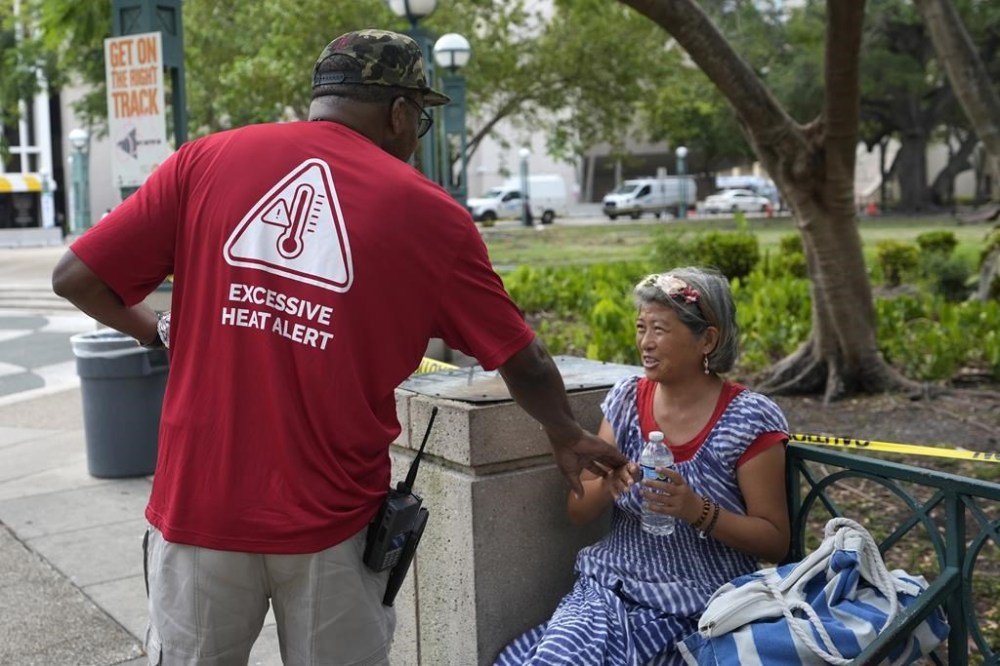
FILE - Ricky Leath, an outreach specialist with the City of Miami, talks with Bei Zhao, right, as he works with the Miami-Dade County Homeless Trust to distribute bottles of water and other supplies to the homeless population, helping them manage high temperatures, May 15, 2024, in Miami. (AP Photo/Lynne Sladky, File)

Millions of people endured stifling heat this year. Northern California and Death Valley baked. Sizzling daytime temperatures scorched Mexico and Central America. Heat endangered already vulnerable children in West Africa. Skyrocketing southern European temperatures forced Greece to close the Acropolis. In South and Southeast Asian countries, heat forced school closures. Earth experienced some of the hottest days ever measured and its hottest-yet summer, with a 13-month heat streak that just barely broke.

To do its heat analysis, the team of volunteer international scientists compared daily temperatures around the globe in 2024 to the temperatures that would have been expected in a world without climate change. The results are not yet peer-reviewed, but researchers use peer-reviewed methods.

Some areas saw 150 days or more of extreme heat due to climate change.

“The poorest, least developed countries on the planet are the places that are experiencing even higher numbers,” said Kristina Dahl, vice president of climate science at Climate Central.

What’s worse, heat-related deaths are often underreported.

“People don’t have to die in heat waves. But if we can’t communicate convincingly, ‘but actually a lot of people are dying,’ it’s much harder to raise this awareness,” Otto said. “Heat waves are by far the deadliest extreme event, and they are the extreme events where climate change is a real game changer.”

This year was a warning that the planet is getting dangerously close to the Paris Agreement’s 1.5 degrees Celsius (2.7 degrees Fahrenheit) warming limit compared to the pre-industrial average, according to the scientists. Earth is expected to soon edge past that threshold, although it’s not considered to have been breached until that warming is sustained over decades.

The researchers closely examined 29 extreme weather events this year that killed at least 3,700 people and displaced millions, and found that 26 of them had clear links to climate change.

The El Niño weather pattern, which naturally warms the Pacific Ocean and changes weather around the world, made some of this weather more likely earlier in the year. But the researchers said most of their studies found that climate change played a bigger role than that phenomenon in fueling 2024’s events. Warm ocean waters and warmer air fueled more destructive storms, according to the researchers, while temperatures led to many record-breaking downpours.

Jennifer Francis, a climate scientist at the Woodwell Climate Research Center in Cape Cod who wasn’t involved in the research, said the science and findings were sound.

“Extreme weather will continue to become more frequent, intense, destructive, costly, and deadly, until we can lower the concentration of heat-trapping gases in the atmosphere,” she said.

Significantly more climate extremes could be expected without action, the United Nations Environment Programme said in the fall, as more planet-warming carbon dioxide has been sent into the air this year by burning fossil fuels than last year.

But the deaths and damages from extreme weather events aren’t inevitable, said Julie Arrighi, director of programmes at the Red Cross Red Crescent Climate Centre and part of the research.

“Countries can reduce those impacts by preparing for climate change and adapting for climate change, and while the challenges faced by individual countries or systems or places vary around the world, we do see that every country has a role to play,” she said.

___

Alexa St. John is an Associated Press climate solutions reporter. Follow her on X: @alexa_stjohn. Reach her at ast.john@ap.org.

___

Read more of AP’s climate coverage at http://www.apnews.com/climate-and-environment

___

The Associated Press’ climate and environmental coverage receives financial support from multiple private foundations. AP is solely responsible for all content. Find AP’s standards for working with philanthropies, a list of supporters and funded coverage areas at AP.org.

Report Error Submit a Tip

More Stories

Netminder no stranger to heavy workload as Jets new No. 1 readies for regular-season start

Ken Wiebe 7 minute read Preview

Netminder no stranger to heavy workload as Jets new No. 1 readies for regular-season start

Ken Wiebe 7 minute read Wednesday, Sep. 30, 2026

Stuart Skinner is quick to admit that he wasn’t always wired this way.

As the Winnipeg Jets new starting goalie prepares for his fifth NHL season, Skinner conceded that the accountability aspect that is now synonymous with his character took some time to build up.

“As I grew up and got older, you go through certain things in life that either build character or make things worse for you. It depends on your choice and your decision,” Skinner said during a recent conversation with the Free Press. “I learned it through trial and error. I learned that, sometimes, it’s hard to get honest with yourself… For me, it’s definitely been a road for me to get to a place like this.

“It definitely is one of my pillars. Accountability is so important because that brings you into a spot of what you’re going to do next. It’s easy to let yourself off the hook. I’m more in the business of putting myself on the hook.”

Read
Wednesday, Sep. 30, 2026

Jets bench boss Arniel talks rebuilding from last season’s struggles

Mike McIntyre and Ken Wiebe 12 minute read Preview

Jets bench boss Arniel talks rebuilding from last season’s struggles

Mike McIntyre and Ken Wiebe 12 minute read Yesterday at 5:42 PM CDT

Scott Arniel has a lot on his plate these days.

But the head coach of the Winnipeg Jets took some time Thursday to sit down with Free Press hockey writers Mike McIntyre and Ken Wiebe to discuss a number of topics on the eve of a new hockey season. This interview has been condensed and edited for clarity.

Wiebe: What was the evaluation of last season like? What did you personally do in an attempt to improve after going from first-overall to 26th-overall?

I just went back and looked at things and made sure my communication was where it needed to be with my players. Was my communication where it needed to be with my boss, with my general manager (Kevin Cheveldayoff)? How our coaching staff worked. How we handled highs and lows. Things I felt I could have done better.

Read
Yesterday at 5:42 PM CDT

Transit, roads and city council’s priorities

Erna Buffie 5 minute read Preview

Transit, roads and city council’s priorities

Erna Buffie 5 minute read 2:00 AM CDT

Did any of you happen to notice that the week of Sept. 14 marked an interesting confluence of events in Winnipeg? First up was the mayoral debate on public transit. Second was an announcement that the city would be undertaking a survey to determine whether their citizens’ “transportation needs” are being met.

Read
2:00 AM CDT

Port of Churchill signs agreement with Dutch port

Aaron Epp 2 minute read Preview

Port of Churchill signs agreement with Dutch port

Aaron Epp 2 minute read Tuesday, Sep. 29, 2026

Arctic Gateway Group, operator of the Port of Churchill, has signed an agreement with the Port of Rotterdam in the Netherlands to attract business and strengthen supply chains linking Western Canada and Europe.

The agreement enables the two ports to work together to develop new trade in critical minerals and energy products, connect Canadian producers with European buyers, and identify opportunities to improve the supply chain from Western Canadian resource projects through Churchill and into European markets.

The Port of Rotterdam is Europe’s largest port and home to more than 3,000 businesses across its industrial complex, serving as a major gateway for critical raw materials and energy.

Meanwhile, the Port of Churchill has been identified as a transformative national strategy for Canada and is emerging as a northern trade corridor connecting Western Canada’s resources to global markets.

Read
Tuesday, Sep. 29, 2026

Minimum wage hikes set to begin across five provinces

The Canadian Press 2 minute read Preview

Minimum wage hikes set to begin across five provinces

The Canadian Press 2 minute read Updated: Yesterday at 3:12 PM CDT

The minimum wage is going up in five provinces.

The bumps of between 25 and 40 cents come in Ontario, Prince Edward Island, Nova Scotia, Manitoba and Saskatchewan.

Like other government announcements, Ontario has tied the increase to the rising cost of living.

It's moving its minimum wage up to $17.95 an hour, while P.E.I. is boosting it to $17.30 and Nova Scotia moves it to $17.

Read
Updated: Yesterday at 3:12 PM CDT

Small businesses outline election priorities

Robin Bezte 5 minute read 2:00 AM CDT

Since moving to Winnipeg earlier this year, I have come to know the city through its small businesses. As a new Exchange District resident, grabbing coffee at Little Sister, walking through The Forks Market and stopping at Pho Hoang for lunch have become part of my routine. These are the places that give Winnipeg’s neighbourhoods their character and have helped make a new city feel like home.

That is why an empty storefront never feels like just vacant real estate. It represents someone’s investment and hope. When a small business disappears, the community loses a piece of itself.

On Oct. 28, Manitobans in most municipalities will choose their next mayors, reeves and councillors. While city councils may not set interest rates or negotiate global trade agreements, they do have some control over many of the barriers entrepreneurs encounter day to day, from property tax bills and permit applications to public safety and construction disruptions.

Ahead of the upcoming elections, the Canadian Federation of Independent Business (CFIB) surveyed Manitoba small business owners to get a sense of their municipal priorities and concerns.