‘Dinosaur highway’ tracks dating back 166 million years are discovered in England
Advertisement
Read this article for free:
or
Already have an account? Log in here »
To continue reading, please subscribe:

Digital Subscription
One year of digital access for only $205*
- Enjoy unlimited reading on winnipegfreepress.com
- Read the E-Edition, our digital replica newspaper
- Access News Break, our award-winning app
- Play interactive puzzles
*First annual payment billed as $205.00 + GST for one year. This annual subscription will automatically renew at $233.00 + GST every 52 weeks (10% off the regular annual price of $259.35). Offer available to new and qualified returning subscribers only. Cancel any time.
To continue reading, please subscribe:
Add Free Press access to your Brandon Sun subscription for only an additional
$1 for the first 4 weeks*
- Enjoy unlimited reading on winnipegfreepress.com
- Read the E-Edition, our digital replica newspaper
- Access News Break, our award-winning app
- Play interactive puzzles
*Your next Brandon Sun subscription payment will increase by $1.00 and you will be charged $17.95 plus GST for four weeks. After four weeks, your payment will increase to $24.95 plus GST every four weeks.
Read unlimited articles for free today:
or
Already have an account? Log in here »
Hey there, time traveller!
This article was published 02/01/2025 (632 days ago), so information in it may no longer be current.
LONDON (AP) — A worker digging up clay in a southern England limestone quarry noticed unusual bumps that led to the discovery of a “dinosaur highway” and nearly 200 tracks that date back 166 million years, researchers said Thursday.
The extraordinary find made after a team of more than 100 people excavated the Dewars Farm Quarry, in Oxfordshire, in June expands upon previous paleontology work in the area and offers greater insights into the Middle Jurassic period, researchers at the universities of Oxford and Birmingham said.
“These footprints offer an extraordinary window into the lives of dinosaurs, revealing details about their movements, interactions, and the tropical environment they inhabited,” said Kirsty Edgar, a micropaleontology professor at the University of Birmingham.
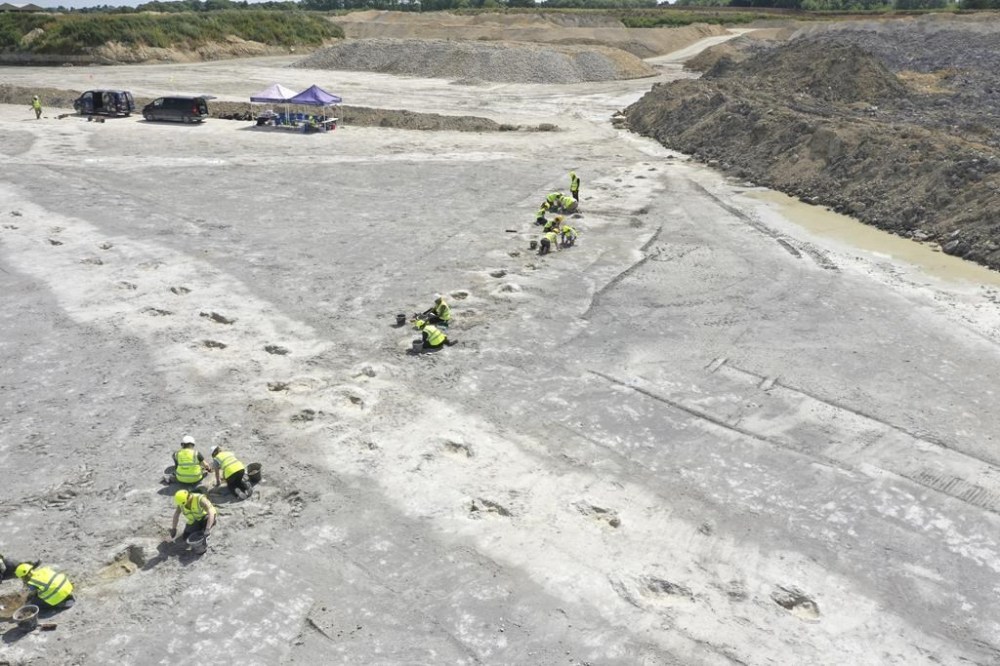
Four of the sets of tracks that make up the so-called highway show paths taken by gigantic, long-necked, herbivores called sauropods, thought to be Cetiosaurus, a dinosaur that grew to nearly 60 feet (18 meters) in length. A fifth set belonged to the Megalosaurus, a ferocious 9-meter predator that left a distinctive triple-claw print and was the first dinosaur to be scientifically named two centuries ago.
An area where the tracks cross raises questions about possible interactions between the carnivores and herbivores.
“Scientists have known about and been studying Megalosaurus for longer than any other dinosaur on Earth, and yet these recent discoveries prove there is still new evidence of these animals out there, waiting to be found,” said Emma Nicholls, a vertebrate paleontologist at the Oxford University Museum of Natural History.
Nearly 30 years ago, 40 sets of footprints discovered in a limestone quarry in the area were considered one of the world’s most scientifically important dinosaur track sites. But that area is mostly inaccessible now and there’s limited photographic evidence because it predated the use of digital cameras and drones to record the findings.
The group that worked at the site this summer took more than 20,000 digital images and used drones to create 3-D models of the prints. The trove of documentation will aid future studies and could shed light on the size of the dinosaurs, how they walked and the speed at which they moved.

“The preservation is so detailed that we can see how the mud was deformed as the dinosaur’s feet squelched in and out,” said Duncan Murdock, an earth scientist at the Oxford museum. “Along with other fossils like burrows, shells and plants we can bring to life the muddy lagoon environment the dinosaurs walked through.”
The findings will be shown at a new exhibit at the museum and also broadcast on the BBC’s “Digging for Britain” program next week.